


Short term estimates of adult HIV incidence by mode of transmission: Kenya and Thailand as examples
- PMID: 16735294
- PMCID: PMC2576735
- DOI: 10.1136/sti.2006.020164
Short term estimates of adult HIV incidence by mode of transmission: Kenya and Thailand as examples
Abstract
Objective: Patterns of transmission of HIV are different among different regions of the world and change over time within regions. In order to adapt prevention strategies to changing patterns of risk, we need to understand the behaviours that put people at risk of infection and how new infections are distributed among risk groups.
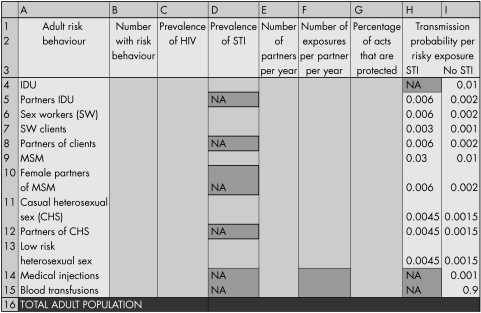
Methods: A model is described to calculate the expected incidence of HIV infections in the adult population by mode of exposure using the current distribution of prevalent infections and the patterns of risk within different populations. For illustration the model is applied to Thailand and Kenya.
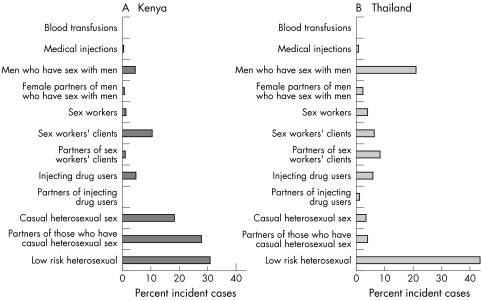
Results: New infections in Kenya were mainly transmitted through heterosexual contact (90%), while a small but significant number were related to injecting drug use (4.8%) and men who have sex with men (4.5%). In Thailand, the epidemic has spread over time to the sexual partners of vulnerable groups and in 2005 the majority of new infections occurred among the low risk heterosexual population (43%). Men having sex with men accounted for 21% and sex work (including sex workers, clients, and partners of clients) for 18% of new infections. Medical interventions did not contribute significantly to new infections in either Kenya or Thailand.
Conclusions: The model provides a simple tool to inform the planning of effective, appropriately targeted, country specific intervention programmes. However, better surveillance systems are needed in countries to obtain more reliable biological and behavioural data in order to improve the estimates of incidence by risk group.
Conflict of interest statement
Competing interests: none.
References
-
- UNAIDS/WHO AIDS Epidemic Update: December 2005. Geneva, Switzerland
-
- Joint United Nations Programme on HIV/AIDS (UNAIDS) A scaled‐up response to AIDS in Asia and the Pacific. UNAIDS, Bangkok. UNAIDS/05. 15E 2005
-
- UNAIDS Reference Group on Estimates, Modelling and Projections Modelling the expected short term distribution of incidence of HIV infections by exposure group. Available at http://www.unaids.org (accessed April 2006)
-
- Baggaley R, Boily M C, White R G.et alReport of Systematic review of HIV‐1 transmission probabilities in absence of antiretroviral therapy. 2004 Imperial College, London. (Supporting document for the UNAIDS report by White R, et al. The proportion of HIV incidence due to unsafe injections, unsafe blood transfusions and mother to child transmission in rural Masaka, Uganda. London: London School of Hygiene and Tropical Medicine, 2004, )
MeSH terms
LinkOut - more resources
Full Text Sources
Medical
