Multimodal evoked potentials to assess the evolution of multiple sclerosis: a longitudinal study
- PMID: 16735397
- PMCID: PMC2077734
- DOI: 10.1136/jnnp.2005.086280
Multimodal evoked potentials to assess the evolution of multiple sclerosis: a longitudinal study
Abstract
Background: Evoked potentials are used in the functional assessment of sensory and motor pathways. Their usefulness in monitoring the evolution of multiple sclerosis has not been fully clarified.
Objective: The aim of this longitudinal study was to examine the usefulness of multimodal evoked potential in predicting paraclinical outcomes of disease severity and as a prognostic marker in multiple sclerosis.
Methods: Eighty four patients with clinically definite multiple sclerosis underwent Expanded Disability Status Scale (EDSS) and functional system scoring at study entry and after a mean (standard deviation) follow-up of 30.5 (11.7) months. Sensory and motor evoked potentials were obtained in all patients at study entry and at follow-up in 64 of them, and quantified according to a conventional score.
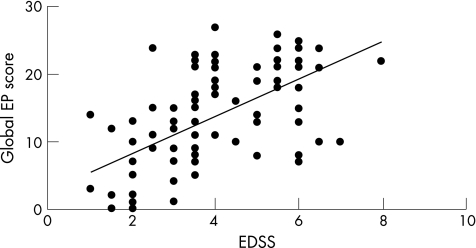
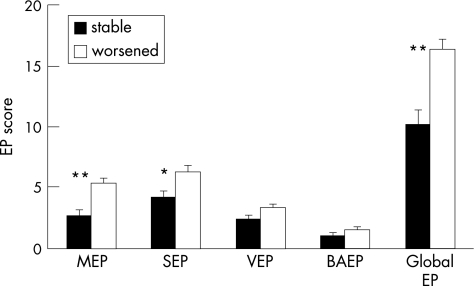
Results: Cross-sectionally, the severity of each evoked potential score significantly correlated with the corresponding functional system (0.32 < R < 0.60, p < 0.01, for all but follow-up visual evoked potential) and with EDSS (0.34 < R < 0.61; p < 0.001 for all but brain stem evoked potential). EDSS significantly correlated with global evoked potential score severity (baseline R = 0.60, follow-up R = 0.46, p < 0.001). Using longitudinal analysis, only changes in somatosensory evoked potential scores were significantly correlated with changes of sensory functional system (R = 0.34, p = 0.006). However, patients with multiple sclerosis with disability progression at follow-up had more severe baseline evoked potential scores than patients who remained stable. Patients with severe baseline global evoked potential score (higher than the median value) had a risk of 72.5% to progress on disability at follow-up, whereas patients with multiple sclerosis with lower scores had a risk of only 36.3%.
Conclusions: These results suggest that evoked potential is a good marker of the severity of nervous damage in multiple sclerosis and may have a predictive value regarding the evolution of disability.
Conflict of interest statement
Competing interests: None declared.
References
-
- Comi G, Locatelli T, Leocani L.et al Can evoked potentials be useful in monitoring multiple sclerosis evolution? Electroencephalogr Clin Neurophysiol Suppl 199950349–357. - PubMed
-
- Trapp B D, Peterson J, Ransohoff R M.et al Axonal transection in the lesions of multiple sclerosis. N Engl J Med 1998338278–285. - PubMed
-
- Bitsch A, Schuchardt J, Bunkowski S.et al Acute axonal injury in multiple sclerosis. Correlation with demyelination and inflammation. Brain 20001231174–1183. - PubMed
-
- McDonald W I, Sears T A. The effects of experimental demyelination on conduction in the central nervous system. Brain 197093583–598. - PubMed
-
- McDonald W, Compston D, Edan G.et al Recommended diagnostic criteria for multiple sclerosis: guidelines from the international panel on the diagnosis of multiple sclerosis. Ann Neurol 200150121–127. - PubMed
Publication types
MeSH terms
Substances
LinkOut - more resources
Full Text Sources
Medical