. 2006 May 31;26(22):6004-10.
doi: 10.1523/JNEUROSCI.4494-05.2006.

Activation of muscarinic and nicotinic acetylcholine receptors in the nucleus accumbens core is necessary for the acquisition of drug reinforcement

Affiliations

Activation of muscarinic and nicotinic acetylcholine receptors in the nucleus accumbens core is necessary for the acquisition of drug reinforcement

Jose A Crespo et al. J Neurosci. .

Abstract

Neurotransmitter release in the nucleus accumbens core (NACore) during the acquisition of remifentanil or cocaine reinforcement was determined in an operant runway procedure by simultaneous tandem mass spectrometric analysis of dopamine, acetylcholine, and remifentanil or cocaine itself. Run times for remifentanil or cocaine continually decreased over the five consecutive runs of the experiment. Intra-NACore dopamine, acetylcholine, and drug peaked with each intravenous remifentanil or cocaine self-administration and decreased to pre-run baseline with half-lives of approximately 10 min. As expected, remifentanil or cocaine peaks did not vary between the five runs. Surprisingly, however, drug-contingent dopamine peaks also did not change over the five runs, whereas acetylcholine peaks did. Thus, the acquisition of drug reinforcement was paralleled by a continuous increase in acetylcholine overflow in the NACore, whereas the overflow of dopamine, the expected prime neurotransmitter candidate for conditioning in drug reinforcement, did not increase. Local intra-accumbens administration by reverse microdialysis of either atropine or mecamylamine completely and reversibly blocked the acquisition of remifentanil reinforcement. Our findings suggest that activation of muscarinic and nicotinic acetylcholine receptors in the NACore by acetylcholine volume transmission is necessary during the acquisition phase of drug reinforcement conditioning.


Figures

Figure 1.
Figure 1.
Operant responding for intravenous 0.032 mg/kg RMF and associated changes in levels of ACh, DA, and RMF in the NACore. x-axis, Consecutive number of 10 min samples (i.e., time); y-axis, femtomoles per 10 min sample (means ± 1 SEM). Rats either actively ran for intravenous RMF (i.e., contingent RMF; •; n = 6) or intravenous saline (i.e., operant level; ▿; n = 6) during samples 4 (run 1), 8 (run 2), 12 (run 3), 16 (run 4), and 20 (run 5) or passively received RMF within the confines of the start area of the runway and were then allowed to traverse the runway (○; n = 5). Run times for noncontingent RMF are not shown because rats that passively received RMF did not leave the start area because of the acute sedative and locomotor impairing effect of RMF. Baseline overflow (samples 1–3) of ACh and DA did not differ significantly between groups. Repeated-measures-corrected group comparisons were statistically significant for run times (saline vs contingent RMF; Friedman test, p = 0.0001; run times for run 1 vs runs 3–5, p < 0.001 each), ACh peaks (saline vs noncontingent RMF vs contingent RMF; 2-factor ANOVA each; p < 0.0001 each for time, treatment, and time-by-treatment interaction; ACh peak comparison for run 1 vs run 4 or 5, p < 0.05 each), and DA peaks (saline vs noncontingent RMF vs contingent RMF; p = 0.0073 each for time, treatment, and time-by-treatment interaction; DA peak comparison: run 1 vs run 2, p < 0.05; run 1 vs runs 3–5, p > 0.05 each).
Figure 2.
Figure 2.
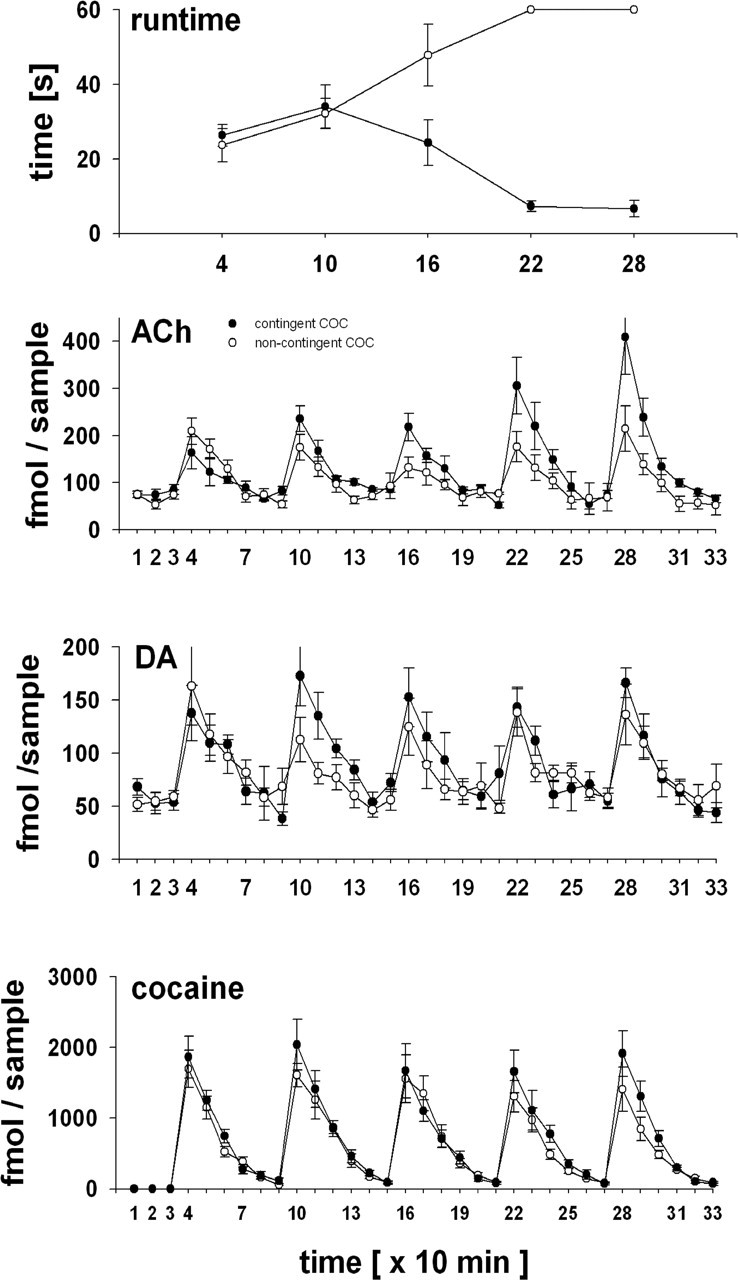
Operant responding for intravenous 0.33 mg/kg COC and associated changes in levels of ACh, DA, and COC in the NACore. x-axis, Consecutive number of 10 min samples (i.e., time); y-axis, femtomoles per 10 min sample (means ± 1 SEM). Rats either actively ran for intravenous COC (i.e., contingent COC; •; n = 6) during samples 4 (run 1), 10 (run 2), 16 (run 3), 22 (run 4), and 28 (run 5) or passively received intravenous COC within the confines of the start area of the runway and were then allowed to traverse the runway alley (i.e., noncontingent COC; ○; n = 6). Baseline overflow (samples 1–3) of ACh and DA did not differ significantly between the contingent and noncontingent groups. Repeated-measures-corrected group comparisons were significantly different for run times (contingent vs noncontingent COC; Friedman test, p = 0.0071; run times for run 1 vs runs 4 and 5, p < 0.05 each) and ACh (2-factor ANOVA; p = 0.012 for treatment; p < 0.0001 for time; p = 0.0003 for time-by-treatment interaction; ACh peak comparison for run 1 vs run 5, p < 0.01) but not for NACore DA (treatment, p = 0.3) or NACore COC (treatment, p = 0.13).
Figure 3.
Figure 3.
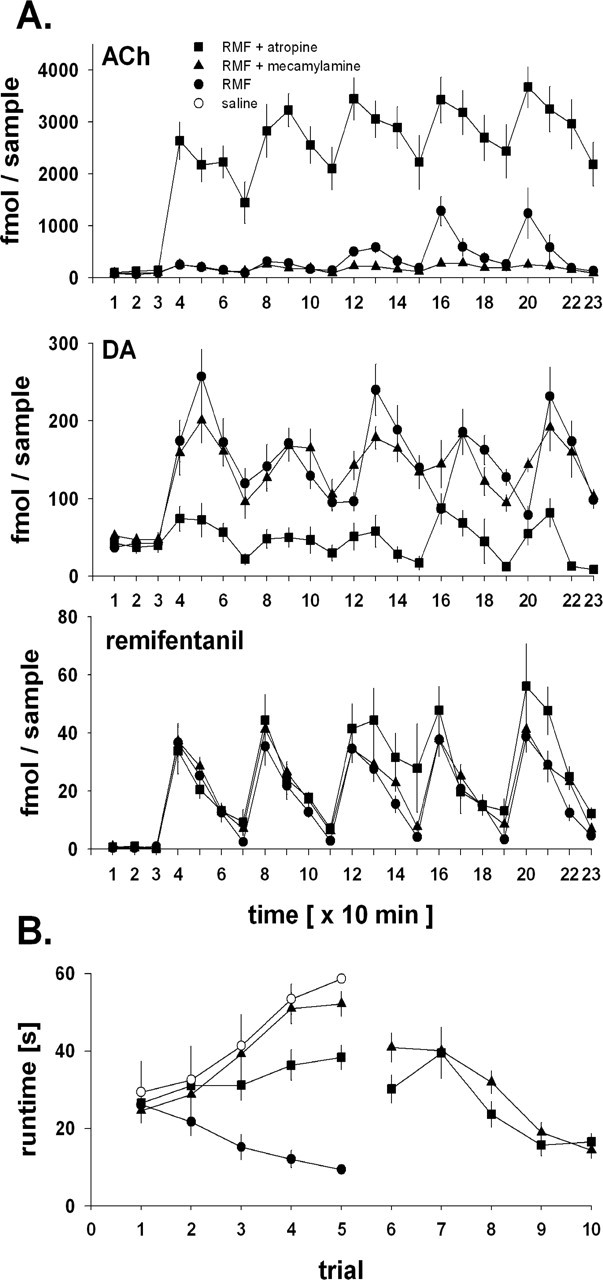
A, Effects of intra-accumbens core atropine and mecamylamine on the acquisition of RMF reinforcement. Operant responding for intravenous 0.032 mg/kg RMF and associated changes in levels of ACh, DA, and RMF in the NACore was determined in the absence (•; n = 6) or presence of atropine (10 μm; ▪; n = 6) or mecamylamine (100 μm; ▴; n = 10), which was locally administered into the NACore by reverse microdialysis starting 5 min into sample 3 (i.e., 5 min before the rat had the opportunity to run for the first RMF injection). x-axis, Consecutive number of 10 min samples (i.e., time); y-axis, femtomoles per 10 min sample (means ± 1 SEM). Rats ran for contingent intravenous RMF during samples 4 (run 1), 8 (run 2), 12 (run 3), 16 (run 4), and 20 (run 5). B, Reversibility of the effect of intra-accumbens atropine or mecamylamine on the acquisition of RMF reinforcement. On day 1 (left; runs 1–5), rats ran for intravenous saline (○; n = 6; see also Fig. 1) or intravenous 0.032 mg/kg RMF in the absence (•; n = 6; see also Fig. 1) or presence of intra-accumbens atropine (▪; n = 6; see also Fig. 2, top) or mecamylamine (▴; n = 10; see also Fig. 2, top). On day 4 (right; runs 6–10), the same experiment was repeated for those animals that had run for RMF in the presence of atropine (▪) or mecamylamine (▴) on day 1.

References

    1. Acquas E, Marrocu P, Pisanu A, Cadoni C, Zernig G, Saria A, DiChiara G (2001). Intravenous administration of 3,4-methylenedioxymethamphetamine (“Ecstasy”) enhances cortical and striatal acetylcholine in vivo. Eur J Pharmacol 418:207–211. - PubMed
    1. Aosaki T, Tsubokawa H, Ishida A, Watanabe K, Graybiel AM, Kimura M (1994). Responses of tonically active neurons in the primate's striatum undergo systematic changes during behavioral sensorimotor conditioning. J Neurosci 14:3969–3984. - PMC - PubMed
    1. Bassareo V, DiChiara G (1999). Differential responsiveness of dopamine transmission to food-stimuli in nucleus accumbens shell/core compartments. Neuroscience 89:637–641. - PubMed
    1. Berridge KC, Robinson TE (2003). Parsing reward. Trends Neurosci 26:507–513. - PubMed
    1. Bhargava HN, Larsen AK, Rahmani NH, Villar VM (1993). Naltrexone-induced alterations of the distribution of morphine in brain regions and spinal cord of the rat. Brain Res 607:1–8. - PubMed

Publication types