


Effectiveness of respondent-driven sampling for recruiting drug users in New York City: findings from a pilot study
- PMID: 16739048
- PMCID: PMC2527186
- DOI: 10.1007/s11524-006-9052-7
Effectiveness of respondent-driven sampling for recruiting drug users in New York City: findings from a pilot study
Erratum in
- J Urban Health. 2008 Jan;85(1):148
Abstract
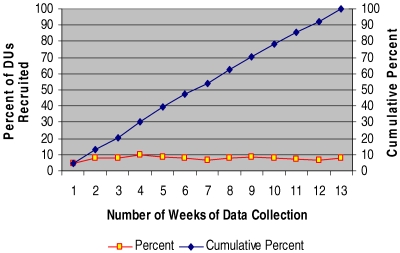
A number of sampling methods are available to recruit drug users and collect HIV risk behavior data. Respondent-driven sampling (RDS) is a modified form of chain-referral sampling with a mathematical system for weighting the sample to compensate for its not having been drawn randomly. It is predicated on the recognition that peers are better able than outreach workers and researchers to locate and recruit other members of a "hidden" population. RDS provides a means of evaluating the reliability of the data obtained and also allows inferences about the characteristics of the population from which the sample is drawn. In this paper we present findings from a pilot study conducted to assess the effectiveness of RDS to recruit a large and diversified group of drug users in New York City. Beginning with eight seeds (i.e., initial recruits) we recruited 618 drug users (injecting and non-injecting) in 13 weeks. The data document both cross-gender and cross-race and -ethnic recruitment as well as recruitment across drug-use status. Sample characteristics are similar to the characteristics of the drug users recruited in other studies conducted in New York City. The findings indicate that RDS is an effective sampling method for recruiting diversified drug users to participate in HIV-related behavioral surveys.
Figures


References
-
- Watters JK, Biernacki P. Targeted sampling: options for the study of hidden populations. Soc Probl. 1989;36:416–430. - DOI
-
- Bluthanthal RN, Watters JK. Multimethod research: from targeted sampling to HIV risk behaviors. Qualitative Methods in Drug Abuse and HIV Research, No. 157. Rockville, Md: National Institute on Drug Abuse; 1994.
-
- Carlson RG, Wang J, Siegal HA, et al. An ethnographic approach to targeted sampling: problems and solutions in AIDS prevention research among injection drug and crack‐cocaine users. Hum Organ. 1994;53:279–286.
-
- Semaan S, Lauby J, Liebman J. Street and network sampling in evaluation studies of HIV risk-reduction interventions. AIDS Rev. 2002;4:213–223. - PubMed
MeSH terms
LinkOut - more resources
Full Text Sources
Medical
