. 2006 Jun;188(12):4183-9.
doi: 10.1128/JB.00197-06.

Lesions in teichoic acid biosynthesis in Staphylococcus aureus lead to a lethal gain of function in the otherwise dispensable pathway

Affiliations

Lesions in teichoic acid biosynthesis in Staphylococcus aureus lead to a lethal gain of function in the otherwise dispensable pathway

Michael A D'Elia et al. J Bacteriol. 2006 Jun.

Abstract

An extensive study of teichoic acid biosynthesis in the model organism Bacillus subtilis has established teichoic acid polymers as essential components of the gram-positive cell wall. However, similar studies pertaining to therapeutically relevant organisms, such as Staphylococcus aureus, are scarce. In this study we have carried out a meticulous examination of the dispensability of teichoic acid biosynthetic enzymes in S. aureus. By use of an allelic replacement methodology, we examined all facets of teichoic acid assembly, including intracellular polymer production and export. Using this approach we confirmed that the first-acting enzyme (TarO) was dispensable for growth, in contrast to dispensability studies in B. subtilis. Upon further characterization, we demonstrated that later-acting gene products (TarB, TarD, TarF, TarIJ, and TarH) responsible for polymer formation and export were essential for viability. We resolved this paradox by demonstrating that all of the apparently indispensable genes became dispensable in a tarO null genetic background. This work suggests a lethal gain-of-function mechanism where lesions beyond the initial step in wall teichoic acid biosynthesis render S. aureus nonviable. This discovery poses questions regarding the conventional understanding of essential gene sets, garnered through single-gene knockout experiments in bacteria and higher organisms, and points to a novel drug development strategy targeting late steps in teichoic acid synthesis for the infectious pathogen S. aureus.


Figures
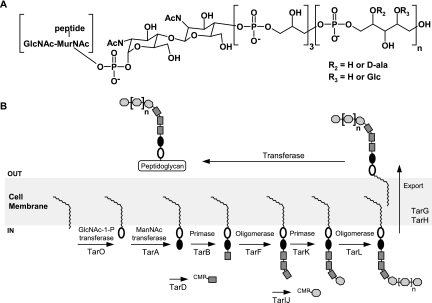
FIG. 1.
FIG. 1.
Proposed scheme for teichoic acid synthesis in S. aureus. (A) The chemical structure for the completed polymer covalently bound to N-acetylmuramic acid is depicted. The repeating ribitol-5-phosphate polymer is often replaced by d-alanine or glucose (R2 and R3). (B) S. aureus teichoic acid comprises a polymer composed of a disaccharide containing N-acetylglucosamine-1-phosphate (filled oval) and N-acetylmannosamine (open oval), 3 units of glycerol-3-phosphate (square), and ∼30 repeating ribitol-5-phosphate (octagon) units. These polymers are synthesized in a stepwise manner on the cytoplasmic face of the cell membrane onto undecaprenyl-phosphate (wavy line). Following synthesis, the entire polymer is exported out of the cell and attached to N-acetylmuramic acid of peptidoglycan.
FIG. 2.
FIG. 2.
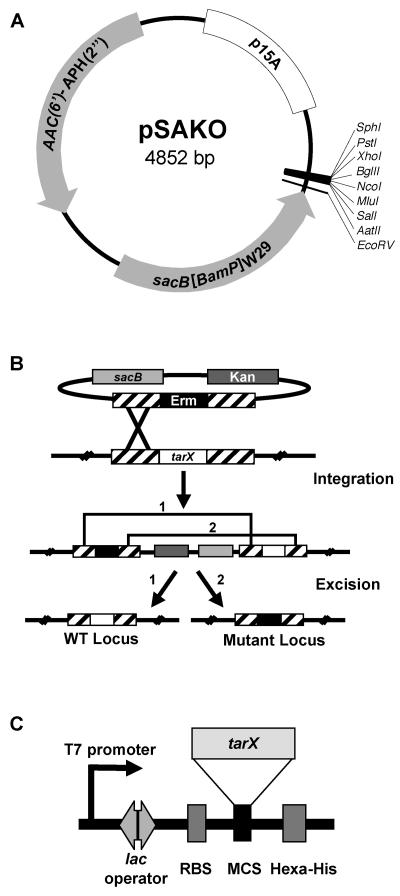
A novel genetic strategy for testing dispensability in S. aureus. (A) pSAKO contains a gram-negative p15A replication origin that allows replication in E. coli but not in S. aureus. Selection in both E. coli and S. aureus is accomplished using the kanamycin resistance cassette, AAC(2′)-APH(6"), while a mutant form of SacB (sacB[BamP]W29) permits counterselection. Unique restriction sites found within the MCS are highlighted on the outside of the plasmid. (B) Integration of pSAKO encoding kanamycin resistance and containing an erythromycin resistance cassette, the latter flanked by ∼1,000 bp of chromosomal sequences upstream and downstream of the targeted gene (tarX), occurs through single recombination. Selection for excision of the plasmid sequence is accomplished using sacB[BamP]W29 (sacB) (8) on medium containing sucrose. Excision results in restoration of the wild-type (WT) locus or generation of a mutant locus. (C) The expression cassette located on pG164 was used to express the complementing copy of the gene of interest (tarX) cloned into the MCS. Protein expression was driven by a T7 promoter controlled by a chromosomally integrated T7 polymerase induced by IPTG.
FIG. 3.
FIG. 3.
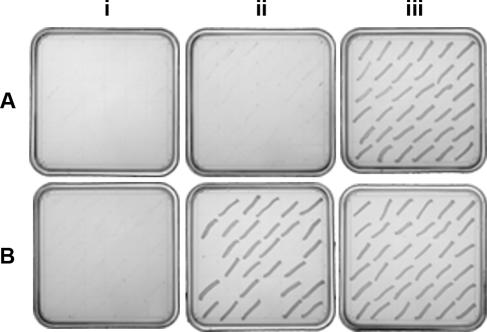
Dispensability analysis of S. aureus tarD. Integrants targeting tarD (EBII3 and EBII15) were subjected to selection for excisants on MHA containing sucrose (EBII3) (A) and MHA containing chloramphenicol, IPTG, and sucrose (EBII15) (B). The phenotypic outcome of selection was revealed in the resistance profile of three test plates containing (i) kanamycin, (ii) erythromycin, and (iii) no antibiotic.

References

    1. Aizenman, E., H. Engelberg-Kulka, and G. Glaser. 1996. An Escherichia coli chromosomal “addiction module” regulated by guanosine [corrected] 3′,5′-bispyrophosphate: a model for programmed bacterial cell death. Proc. Natl. Acad. Sci. USA 93:6059-6063. - PMC - PubMed
    1. Ames, B. N. 1966. Assay of inorganic phosphate, total phosphate and phosphatases. Methods Enzymol. 8:115-118.
    1. Anderson, R. G., H. Hussey, and J. Baddiley. 1972. The mechanism of wall synthesis in bacteria. The organization of enzymes and isoprenoid phosphates in the membrane. Biochem. J. 127:11-25. - PMC - PubMed
    1. Benson, A. K., and W. G. Haldenwang. 1993. Regulation of sigma B levels and activity in Bacillus subtilis. J. Bacteriol. 175:2347-2356. - PMC - PubMed
    1. Bhavsar, A. P., T. J. Beveridge, and E. D. Brown. 2001. Precise deletion of tagD and controlled depletion of its product, glycerol-3-phosphate cytidylyltransferase, leads to irregular morphology and lysis of Bacillus subtilis grown at physiological temperature. J. Bacteriol. 183:6688-6693. - PMC - PubMed

Publication types

MeSH terms

Substances