. 2006 Jun;188(12):4198-206.
doi: 10.1128/JB.00061-06.

Mutations and rearrangements in the genome of Sulfolobus solfataricus P2

Affiliations

Mutations and rearrangements in the genome of Sulfolobus solfataricus P2

Peter Redder et al. J Bacteriol. 2006 Jun.

Abstract

The genome of Sulfolobus solfataricus P2 carries a larger number of transposable elements than any other sequenced genome from an archaeon or bacterium and, as a consequence, may be particularly susceptible to rearrangement and change. In order to gain more insight into the natures and frequencies of different types of mutation and possible rearrangements that can occur in the genome, the pyrEF locus was examined for mutations that were isolated after selection with 5-fluoroorotic acid. About two-thirds of the 130 mutations resulted from insertions of mobile elements, including insertion sequence (IS) elements and a single nonautonomous mobile element, SM2. For each of these, the element was identified and shown to be present at its original genomic position, consistent with a progressive increase in the copy numbers of the mobile elements. In addition, several base pair substitutions, as well as small deletions, insertions, and a duplication, were observed, and about one-fifth of the mutations occurred elsewhere in the genome, possibly in an orotate transporter gene. One mutant exhibited a 5-kb genomic rearrangement at the pyrEF locus involving a two-step IS element-dependent reaction, and its boundaries were defined using a specially developed "in vitro library" strategy. Moreover, while searching for the donor mobile elements, evidence was found for two major changes that had occurred in the genome of strain P2, one constituting a single deletion of about 4% of the total genome (124 kb), while the other involved the inversion of a 25-kb region. Both were bordered by IS elements and were inferred to have arisen through recombination events. The results underline the caution required in working experimentally with an organism such as S. solfataricus with a continually changing genome.


Figures
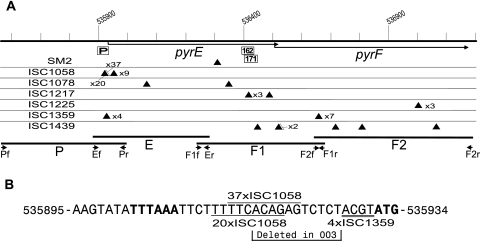
FIG. 1.
FIG. 1.
(A) The 1,600-bp pyrEF locus, with pyrE and pyrF denoted by arrows. The PCR coverage (lower lines, P, E, F1, and F2) and mobile-element insertion sites (triangles) are shown. The numbers adjacent to the triangles indicate the total number of insertions observed at each site. The primer pairs Pf-Pr, Ef-Er, F1f-F1r, and F2f-F2r are indicated by small arrows. Boxed P, 162, and 171 mark the promoter region, the deletion in mutant P2A-162, and the duplication in P2A-171, respectively. (B) Sequence of the promoter region, with the TATA-like box and the pyrE start codon indicated in boldface; the bracket indicates the 9 bp deleted from strain P2A-003. Lines below and above the sequence denote the DR of the ISC1058s inserted at positions 535912 and 535914, respectively. The double line indicates the DR of ISC1359 (P2A-003, -102, -150, and -177).
FIG. 2.
FIG. 2.
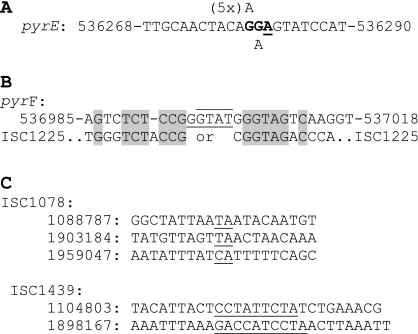
(A) The sequence bordering the six mutations in codon 117 of pyrE (in boldface). Five G-to-A mutations are indicated, which yielded four Gly117Arg and one Gly117Glu change. A single-base-pair deletion is also underlined. (B) Sequence alignment showing the similarity between the inverted terminal repeats of ISC1225 and its preferred target site in pyrF. Gray shading denotes identical bases, and the 4-bp and 5-bp DRs are indicated by lines above and below the sequence, respectively. (C) Empty target sites for ISC1078 at three positions and for ISC1439 at two positions. Nucleotides that produce the DR in the published genome sequence are underlined.
FIG. 3.
FIG. 3.
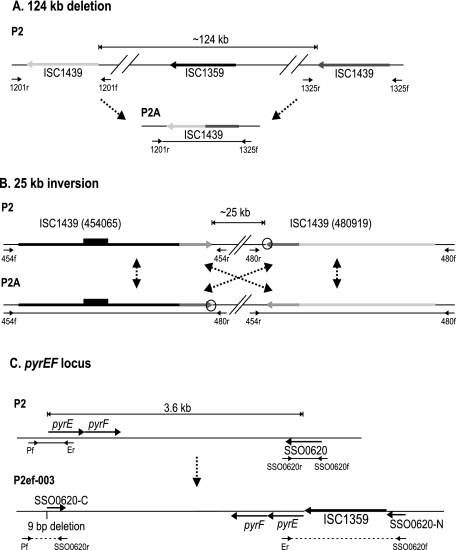
Genome rearrangements. Lines indicate PCR products obtained using strain P2A DNA as a template, and small arrows with labels indicate annealing sites for PCR primers. (A) The 124-kb region of S. solfataricus P2, bordered by ISC1439 elements, which has been deleted in strain P2A as a result of recombination at the two tandemly arranged elements. The black arrow indicates the deleted copy of ISC1359 at position 1300529. (B) Putative rearrangement that has occurred between positions 454065 and 480919. The upper line corresponds to the published genome sequence (8), while the lower line corresponds to strain P2A. The two ISC1439 copies are indicated by horizontal lines (shown in black and light gray). The lower-right copy (480919) is identical to the one inserted in pyrEF in strains P2A-121, -147, and -165. This copy exhibits only 2 bp difference (encircled) compared to the published 480919 copy (upper right), whereas the other ISC1439 (in black) contains numerous mismatches and a 208-bp insertion (black box) compared with this copy. The two 277-bp regions in which recombination (or misassembly) occurred are indicated by intermediate shading. (C) Rearrangement at the pyrEF locus in strain P2A-003 with the relevant genes indicated by arrows. The upper line shows the organization of the parent P2A strain (identical to the published sequence), and the lower part shows the changes found in strain P2A-003, where SSO0620 is partitioned and the arrow on the boxed ISC1359 indicates the direction of the transpose gene. The structure was confirmed by generating PCR products using primer pairs Pf-SSO0620r and Er-SSO0620f (dotted lines) on P2A-003 template DNA.
FIG. 4.
FIG. 4.
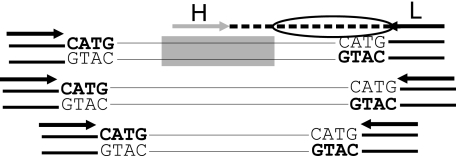
The “in vitro library” strategy. The restriction-digested genome (thin lines) is ligated to a synthetic library template (thick lines and boldfac restriction sequence). The library primer (black arrows; L) anneals to all of the ligation products, but only one type of fragment contains the known sequence (gray shading) to which the homing primer (gray arrow; H) can anneal. The desired fragment was amplified using primers H and L (dotted line) and yielded the unknown sequence (encircled) when sequenced using the homing primer.
FIG. 5.
FIG. 5.
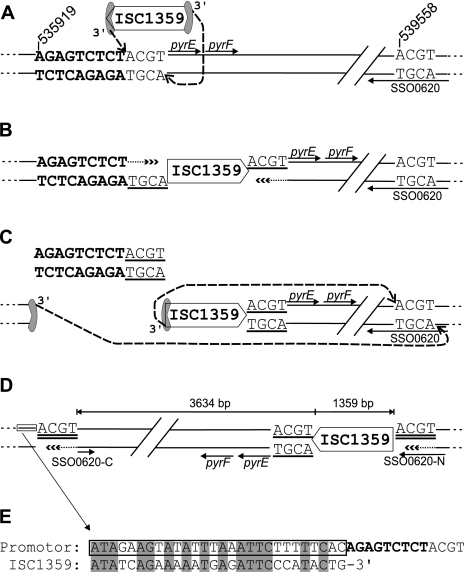
Proposed model for the genomic rearrangement in strain P2A-003 mediated by the ISC1359-encoded transposase. The scheme shows a 3,643-bp section of the S. solfataricus P2 genome with the pyrE, pyrF, and SSO0620 genes represented by arrows and the 9-bp segment (boldface) deleted from strain P2A-003. (A) The multimeric transposase (gray shaded) binds to the inverted terminal repeats of ISC1359 and catalyzes the nucleophillic attack of the 3′ ends of ISC1359 on the 5′ ends of the ACGT target site (dashed arrows), located between the 9-bp segment (boldface) and the pyrE gene. (B) The tetranucleotides of the target site (underlined) are localized at each end of ISC1359, and the resulting single-strand gaps are repaired by host enzymes (small dotted arrows). (C) The transposase binds to one end of ISC1359 and the sequence immediately adjacent to the 9-bp segment. It then induces double-stranded cuts, which remove the 9-bp segment and one copy of the duplicated 4-bp target site. The transposase then catalyzes nucleophilic attack (dashed arrows) of the free 3′ ends on the ACGT target site in the SSO0620 locus. In effect, this turns the entire genome (minus the excised 9 + 4 bp) into a transposon, which inserts into itself. (D) The previous reaction produced (i) a second target site duplication (double underlining), (ii) partitioning of the SSO0620 gene into SSO0620-N and -C, and (iii) inversion of the 3,634-bp sequence (plus the inserted ISC1359) between pyrE and the SSO0620 target site. The resulting single-strand gaps are repaired by host enzymes (small dotted arrows), leading to the sequence found in strain P2A-003. (E) Sequence similarity between the proposed transposase binding site in the pyrEF locus (boxed) and the 3′ end of ISC1359. Identical bases are shaded. The position of the 9-bp segment (boldface) that is lost from strain P2A-003 is also shown.

References

    1. Bender, J., J. Kuo, and N. Kleckner. 1991. Genetic evidence against intramolecular rejoining of the donor DNA molecule following IS10 transposition. Genetics 128:687-694. - PMC - PubMed
    1. Bernander, R., and A. Poplawski. 1997. Cell cycle characteristics of thermophilic archaea. J. Bacteriol. 179:4963-4969. - PMC - PubMed
    1. Blount, Z. D., and D. W. Grogan. 2005. New insertion sequences of Sulfolobus: functional properties and implications for genome evolution in hyperthermophilic archaea. Mol. Microbiol. 55:312-325. - PubMed
    1. Brügger, K., P. Redder, Q. She, F. Confalonieri, Y. Zivanovic, and R. A. Garrett. 2002. Mobile elements in archaeal genomes. FEMS Microbiol. Lett. 206:131-141. - PubMed
    1. Brügger, K., E. Torarinsson, P. Redder, L. Chen, and R. A. Garrett. 2004. Shuffling of Sulfolobus genomes by autonomous and non-autonomous mobile elements. Biochem. Soc. Trans. 32:179-183. - PubMed

Publication types

MeSH terms