. 2006 Jun;188(12):4236-43.
doi: 10.1128/JB.01660-05.

Molecular mechanism of tryptophan-dependent transcriptional regulation in Chlamydia trachomatis

Affiliations

Molecular mechanism of tryptophan-dependent transcriptional regulation in Chlamydia trachomatis

Johnny C Akers et al. J Bacteriol. 2006 Jun.

Abstract

Tryptophan is an essential amino acid that is required for normal development in Chlamydia species, and tryptophan metabolism has been implicated in chlamydial persistence and tissue tropism. The ability to synthesize tryptophan is not universal among the Chlamydiaceae, but species that have a predicted tryptophan biosynthetic pathway also encode an ortholog of TrpR, a regulator of tryptophan metabolism in many gram-negative bacteria. We show that in Chlamydia trachomatis serovar D, TrpR regulates its own gene and trpB and trpA, the genes for the two subunits of tryptophan synthase. These three genes form an operon that is transcribed by the major form of chlamydial RNA polymerase. TrpR acts as a tryptophan-dependent aporepressor that binds specifically to operator sequences upstream of the trpRBA operon. We also found that TrpR repressed in vitro transcription of trpRBA in a promoter-specific manner, and the level of repression was dependent upon the concentrations of TrpR and tryptophan. Our findings provide a mechanism for chlamydiae to sense changes in tryptophan levels and to respond by modulating expression of the tryptophan biosynthesis genes, and we present a unified model that shows how C. trachomatis can combine transcriptional repression and attenuation to regulate intrachlamydial tryptophan levels. In the face of host defense mechanisms that limit tryptophan availability from the infected cell, the ability to maintain homeostatic control of intrachlamydial tryptophan levels is likely to play an important role in chlamydial pathogenesis.


Figures
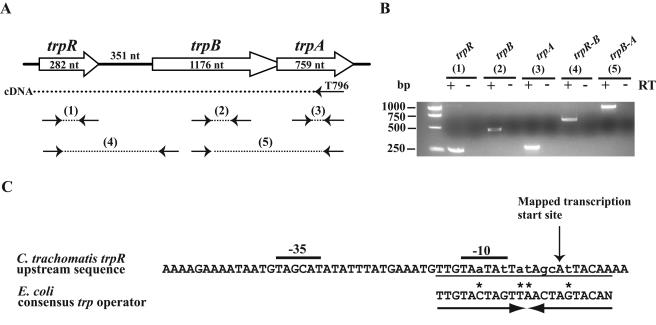
FIG. 1.
FIG. 1.
Transcriptional organization of tryptophan biosynthesis genes in C. trachomatis. (A) Schematic diagram of genes involved in tryptophan biosynthesis showing predicted RT-PCR products. nt, nucleotides. (B) RT-PCR analysis. cDNA synthesized using a primer that annealed in trpA (T796) was amplified using primers for trpR (product 1, shown in part A), trpB (product 2), trpA (product 3), trpR-trpB (product 4), and trpB-trpA (product 5). A no-RT control is included for each reaction. (C) Sequence upstream of trpR. The transcription start site determined by primer extension is marked by a vertical arrow. Predicted σ66 −35 and −10 promoter elements are marked. A putative trp operator overlapping the −10 promoter element and the transcription start site is underlined and aligned with the E. coli consensus trp operator. The operator forms an inverted repeat as shown by a pair of arrows. Lowercase letters indicate mismatches with the consensus, and an asterisk marks a position in the chlamydial sequence where the mismatch is accompanied by a complementary change in the inverted repeat.
FIG. 2.
FIG. 2.
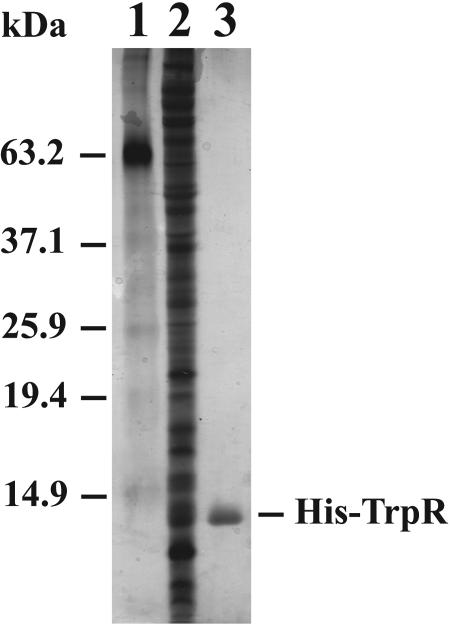
Silver stain of SDS-PAGE gel showing purification of recombinant His-TrpR. Lane 1, molecular mass markers; lane 2, lysate of E. coli overexpressing C. trachomatis TrpR; lane 3, TrpR after purification with a Ni column.
FIG. 3.
FIG. 3.
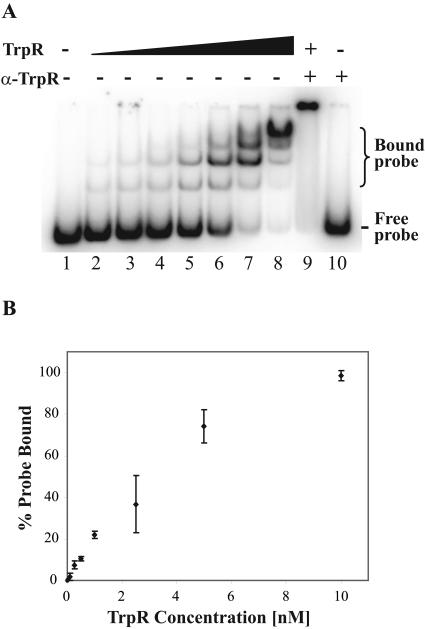
EMSA with C. trachomatis trpR probe titrated with recombinant TrpR. EMSA reactions and electrophoresis were performed in the presence of l-tryptophan. (A) The positions of bound and free probe are indicated. Lane 1, labeled probe alone; lanes 2 to 8, addition of increasing concentrations of TrpR (0.1, 0.25, 0.5, 1, 2.5, 5, and 10 nM, respectively); lane 9, addition of 10 nM TrpR and polyclonal anti-TrpR antibody; lane 10, addition of polyclonal anti-TrpR antibody alone. (B) Quantification of EMSA. EMSA reactions with various concentrations of recombinant TrpR were performed in triplicate and quantified by phosphorimager analysis. Standard deviations are marked by error bars.
FIG. 4.
FIG. 4.
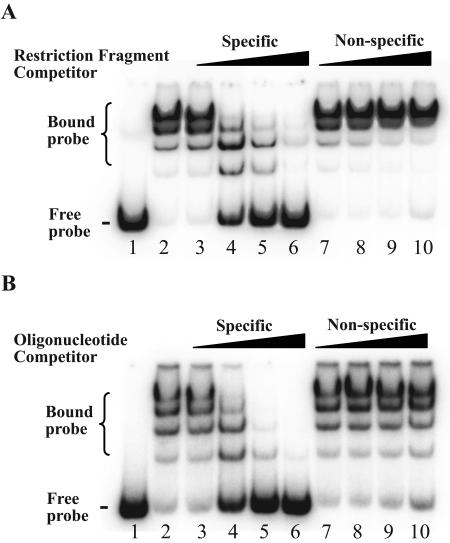
Competitive EMSA with trpR probe and recombinant TrpR. All reactions, except those with probe alone, were performed with 10 nM TrpR. (A) Competition with DNA fragment containing trp operator. Lane 1, probe alone; lane 2, no competitor; lanes 3 to 6, increasing amounts of molar excess of specific competitor relative to labeled probe (1-, 4-, 16-, and 64-fold, respectively); lanes 7 to 10, molar excess of nonspecific competitor (1-, 4-, 16-, and 64-fold, respectively). (B) Competition with double-stranded DNA oligonucleotide containing trp operator. Lane 1, probe alone; lane 2, no competitor; lanes 3 to 6, increasing amount of molar excess of specific competitor (10-, 50-, 250-, and 1,250-fold, respectively); lanes 7 to 10, molar excess of nonspecific competitor (10-, 50-, 250-, and 1,250-fold, respectively).
FIG. 5.
FIG. 5.
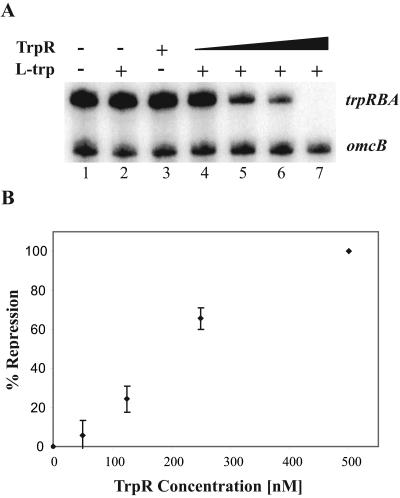
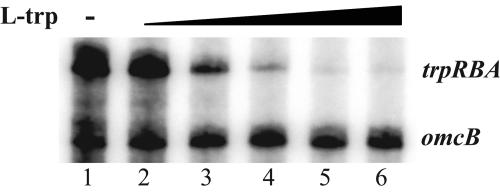
In vitro transcription with C. trachomatis RNA polymerase and recombinant TrpR. The upper band is the transcript from the trpRBA promoter, and the lower band is the transcript from the omcB promoter. (A) Lane 1, no TrpR, no l-tryptophan; lane 2, no TrpR, 50 μM l-tryptophan; lane 3, 500 nM TrpR, no l-tryptophan; lanes 4 to 7, increasing concentrations of TrpR (50, 125, 250, and 500 nM, respectively), 50 μM l-tryptophan. (Β) Quantification of TrpR-mediated transcriptional repression. Reactions were performed in triplicate and quantified by phosphorimager analysis. Standard deviations are marked by error bars. The degree of transcriptional repression was calculated by normalizing it to the amount of transcription in the absence of TrpR and the presence of l-tryptophan.
FIG. 6.
FIG. 6.
In vitro transcription assaying the effect of l-tryptophan titration on TrpR-mediated repression. All reactions were performed with 250 nM recombinant TrpR. Lane 1, no l-tryptophan; lanes 2 to 6, increasing concentrations of l-tryptophan (1, 5, 10, 25, and 50 μM, respectively).
FIG. 7.
FIG. 7.
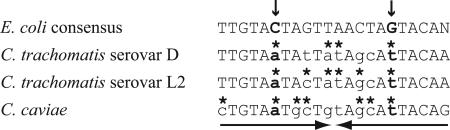
Alignment of the E. coli consensus trp operator with the C. trachomatis serovar D trp operator and predicted trp operators from C. trachomatis serovar L2 and C. caviae. An inverted repeat within the operator is marked by a pair of arrows. Lowercase letters indicate mismatches with the consensus, and an asterisk marks a position in the chlamydial sequence where the mismatch is accompanied by a complementary change in the inverted repeat. Vertical arrows and boldface mark invariant positions in the E. coli consensus operator that are not conserved in the chlamydial trp operators.

References

    1. Beatty, W. L., G. I. Byrne, and R. P. Morrison. 1993. Morphologic and antigenic characterization of interferon gamma-mediated persistent Chlamydia trachomatis infection in vitro. Proc. Natl. Acad. Sci. USA 90:3998-4002. - PMC - PubMed
    1. Beatty, W. L., R. P. Morrison, and G. I. Byrne. 1994. Persistent chlamydiae: from cell culture to a paradigm of chlamydial pathogenesis. Microbiol. Rev. 58:686-699. - PMC - PubMed
    1. Belland, R. J., D. E. Nelson, D. Virok, D. D. Crane, D. Hogan, D. Sturdevant, W. L. Beatty, and H. D. Caldwell. 2003. Transcriptome analysis of chlamydial growth during IFN-gamma-mediated persistence and reactivation. Proc. Natl. Acad. Sci. USA 100:15971-15976. - PMC - PubMed
    1. Carey, J. 1988. Gel retardation at low pH resolves trp repressor-DNA complexes for quantitative study. Proc. Natl. Acad. Sci. USA 85:975-979. - PMC - PubMed
    1. Carlson, J. H., H. Wood, C. Roshick, H. D. Caldwell, and G. McClarty. 2006. In vivo and in vitro studies of Chlamydia trachomatis TrpR:DNA interactions. Mol. Microbiol. 59:1678-1691. - PMC - PubMed

Publication types

MeSH terms