


Post-retrieval effects of icv infusions of hemicholinium in mice are dependent on the age of the original memory
- PMID: 16741287
- PMCID: PMC1475820
- DOI: 10.1101/lm.150306
Post-retrieval effects of icv infusions of hemicholinium in mice are dependent on the age of the original memory
Abstract
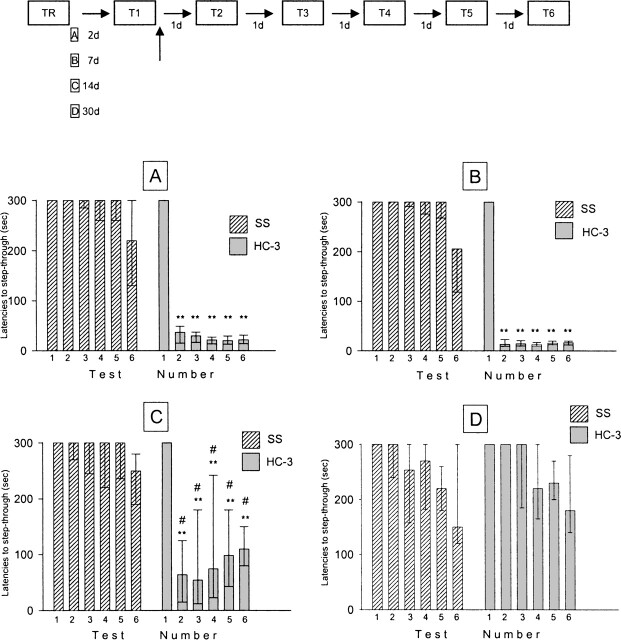
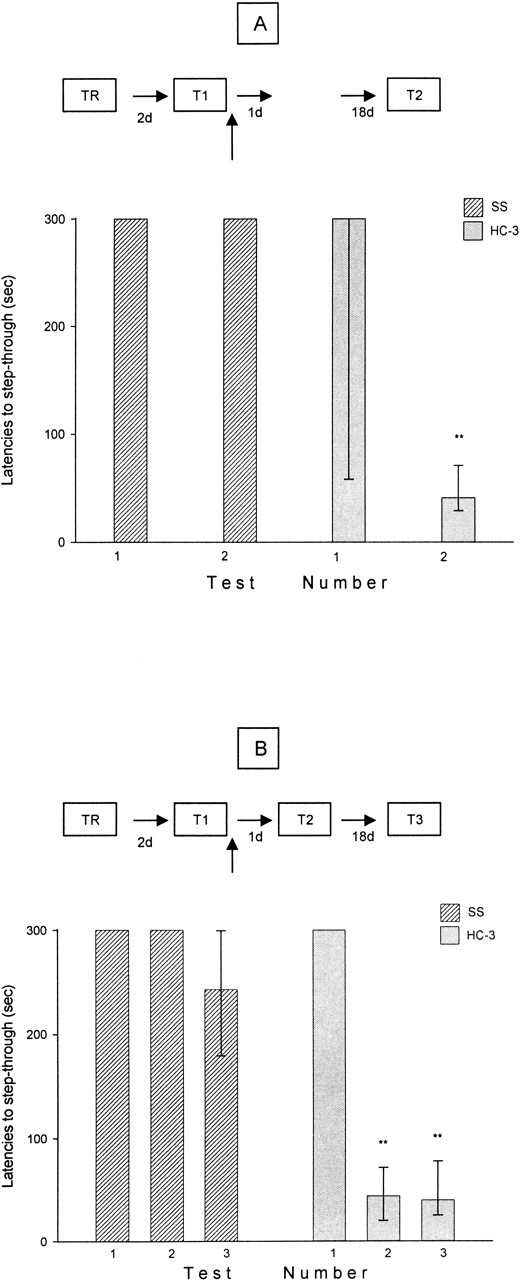
CF-1 male mice were trained in an inhibitory avoidance task using a high footshock (1,2 mA, 50 Hz, 1 sec) in order to reduce the influence of extinction on retention performance. At 2, 7, 14, or 30 d after training, the first retention test was performed and hemicholinium (HC-3, 1.0 microg/mice), a specific inhibitor of high-affinity choline uptake in brain cholinergic neurons, was given intracerebroventricularly immediately after. Twenty four hours after treatment, mice were tested in an inhibitory avoidance task during five consecutive days, each 24 h apart. Retention performance was impaired by HC-3 when the first re-exposure took place at 2, 7, or 14 d, but the effect was no longer seen when re-exposure occurred 30 d after training. We did not find spontaneous recovery 21 d after training, when memory was retrieved 2 d after training and HC-3 was given immediately after. Although we cannot definitively discard a retrieval deficit, this lack of spontaneous recovery is in accordance with the storage-deficit interpretation. These results confirm and extend previous ones, suggesting that central cholinergic mechanisms are involved in the hypothetical reconsolidation memory processes of an inhibitory avoidance task in mice and also suggest that this participation depends on the "age" of the original memory trace. This implies that the vulnerability of a reactivated memory to a specific treatment, as the one used in this study, inversely correlates with the age of the original memory, and it is likely to determine memory reconsolidation processes.
Figures
References
-
- Alberini C.M. Mechanisms of memory stabilization: Are consolidation and reconsolidation similar or distinct processes? Trends Neurosci. 2005;28:51–56. - PubMed
-
- Anokhin K.V., Tiunova A.A., Rose S.P.R. Reminder effects—reconsolidation or retrieval deficit? Pharmacological dissection with protein synthesis inhibitors following reminder for passive-avoidance task in young chicks. Eur. J. Neurosci. 2002;15:1759–1765. - PubMed
-
- Arshavsky Y.L. Long-term memory: Does it have a structural or chemical basis? Trends Neurosci. 2003;26:465–466. - PubMed
-
- Bahar A., Dorfman N., Dudai Y. Amygdalar circuits required for either consolidation or extinction of taste aversion memory are not required for reconsolidation. Eur. J. Neurosci. 2004;19:1115–1118. - PubMed
-
- Berman D.E., Dudai Y. Memory extinction, learning anew, and learning the new: Dissociations in the molecular machinery of learning in cortex. Science. 2001;291:2417–2419. - PubMed
Publication types
MeSH terms
Substances
LinkOut - more resources
Full Text Sources