Comparative Study
. 2006 Jun;72(6):4239-44.
doi: 10.1128/AEM.02532-05.

Use of copper cast alloys to control Escherichia coli O157 cross-contamination during food processing

Affiliations
Comparative Study

Use of copper cast alloys to control Escherichia coli O157 cross-contamination during food processing

J O Noyce et al. Appl Environ Microbiol. 2006 Jun.

Abstract

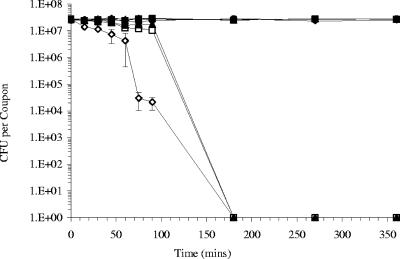
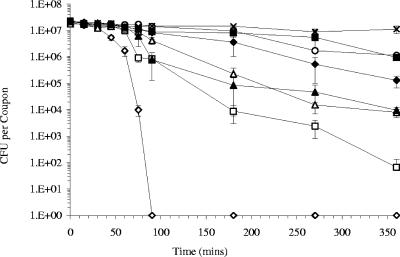
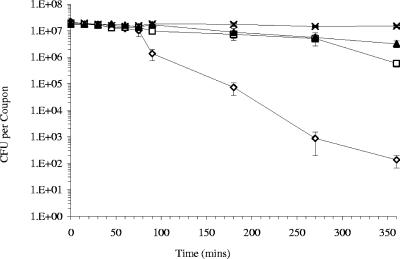
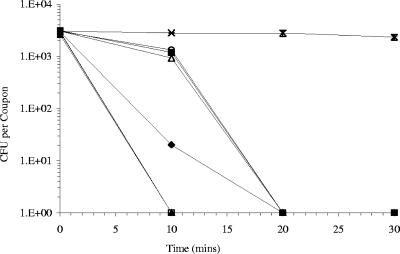
The most notable method of infection from Escherichia coli O157 (E. coli O157) is through contaminated food products, usually ground beef. The objective of this study was to evaluate seven cast copper alloys (61 to 95% Cu) for their ability to reduce the viability of E. coli O157, mixed with or without ground beef juice, and to compare these results to those for stainless steel. E. coli O157 (NCTC 12900) (2 x 10(7) CFU) mixed with extracted beef juice (25%) was inoculated onto coupons of each copper cast alloy or stainless steel and incubated at either 22 degrees C or 4 degrees C for up to 6 h. E. coli O157 viability was determined by plate counts in addition to staining in situ with the respiratory indicator fluorochrome 5-cyano-2,3-ditolyl tetrazolium. Without beef extract, three alloys completely killed the inoculum during the 6-h exposure at 22 degrees C. At 4 degrees C, only the high-copper alloys (>85%) significantly reduced the numbers of O157. With beef juice, only one alloy (95% Cu) completely killed the inoculum at 22 degrees C. For stainless steel, no significant reduction in cell numbers occurred. At 4 degrees C, only alloys C83300 (93% Cu) and C87300 (95% Cu) significantly reduced the numbers of E. coli O157, with 1.5- and 5-log kills, respectively. Reducing the inoculum to 10(3) CFU resulted in a complete kill for all seven cast copper alloys in 20 min or less at 22 degrees C. These results clearly demonstrate the antimicrobial properties of cast copper alloys with regard to E. coli O157, and consequently these alloys have the potential to aid in food safety.


Figures
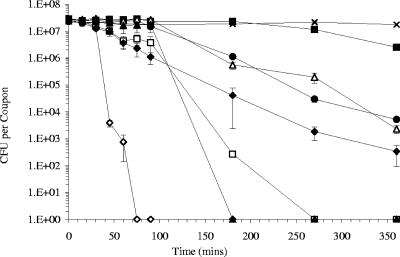
FIG. 1.
FIG. 1.
Effect on E. coli O157 viability of a 6-h exposure to either stainless steel (×), C873000 (⋄), C83600 (▴), C83300 (□), C97600 (⧫), C95800 (•), C85700 (▵), or C95500 (▪) at 22°C. Coupons (1 cm by 1 cm) were inoculated with 20 μl of a 19-h E. coli O157 culture. Following the exposure period, coupons were transferred to tubes containing 10 ml sterile PBS with 2-mm-diameter glass beads. Cells were subsequently removed from the coupons into suspension by vortexing, and 100 μl was removed and serially diluted to 10−4 in sterile PBS. TSB plates were then inoculated (50 μl) for each dilution and subsequently incubated at 37°C for 18 h. Postincubation, the number of CFU on each plate was counted and used to calculate the number of viable CFU per coupon. Points represent the means (n = 3) ± SEM.
FIG. 2.
FIG. 2.
Effect on E. coli O157 viability of a 6-h exposure to either stainless steel (×), C873000 (⋄), C83600 (▴), C83300 (□), C97600 (⧫), C95800 (•), C85700 (▵), or C95500 (▪) at 4°C. Coupons (1 cm by 1 cm) were inoculated with 20 μl of a 19-h E. coli O157 culture. Following the exposure period, coupons were transferred to tubes containing 10 ml sterile PBS with 2-mm-diameter glass beads. Cells were subsequently removed from the coupons into suspension by vortexing, and 100 μl was removed and serially diluted to 10−4 in sterile PBS. TSB plates were then inoculated (50 μl) for each dilution and subsequently incubated at 37°C for 18 h. Postincubation, the number of CFU on each plate was counted and used to calculate the number of viable CFU per coupon. Points represent the means (n = 3) ± SEM.
FIG. 3.
FIG. 3.
Effect on E. coli O157 viability of a 6-h exposure to either stainless steel (×), C873000 (⋄), C83600 (▴), C83300 (□), C97600 (⧫), C95800 (•), C85700 (▵), or C95500 (▪) at 22°C in the presence of liquid beef extract. Coupons (1 cm by 1 cm) were inoculated with 20 μl of a 19-h E. coli O157 culture. Following the exposure period, coupons were transferred to tubes containing 10 ml sterile PBS with 2-mm-diameter glass beads. Cells were subsequently removed from the coupons into suspension by vortexing, and 100 μl was removed and serially diluted to 10−4 in sterile PBS. TSB plates were then inoculated (50 μl) for each dilution and subsequently incubated at 37°C for 18 h. Postincubation, the number of CFU on each plate was counted and used to calculate the number of viable CFU per coupon. Points represent the means (n = 3) ± SEM.
FIG. 4.
FIG. 4.
Effect on E. coli O157 viability of a 6-h exposure to either stainless steel (×), C873000 (⋄), C83600 (▴), or C83300 (□) at 4°C in the presence of liquid beef extract. Coupons (1 cm by 1 cm) were inoculated with 20 μl of a 19-h E. coli O157 culture mixed with liquid beef extract (25%). Following the exposure period, coupons were transferred to tubes containing 10 ml sterile PBS with 2-mm-diameter glass beads. Cells were subsequently removed from the coupons into suspension by vortexing, and 100 μl was removed and serially diluted to 10−4 in sterile PBS. TSB plates were then inoculated (50 μl) for each dilution and subsequently incubated at 37°C for 18 h. Postincubation, the number of CFU on each plate was counted and used to calculate the number of viable CFU per coupon. Points represent the means (n = 3) ± SEM.
FIG. 5.
FIG. 5.
Effect of reduced inoculum size on time for total kill when exposed to copper cast alloys C873000 (⋄), C83600 (▴), C83300 (□), C97600 (⧫), C95800 (•), C85700 (▵), or C95500 (▪) or stainless steel (×) at 22°C. Coupons (1 cm by 1 cm) were inoculated with 20 μl of a serially diluted E. coli culture-liquid beef extract solution (103 CFU). Following the exposure period, coupons were transferred to tubes containing 10 ml sterile PBS with 2-mm-diameter glass beads and vortexed for 30 s, and 50 μl was removed and TSB plates inoculated, followed by incubation at 37°C for 18 h. Postincubation, the number of CFU on each plate was counted and used to calculate the number of viable CFU per coupon. Points represent the means (n = 3) ± SEM.

References

    1. Ackman, D., S. Marks, P. Mack, M. Caldwell, T. Root, and G. Birkhead. 1997. Swimming-associated haemorrhagic colitis due to Escherichia coli O157:H7 infection: evidence of prolonged contamination of a fresh water lake. Epidemiol. Infect. 119:1-8. - PMC - PubMed
    1. Armstrong, G. L., J. Hollingsworth, and J. G. Morris, Jr. 1996. Emerging foodborne pathogens: Escherichia coli O157:H7 as a model of entry of a new pathogen into the food supply of the developed world. Epidemiol. Rev. 18:29-51. - PubMed
    1. Bartosch, S., R. Mansch, K. Knotzsch, and E. Bock. 2003. CTC staining and counting of actively respiring bacteria in natural stone using confocal laser scanning microscopy. J. Microbiol. Methods 52:75-84. - PubMed
    1. Borkow, G., and J. Gabbay. 2004. Putting copper into action: copper-impregnated products with potent biocidal activities. FASEB J. 18:1728-1730. - PubMed
    1. Carney, E., S. B. O'Brien, J. J. Sheridan, D. A. McDowell, I. S. Blair, and G. Duffy. 2006. Prevalence and level of Escherichia coli O157 on beef trimmings, carcasses and boned head meat at a slaughter plant. Food Microbiol. 23:52-59. - PubMed

Publication types

LinkOut - more resources