


Improved recovery of Mycobacterium tuberculosis from children using the microscopic observation drug susceptibility method
- PMID: 16751616
- PMCID: PMC7617044
- DOI: 10.1542/peds.2005-2623
Improved recovery of Mycobacterium tuberculosis from children using the microscopic observation drug susceptibility method
Abstract
Objective: The diagnosis of pulmonary tuberculosis presents challenges in children, because symptoms are nonspecific, sputa are not accessible, and Mycobacterium tuberculosis cultures and smears often are negative. The Microscopic Observation Drug Susceptibility technique is a simple, inexpensive method for Mycobacterium tuberculosis isolation with superior speed and sensitivity over Lowenstein-Jensen culture in studies of adults with pulmonary tuberculosis. The objective of this study was to determine whether Microscopic Observation Drug Susceptibility culture can improve the sensitivity and the speed of Mycobacterium tuberculosis recovery among Peruvian children with symptoms suggestive of pulmonary tuberculosis.
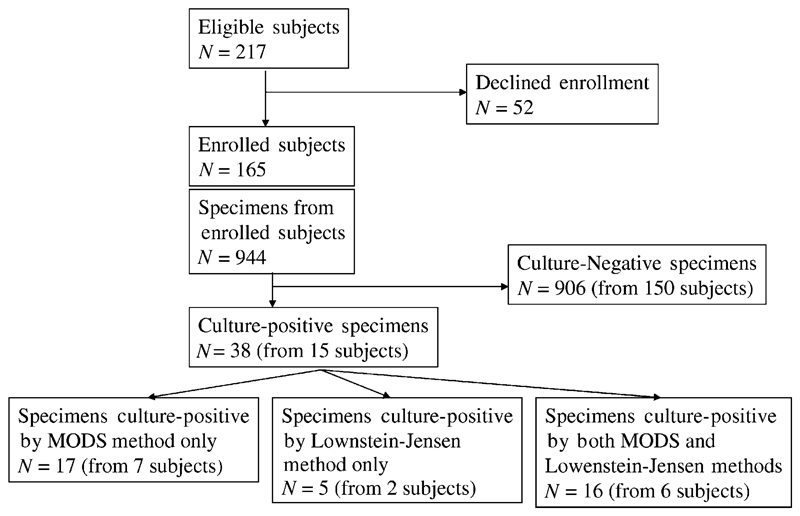
Methods: Two specimens of each type (gastric aspirate, nasopharyngeal aspirate, and stool specimens) were collected from each patient, examined by auramine stain, and cultured by Microscopic Observation Drug Susceptibility and Lowenstein-Jensen techniques. Patients (n = 165) were enrolled between April 2002 and February 2004 at the Instituto de Salud del Niño, the major pediatric hospital in Lima, Peru. Inclusion criteria were age < or = 12 years, Stegen-Toledo clinical score > or = 5 points, and absence of antituberculous therapy. The main outcome measurements were (1) proportion of specimens that were culture positive by Microscopic Observation Drug Susceptibility versus Lowenstein-Jensen and (2) days required for positive culture result, stratified by specimen type and auramine stain result.
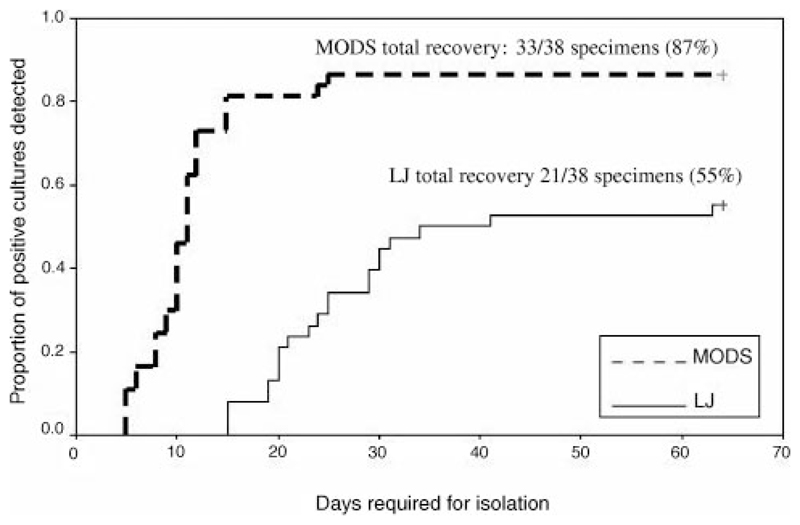
Results: Fifteen (9%) patients had at least 1 positive Mycobacterium tuberculosis culture (from stool in 3 cases, nasopharyngeal aspirate in 8 cases, and gastric aspirate in 15 cases). Thirty-eight culture-positive specimens were obtained (22 gastric aspirate, 12 nasopharyngeal aspirates, and 4 stools). Microscopic Observation Drug Susceptibility provided significantly more positive cultures than Lowenstein-Jensen (33 of 38 specimens culture positive by Microscopic Observation Drug Susceptibility vs 21 of 38 by Lowenstein-Jensen). This was attributed to enhanced recovery of Mycobacterium tuberculosis from auramine-negative specimens (19 of 23 by Microscopic Observation Drug Susceptibility vs 9 of 23 by Lowenstein-Jensen), in contrast to similar detection rates for the 2 tests with auramine-positive samples. Similar results were found for analyses that were limited to gastric aspirates. Isolation was faster by Microscopic Observation Drug Susceptibility than Lowenstein-Jensen.
Conclusions: Isolation of Mycobacterium tuberculosis from children with suspected pulmonary tuberculosis by Microscopic Observation Drug Susceptibility demonstrated greater yield and faster recovery than by Lowenstein-Jensen method, significantly improving local capabilities to detect pediatric tuberculosis in resource-poor settings.
Figures
References
-
- World Health Organization. Global Tuberculosis Control: Surveillance, Planning, Financing. WHO Report 2004. Geneva, Switzerland: World Health Organization; 2004.
-
- Starke JR, Taylor-Watts KT. Tuberculosis in the pediatric population of Houston, Texas. Pediatrics. 1989;84:28–35. - PubMed
-
- Abadco D, Steiner P. Gastric lavage is better than bronchoalveolar lavage for isolation of Mycobacterium tuberculosis in childhood pulmonary tuberculosis. Pediatr Infect Dis J. 1992;11:735–738. - PubMed
Publication types
MeSH terms
Grants and funding
LinkOut - more resources
Full Text Sources
Miscellaneous
