. 2006 Aug;173(4):2211-26.
doi: 10.1534/genetics.105.052712. Epub 2006 Jun 4.

Unequal sister chromatid and homolog recombination at a tandem duplication of the A1 locus in maize

Affiliations

Unequal sister chromatid and homolog recombination at a tandem duplication of the A1 locus in maize

Marna D Yandeau-Nelson et al. Genetics. 2006 Aug.

Abstract

Tandemly arrayed duplicate genes are prevalent. The maize A1-b haplotype is a tandem duplication that consists of the components, alpha and beta. The rate of meiotic unequal recombination at A1-b is ninefold higher when a homolog is present than when it is absent (i.e., hemizygote). When a sequence heterologous homolog is available, 94% of recombinants (264/281) are generated via recombination with the homolog rather than with the sister chromatid. In addition, 83% (220/264) of homolog recombination events involved alpha rather than beta. These results indicate that: (1) the homolog is the preferred template for unequal recombination and (2) pairing of the duplicated segments with the homolog does not occur randomly but instead favors a particular configuration. The choice of recombination template (i.e., homolog vs. sister chromatid) affects the distribution of recombination breakpoints within a1. Rates of unequal recombination at A1-b are similar to the rate of recombination between nonduplicated a1 alleles. Unequal recombination is therefore common and is likely to be responsible for the generation of genetic variability, even within inbred lines.


Figures

F<sc>igure</sc> 1.—
Figure 1.—
Physical characterization of deletion alleles at a1. (A) Structure of single-component A1-Sh2 haplotypes (Yao et al. 2002). Boxes represent genes. IR, interloop region (Yao et al. 2002). (B) Physical characterization of deletion alleles at a1. DNA gel blot analyses of putative a1-sh2 deletion stocks are shown. Genomic DNAs were digested with HindIII and hybridized with an a1-specific probe (materials and methods).
F<sc>igure</sc> 2.—
Figure 2.—
Physical identification of the α- and β-components of the A1-b allele. Homozygous genomic DNAs derived from a single-component a1 haplotype, a1-m3 Sh2, and double-component a1 haplotypes, α A1 Sh2, α a1-m3 Sh2, A1-b Sh2, and α A1 Sh2, were digested with HindIII and hybridized with an a1 probe (materials and methods). All four double-component a1 haplotypes contain the α-component (∼18 kb) but only A1-b Sh2 contains the β-component (5.8 kb). The two double-component a1 haplotypes designated α A1 Sh2 contain different a1 alleles.
F<sc>igure</sc> 3.—
Figure 3.—
Structure of the A1-b Sh2 haplotype. (A) The A1-b Sh2 haplotype. The sequence identities and sizes of duplicated segments are shown. Black lines designate regions with 100% sequence identity. Boxes and lines designate genes and intergenic regions, respectively. It is not known whether the x1 gene [which is ∼35 kb distal to yz1 in nonduplicated haplotypes (Yao et al. 2002)] is included in the duplication associated with the A1-b haplotype. Not drawn to scale. IR, interloop region (Yao et al. 2002). (B) Structure of A1-b α. A 5.4-kb insertion containing a 3.8-kb transposon-like element that contains a nested 453-bp Ins2 element with 93% identity to Ins2 in bz-R (GenBank accession no. X07938) is located within intron 2. The 3.8-kb element is flanked by 458-bp terminal inverted repeats (TIRs; long thick arrows), for which the first 13 bp of the TIRs are identical to the 13-bp TIRs of Ins2 (short arrows). The distal 458-bp TIR is actually a part of an intact 636-bp transposable element (triangle) with 93% identity to an uncharacterized transposon in intron 3 of the maize fatty aldehyde dehydrogenase1 gene (GenBank accession no. AY374447). Directly adjacent to the 3.8-kb element is a 1.6-kb inverted duplication of a1 sequence (shown in boldface type). Flanking the 5.4-kb insertion are 21-bp flanking direct duplications (solid bars). A Cin4 retrotransposon insertion is located in exon 4 at the same position as within other type II A1 alleles (Schwarz-Sommer et al. 1987) but is not present in the A1-b β-component. Boxes and lines represent exons and introns, respectively. Triangles represent insertions and arrows identify TIRs.
F<sc>igure</sc> 4.—
Figure 4.—
Strategy for isolating and distinguishing interhomolog and interchromatid recombinants. (A) Isolation of unequal recombinants from tandem duplication homozygotes. Unequal pairing configurations between the sequence-identical homologs and sister chromatids within a homozygote yield recombinant gametes with identical structures and therefore make it impossible to determine which recombination template was used. (B) Isolation of unequal recombinants from tandem duplication heterozygotes. Recombination in a heterozygote with a homolog containing a tandem gene duplication and a homolog containing a corresponding sequence heterologous single-copy gene can be detected between homologs and sister chromatids by virtue of the molecularly distinguishable recombinant structures. Because the homolog containing the single-copy gene can pair with either component of the tandem duplication (resulting in two distinct pairing configurations), the relative frequencies of alternative pairing configurations with the homolog can also be measured. (C) Isolation of unequal recombinants from tandem duplication hemizygotes. Because the duplicated locus is present only on one homolog in a hemizygote, recombinants isolated from a hemizygote must have occurred via interchromatid recombination. (A–C) The shaded and solid rectangles represent the components of a tandem duplication; (B) the hatched rectangle represents a paralog that is heterologous in sequence as compared to the components of the tandem duplication. Circles and ovals designate centromeres and an “x” designates the position of recombination.
F<sc>igure</sc> 5.—
Figure 5.—
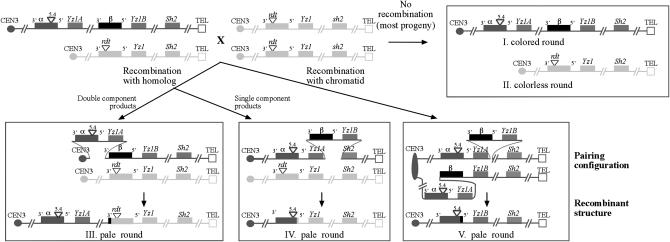
Isolation of recombinants. The parents of and the progeny resulting from cross 2A (materials and methods) are illustrated. Chromosomes from the A1-b Sh2 and a1∷rdt Sh2 stocks are illustrated as solid and shaded, respectively. Triangles indicate the positions of the 5.4-kb insertion in α and the rdt transposon in the single-copy a1 allele. Circles (or ovals) and squares represent centromeres and telomeres, respectively. Although all recombination breakpoints are illustrated as resolving within a1, resolution could potentially occur anywhere in the region between the 5.4-kb insertion of α and the β-component. In classes IV and V, Yz1A is illustrated as pairing with either Yz1 on the homolog (class IV) or Yz1B on the sister chromatid (class V); however, alternative pairing configurations in which Yz1B pairs with the homolog (class IV) or sister chromatid (class V) are also possible. Recombination between equally paired sister chromatids would not be detected in this assay. Unequal interchromatid recombinants from cross 3A would resemble the class V recombinants illustrated here. Unequal interhomolog and interchromatid recombinants from A1-b homozygotes (cross 4A) cannot be distinguished and would both resemble the class V recombinants illustrated here. In crosses 2–4, recombination might also occur between the inverted duplicate sequences within α (Figure 3B). Such recombination events would generate acentric or dicentric products, which would not be recovered following meiosis.
F<sc>igure</sc> 6.—
Figure 6.—
Physical mapping of recombination breakpoints. (A) Locations of unequal recombination breakpoints associated with single-component recombinants (Figure 5, classes IV and V). The schematic diagram represents a single-component recombinant haplotype in which boxes and lines represent genes and intergenic regions, respectively. The triangle indicates the position of the 5.4-kb insertion in α (not drawn to scale). The portion of the interval from the site of the 5.4-kb insertion through yz1, however, is drawn to scale. Thick solid horizontal bars designate the CAAT and TATA boxes (Tuerck and Fromm 1994; Pooma et al. 2002) of a1. The numbers of recombination breakpoints that resolved in each interval from each cross are indicated. Because the α-Yz1A and β-Yz1B intervals are sequence identical from the interloop region through at least Yz1 (Figure 3A), recombinants with the sister chromatid from crosses 2A–4A or with the homolog from cross 4A with recombination breakpoints that resolved distal to the position of the αSNP3F primer cannot be mapped to higher resolution. Crosses 2A–4A were conducted in two isolation plots. Although the rates of pale round recombinants recovered in cross 2A from the two isolation plots differed (see footnote b in Table 2A), χ2-contingency and Freeman–Halton tests failed to detect a significant difference between the distributions of recombination breakpoints from the two plots. Therefore, breakpoint distribution data from cross 2A were combined between the two plots. (B) Locations of unequal recombination breakpoints associated with double-component recombinants (Figure 5, class III) from cross 2A. (i) The structure of the double-component recombinant generated by pairing of the a1∷rdt homolog with β-Yz1B. The boxes and lines represent genes and intergenic regions, respectively. (ii) Locations of unequal recombination breakpoints proximal to the rdt insertion in exon 4. The schematic diagram represents the recombinant a1∷rdt component for which boxes and lines represent exons and introns, respectively. (A and B) Triangle, circle, and square arrows indicate positions of α-, β-, and a1∷rdt-specific primers used for PCR amplification, respectively.

References

    1. Allers, T., and M. Lichten, 2001. Differential timing and control of noncrossover and crossover recombination during meiosis. Cell 106: 47–57. - PubMed
    1. Arabidopsis Genome Initiative, 2000. Analysis of the genome sequence of the flowering plant Arabidopsis thaliana. Nature 408: 796–815. - PubMed
    1. Arbel, A., D. Zenvirth and G. Simchen, 1999. Sister chromatid-based DNA repair is mediated by RAD54, not by DMC1 or TID1. EMBO J. 18: 2648–2658. - PMC - PubMed
    1. Assaad, F. F., and E. R. Signer, 1992. Somatic and germinal recombination of a direct repeat in Arabidopsis. Genetics 132: 553–566. - PMC - PubMed
    1. Bhave, M. R., S. Lawrence, C. Barton and L. C. Hannah, 1990. Identification and molecular characterization of shrunken-2 cDNA clones of maize. Plant Cell 2: 581–588. - PMC - PubMed

Publication types

Associated data