


Is the major increase in notified campylobacteriosis in New Zealand real?
- PMID: 16753076
- PMCID: PMC2870549
- DOI: 10.1017/S0950268806006583
Is the major increase in notified campylobacteriosis in New Zealand real?
Abstract
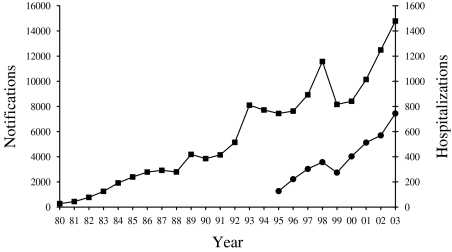
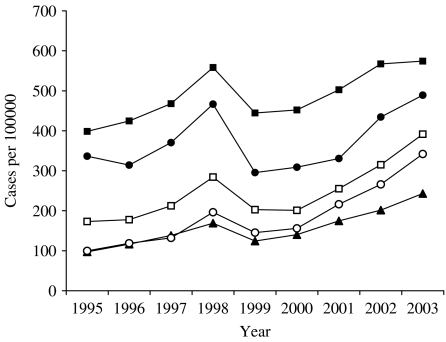
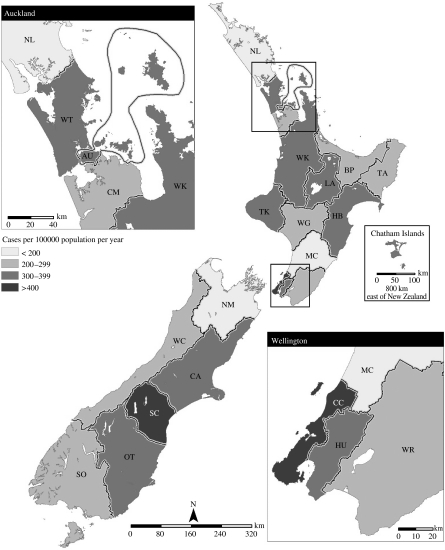
Notifications of campylobacteriosis by New Zealand medical practitioners have increased steadily in the last two decades. To determine if this increase is real, as opposed to a surveillance artefact, we examined both available notification (1980-2003) and hospitalization data (1995-2003). The similarity in the temporal pattern of increasing hospitalizations for campylobacteriosis, with that of notifications, is suggestive that this increase is indeed real. Although some risk factors for this disease have been identified (e.g. uncooked poultry consumption) it is unclear what the likely causes of the increasing rates are. The overall disease burden is also high compared with other developed countries (an annual notification rate of 396 cases per 100000 population in 2003), with highest rates in children aged 1-4 years, males, Europeans, and those living in urban areas. Given the large disease burden, further research and intervention studies should be public health priorities in this country.
Figures
References
-
- McNicholas AM et al. Is New Zealand's recent increase in campylobacteriosis due to changes in laboratory procedures? A survey of 69 medical laboratories. New Zealand Medical Journal. 1995;108:459–461. - PubMed
-
- Simmons G et al. Could laboratory-based notification improve the control of foodborne illness in New Zealand? New Zealand Medical Journal. 2002;115:237–240. - PubMed
-
- Thornley C, Baker M, Nichol C. The rising incidence of salmonella infection in New Zealand, 1995–2001. New Zealand Public Health Report. 2002;9:25–28.
-
- Sneyd E, Baker M. Infectious Diseases in New Zealand: 2002 annual surveillance summary. Wellington: Institute of Environmental Science & Research Ltd (ESR); 2003.
-
- Lake R et al. Lack of association between long-term illness and infectious intestinal disease in New Zealand. New Zealand Medical Journal. 2004;117:U893. - PubMed
MeSH terms
LinkOut - more resources
Full Text Sources
Medical
