Review
. 2006 Jun 29;361(1470):1055-67.
doi: 10.1098/rstb.2006.1844.

Multiple secondary origins of the anaerobic lifestyle in eukaryotes

Affiliations
Review

Multiple secondary origins of the anaerobic lifestyle in eukaryotes

T Martin Embley. Philos Trans R Soc Lond B Biol Sci. .

Abstract

Classical ideas for early eukaryotic evolution often posited a period of anaerobic evolution producing a nucleated phagocytic cell to engulf the mitochondrial endosymbiont, whose presence allowed the host to colonize emerging aerobic environments. This idea was given credence by the existence of contemporary anaerobic eukaryotes that were thought to primitively lack mitochondria, thus providing examples of the type of host cell needed. However, the groups key to this hypothesis have now been shown to contain previously overlooked mitochondrial homologues called hydrogenosomes or mitosomes; organelles that share common ancestry with mitochondria but which do not carry out aerobic respiration. Mapping these data on the unfolding eukaryotic tree reveals that secondary adaptation to anaerobic habitats is a reoccurring theme among eukaryotes. The apparent ubiquity of mitochondrial homologues bears testament to the importance of the mitochondrial endosymbiosis, perhaps as a founding event, in eukaryotic evolution. Comparative study of different mitochondrial homologues is needed to determine their fundamental importance for contemporary eukaryotic cells.


Figures
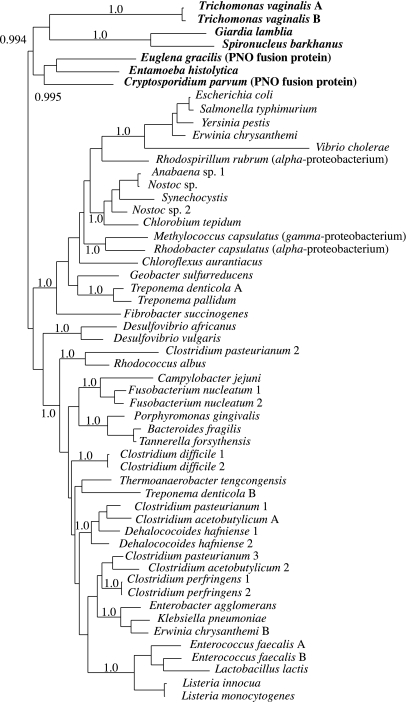
Figure 1
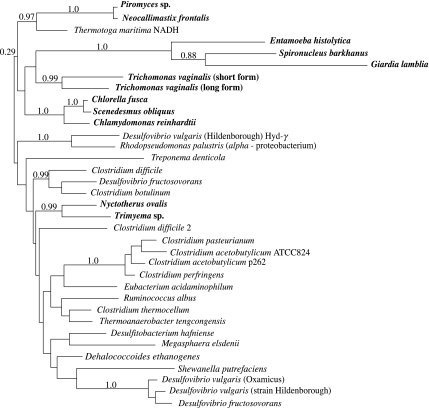
Figure 1
Phylogenetic tree showing the evolutionary relationships between pyruvate:ferredoxin oxidoreductase (PFO) sequences from eukaryotes and eubacteria. Eukaryotes are shown in bold. The tree is a consensus tree from a Bayesian analysis of aligned protein sequences using custom software (available from p.foster@nhm.ac.uk). Aligned positions (715 sites) were recoded into the six Dayhoff groups: C, STPAG, NDEQ, HRK, MILV and FYW to reduce the effects of mutational saturation (Hrdy et al. 2004). Posterior probabilities for some groups are shown, with a value of 1.0 representing maximum support. The strongly supported groups have also been recovered in previously published analyses using different methods, including maximum-likelihood, and different support measures including bootstrapping (Horner et al. 1999; Rotte et al. 2001).
Figure 2
Figure 2
Phylogenetic tree showing the evolutionary relationships between [Fe]-hydrogenase sequences from eukaryotes and eubacteria. Eukaryotes are shown in bold. Details of the analysis on 196 aligned positions are given in the legend to figure 1. The strongly supported groups have also been recovered in previously published analyses using different methods, including maximum-likelihood, and different support measures including bootstrapping (Horner et al. 2000).

References

    1. Abrahamsen M.S, et al. Complete genome sequence of the apicomplexan Cryptosporidium parvum. Science. 2004;304:441–445. 10.1126/science.1094786 - DOI - PubMed
    1. Adams K.L, Palmer J.D. Evolution of mitochondrial gene content: gene loss and transfer to the nucleus. Mol. Phylogenet. Evol. 2003;29:380–395. 10.1016/S1055-7903(03)00194-5 - DOI - PubMed
    1. Adl S.M, et al. The new higher level classification of eukaryotes with emphasis on the taxonomy of protists. J. Eukaryot. Microbiol. 2005;52:399–451. 10.1111/j.1550-7408.2005.00053.x - DOI - PubMed
    1. Akhmanova A, Voncken F, vanAlen T, vanHoek A, Boxma B, Vogels G, Veenhuiss M, Hackstein J.H.P. A hydrogenosome with a genome. Nature. 1998;396:527–528. 10.1038/25023 - DOI - PubMed
    1. Ali V, Shigeta Y, Tokumoto U, Takahashi Y, Nozaki T. An intestinal parasitic protist Entamoeba histolytica, possesses a non-redundant nitrogen fixation-like system for iron–sulfur cluster assembly under anaerobic conditions. J. Biol. Chem. 2004;279:16 863–16 874. 10.1074/jbc.M313314200 - DOI - PubMed

Publication types

LinkOut - more resources