. 2006 Jun 6:4:16.
doi: 10.1186/1741-7007-4-16.

Three rounds (1R/2R/3R) of genome duplications and the evolution of the glycolytic pathway in vertebrates

Affiliations

Three rounds (1R/2R/3R) of genome duplications and the evolution of the glycolytic pathway in vertebrates

Dirk Steinke et al. BMC Biol. .

Abstract

Background: Evolution of the deuterostome lineage was accompanied by an increase in systematic complexity especially with regard to highly specialized tissues and organs. Based on the observation of an increased number of paralogous genes in vertebrates compared with invertebrates, two entire genome duplications (2R) were proposed during the early evolution of vertebrates. Most glycolytic enzymes occur as several copies in vertebrate genomes, which are specifically expressed in certain tissues. Therefore, the glycolytic pathway is particularly suitable for testing theories of the involvement of gene/genome duplications in enzyme evolution.

Results: We assembled datasets from genomic databases of at least nine vertebrate species and at least three outgroups (one deuterostome and two protostomes), and used maximum likelihood and Bayesian methods to construct phylogenies of the 10 enzymes of the glycolytic pathway. Through this approach, we intended to gain insights into the vertebrate specific evolution of enzymes of the glycolytic pathway. Many of the obtained gene trees generally reflect the history of two rounds of duplication during vertebrate evolution, and were in agreement with the hypothesis of an additional duplication event within the lineage of teleost fish. The retention of paralogs differed greatly between genes, and no direct link to the multimeric structure of the active enzyme was found.

Conclusion: The glycolytic pathway has subsequently evolved by gene duplication and divergence of each constituent enzyme with taxon-specific individual gene losses or lineage-specific duplications. The tissue-specific expression might have led to an increased retention for some genes since paralogs can subdivide the ancestral expression domain or find new functions, which are not necessarily related to the original function.


Figures
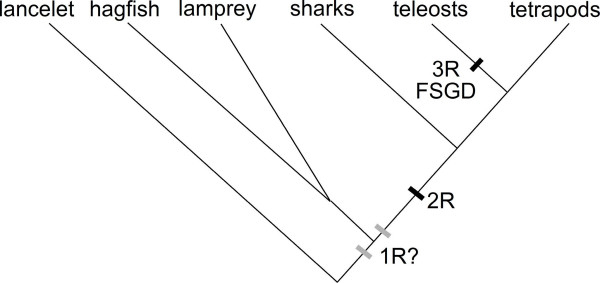
Figure 1
Figure 1
General overview of phylogenetic relationships among gnathostomes and the proposed phylogenetic timing of genome duplication events. Grey rectangles depict the possible position of the first genome duplication (1R); the black ones show the second genome duplication (2R), and fish-specific genome duplication (FSGD or 3R).
Figure 2
Figure 2
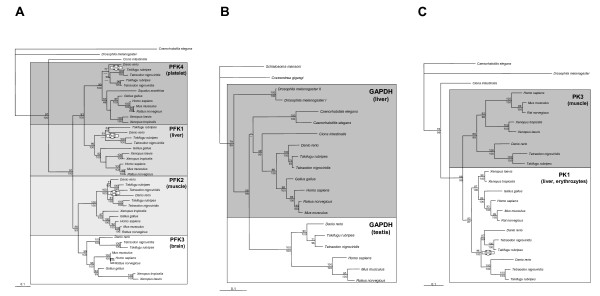
Maximum-likelihood tree of the tetrameric glycolytic enzymes phosphofructokinase (PFK), glyceraldehydes-3-phosphate dehydrogenase (GAPDH) and pyruvate kinase (PK) dataset comprising 44 amino-acid sequences for PFK (430 AA), 22 amino-acid sequences for GAPDH (340 AA), and 23 amino-acid sequences for PK (533 AA). Values at the branches are support values (ML bootstrapping/MB posterior probabilities). "FSGD" depicts putative fish-specific gene duplication events.
Figure 3
Figure 3
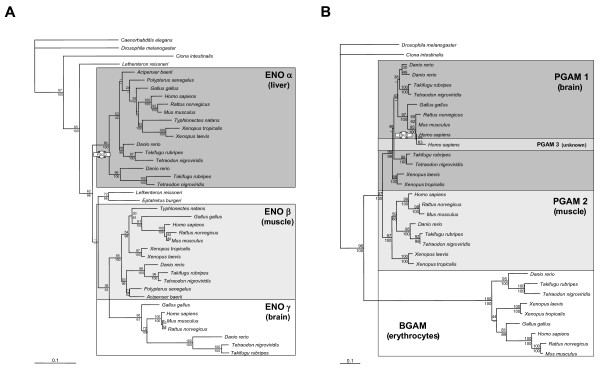
Maximum-likelihood tree of the heterodimeric composing glycolytic enzymes enolase (ENO), and phosphoglycerate mutase (PGAM) dataset comprising 40 amino-acid sequences for ENO (446 AA), and 32 amino-acid sequences for PGAM (256 AA). Values at the branches are support values (ML bootstrapping/MB posterior probabilities). 'FSGD' depicts putative fish-specific gene duplication events.
Figure 4
Figure 4
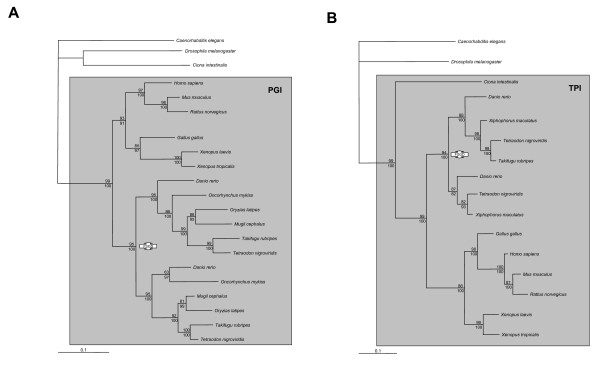
Maximum-likelihood tree of the homodimeric composing glycolytic enzymes phosphoglucose isomerase (PGI), and triosephosphate isomerase (TPI) dataset comprising 22 amino-acid sequences for PGI (555 AA), and 16 amino-acid sequences for TPI (250 AA). Values at the branches are support values (ML bootstrapping/MB posterior probabilities). 'FSGD' depicts putative fish-specific gene duplication events.
Figure 5
Figure 5
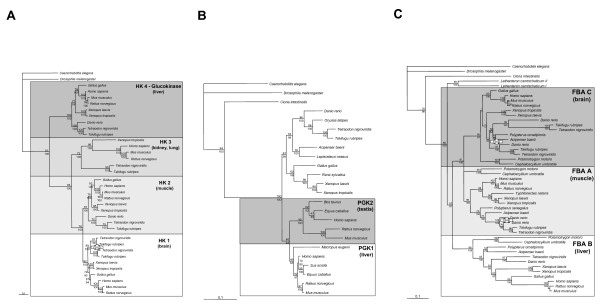
Maximum-likelihood trees of the monomeric glycolytic enzymes hexokinase (HK), phosphoglycerate kinase (PGK) and fructose-bisphosphate aldolase (FBA) dataset comprising 44 amino-acid sequences for HK (909 AA), 15 amino-acid sequences for PGK (417 AA), and 47 amino-acid sequences for FBA (366 AA). Values at the branches are support values (ML bootstrapping/MB posterior probabilities). 'FSGD' depicts putative fish-specific gene duplication events.

References

    1. Ohno S. Evolution by Gene Duplication. New York: Springer-Verlag; 1970.
    1. Hokamp K, McLysaght A, Wolfe KH. The 2R hypothesis and the human genome sequence. J Struc Funct Genomics. 2003;3:95–110. doi: 10.1023/A:1022661917301. - DOI - PubMed
    1. Panopoulou G, Poustka AJ. Timing and mechanism of ancient vertebrate Genome Duplication. The adventure of a hypothesis. Trends Genet. 2005;21:559–567. doi: 10.1016/j.tig.2005.08.004. - DOI - PubMed
    1. Hughes AL, Robert F. 2R or not 2R: Testing hypotheses of genome duplication in early vertebrates. J Struc Funct Genomics. 2003;3:85–93. doi: 10.1023/A:1022681600462. - DOI - PubMed
    1. Hughes AL. Phylogenies of Developmentally Important Proteins Do Not Support the Hypothesis of Two Rounds of Genome Duplication Early in Vertebrate History. J Mol Evol. 1999;48:565–576. doi: 10.1007/PL00006499. - DOI - PubMed

Publication types

MeSH terms

Substances

LinkOut - more resources