


Enhanced detection and typing of human papillomavirus (HPV) DNA in anogenital samples with PGMY primers and the Linear array HPV genotyping test
- PMID: 16757590
- PMCID: PMC1489445
- DOI: 10.1128/JCM.00104-06
Enhanced detection and typing of human papillomavirus (HPV) DNA in anogenital samples with PGMY primers and the Linear array HPV genotyping test
Abstract
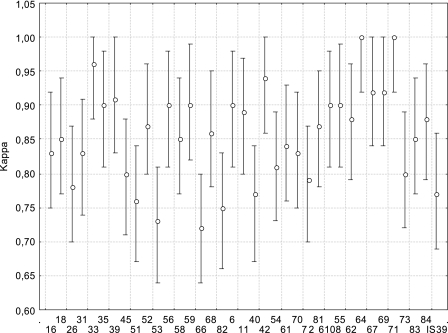
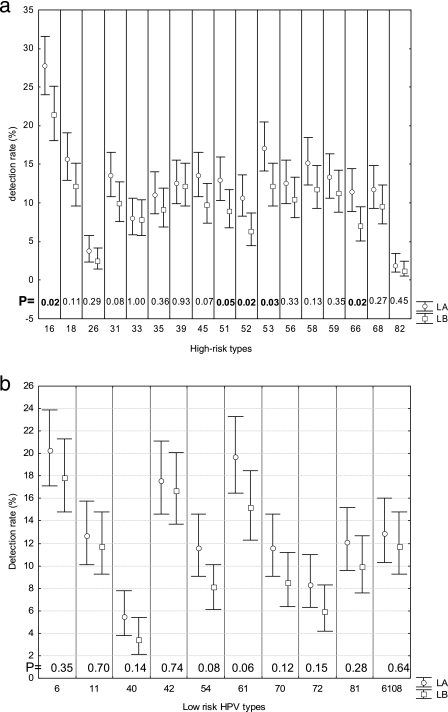
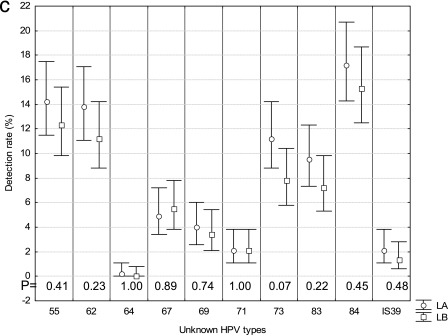
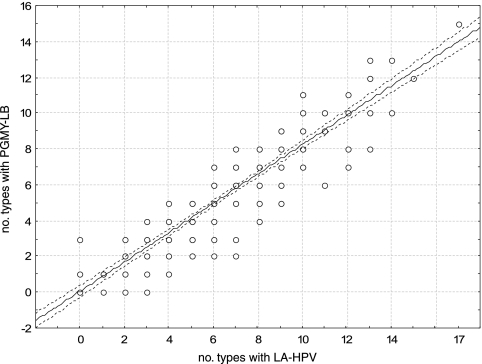
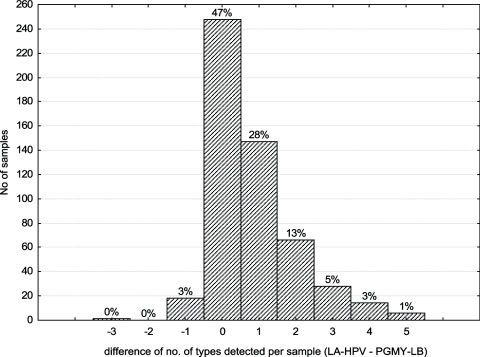
The Roche PGMY primer-based research prototype line blot assay (PGMY-LB) is a convenient tool in epidemiological studies for the detection and typing of human papillomavirus (HPV) DNA. This assay has been optimized and is being commercialized as the Linear Array HPV genotyping test (LA-HPV). We assessed the agreement between LA-HPV and PGMY-LB for detection and typing of 37 HPV genotypes in 528 anogenital samples (236 anal, 146 physician-collected cervical, and 146 self-collected cervicovaginal swabs) obtained from human immunodeficiency virus-seropositive individuals (236 men and 146 women). HPV DNA was detected in 433 (82.0%) and 458 (86.7%) samples with PGMY-LB and LA-HPV (P = 0.047), respectively, for an excellent agreement of 93.8% (kappa = 0.76). Of the 17,094 HPV typing results, 16,562 (1,743 positive and 14,819 negative results) were concordant between tests (agreement = 96.9%; kappa = 0.76). The mean agreement between tests for each type was 96.4% +/- 2.4% (95% confidence interval [CI], 95.6% to 97.2%; range, 86% to 100%), for an excellent mean kappa value of 0.85 +/- 0.10 (95% CI, 0.82 to 0.87). However, detection rates for most HPV types were greater with LA-HPV. The mean number of types per sample detected by LA-HPV (4.2 +/- 3.4; 95% CI, 3.9 to 4.5; median, 3.0) was greater than that for PGMY-LB (3.4 +/- 3.0; 95% CI, 3.1 to 3.6; median, 2.0) (P < 0.001). The number of types detected in excess by LA-HPV in anal samples correlated with the number of types per sample (r = 0.49 +/- 0.06; P = 0.001) but not with patient age (r = 0.03 +/- 0.06; P = 0.57), CD4 cell counts (r = 0.06 +/- 0.06; P = 0.13), or the grade of anal disease (r = -0.11 +/- 0.06; P = 0.07). LA-HPV compared favorably with PGMY-LB but yielded higher detection rates for newer and well-known HPV types.
Figures
References
-
- Aho, J., C. Hankins, C. Tremblay, F. Lang, P. Forest, K. Pourreaux, F. Rouah, The Canadian Women's HIV Study Group, and F. Coutlée. 2003. Molecular analysis of human papillomavirus type 52 isolates detected in the genital tract of HIV-seropositive and seronegative women. J. Infect. Dis. 188:1517-1527. - PubMed
-
- Bauer, H. M., Y. Ting, C. E. Greer, J. C. Chambers, C. J. Tashiro, J. Chimera, A. Reingold, and M. M. Manos. 1991. Genital human papillomavirus infection in female university students as determined by a PCR-based method. JAMA 265:472-477. - PubMed
-
- Castle, P. E., M. Schiffman, P. E. Gravitt, H. Kendall, S. Fishman, H. Dong, A. Hildesheim, R. Herrero, M. C. Bratti, M. E. Sherman, A. Lorincz, J. E. Schussler, and R. D. Burk. 2002. Comparisons of HPV DNA detection by MY09/11 PCR methods. J. Med. Virol. 68:417-423. - PubMed
-
- Coutlée, F., M. de Ladurantaye, C. Tremblay, J. Vincelette, L. Labrecque, and M. Roger. 2000. An important proportion of genital samples submitted for Chlamydia trachomatis detection by PCR contain small amounts of cellular DNA as measured by β-globin gene amplification. J. Clin. Microbiol. 38:2512-2515. - PMC - PubMed
Publication types
MeSH terms
Substances
LinkOut - more resources
Full Text Sources
Other Literature Sources
Research Materials
