Genetically diverse group A streptococci from children in far-western Nepal share high genetic relatedness with isolates from other countries
- PMID: 16757615
- PMCID: PMC1489425
- DOI: 10.1128/JCM.02456-05
Genetically diverse group A streptococci from children in far-western Nepal share high genetic relatedness with isolates from other countries
Abstract
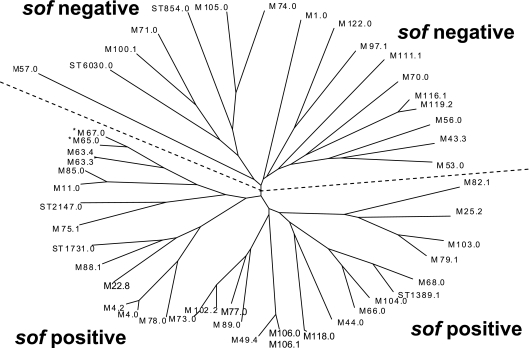
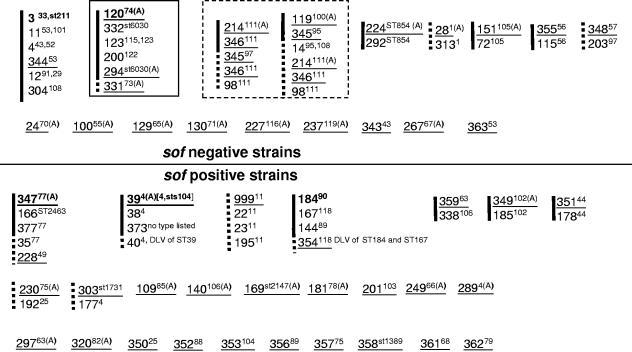
The genetic diversity of group A streptococci (GAS) throughout much of the world has not been adequately explored. To assess genetic variation among GAS in western Nepal, 120 noninvasive GAS, collected from eight different villages, were genetically characterized using emm typing, sof sequencing, and multilocus sequence typing (MLST). A high level of genetic diversity was observed among these isolates, with 51 genotypes based upon 51 multilocus sequence types (STs), 45 emm sequence types, and 28 sof sequence types. On the basis of shared ST-emm and sof-emm associations, 40 of the 51 genotypes were identical or highly related to genotypes characterized from locations outside of Nepal, even though most of the emm sequence and clonal types are rare among GAS within the United States. When analyzing all known STs highly related to Nepal STs, only one example of similar STs shared between a sof PCR-positive strain and a sof PCR-negative strain was observed. Since previous data indicate free exchange of MLST loci between sof-positive and sof-negative strains, there is possibly selection against the expansion of subclones resulting from horizontal transfers of sof or emm genes between sof-positive and sof-negative strains. All 45 emm types encountered in Nepal have also been documented from other countries. These data, together with data encompassing the past decade of emm type surveillance, support the possibility that most existing GAS emm types have been discovered. Similarly, since most (40/51) strain types were highly related to strains found elsewhere, it is likely that a major fraction of the existing GAS clonal complexes have been discovered.
Figures
References
-
- Beall, B., G. Gherardi, M. Lovgren, R. R. Facklam, B. A. Forwick, and G. J. Tyrrell. 2000. emm and sof gene sequence variation in relation to serological typing of opacity factor positive group A streptococci. Microbiology 146:1195-1209. - PubMed
-
- Bessen, D. E., J. R. Carapetis, B. Beall, R. Katz, M. Hibble, B. J. Currie, T. Collingridge, M. W. Izzo, D. A. Scaramuzzino, and K. S. Sriprakash. 2000. Contrasting molecular epidemiology of group A streptococci causing tropical and nontropical infections of the skin and throat. J. Infect. Dis. 182:1109-1116. - PubMed
-
- Bessen, D. E., C. M. Sotir, T. L. Readdy, and S. K. Hollingshead. 1996. Genetic correlates of throat and skin isolates of group A streptococci. J. Infect. Dis. 173:896-900. - PubMed
-
- Centers for Disease Control and Prevention. 2006. CDC emm sequence database. [Online.] http://www.cdc.gov/ncidod/biotech/strep/emmtypes.htm.
-
- Courtney, H. S., D. L. Hasty, Y. Li, H. C. Chiang, J. L. Thacker, and J. B. Dale. 1999. Serum opacity factor is a major fibronectin-binding protein and a virulence determinant of M type 2 Streptococcus pyogenes. Mol. Microbiol. 32:89-98. - PubMed
MeSH terms
Substances
LinkOut - more resources
Full Text Sources
Medical
Miscellaneous