. 2006 Jun 6:1:10.
doi: 10.1186/1747-1028-1-10.

Cdk2 and Cdk4 cooperatively control the expression of Cdc2

Affiliations

Cdk2 and Cdk4 cooperatively control the expression of Cdc2

Cyril Berthet et al. Cell Div. .

Abstract

Progression through the mammalian cell cycle is associated with the activity of four cyclin dependent kinases (Cdc2/Cdk1, Cdk2, Cdk4, and Cdk6). Knockout mouse models have provided insight into the interplay of these Cdks. Most of these models do not exhibit major cell cycle defects revealing redundancies, and suggesting that a single Cdk might be sufficient to drive the cell cycle, similar as in yeast. Recent work on Cdk2/Cdk4 double knockouts has indicated that these two Cdks are required to phosphorylate Rb during late embryogenesis. The lack of Rb phosphorylation is progressive and associated with reduced E2F-inducible gene expression. Cdk2 and Cdk4 share the essential function of coupling the G1/S transition with mitosis. However, proliferation in early embryogenesis appears to be independent of Cdk2 and Cdk4. We discuss these observations and propose molecular mechanisms that establish the requirement for Cdk2 and Cdk4 at the G1/S transition. We are considering that the balance between proliferation and differentiation is disturbed, which affects especially heart development and leads to embryonic lethality in Cdk2-/- Cdk4-/- mutants. We also discuss the specific functions of Cdk4 and Cdk6, which ironically do not compensate for each other.


Figures
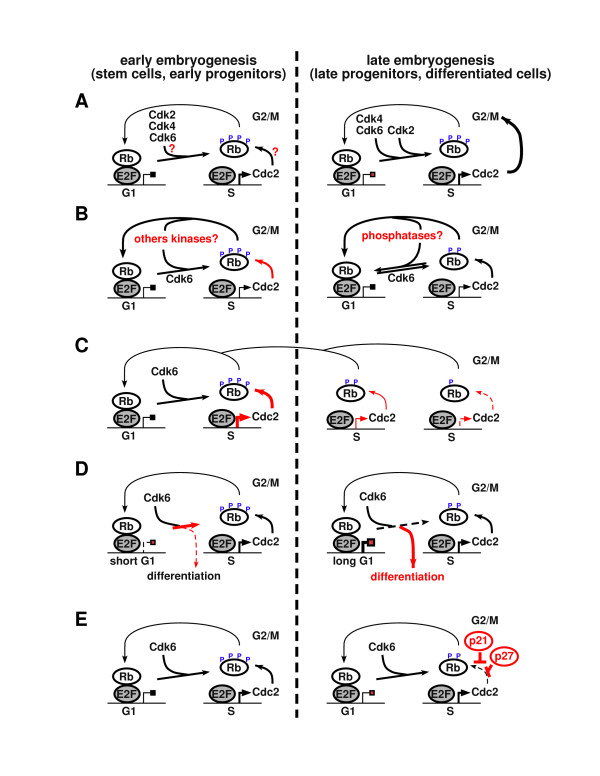
Figure 1
Figure 1
Coupling of G1/S transition with mitosis. Cell proliferation appears to be dependent on Cdk2 and Cdk4 in late embryogenesis but not in early embryogenesis. (A) Previous results suggested that phosphorylation of Rb is differently regulated in stem cells and in differentiated cells [10, 11]. The characterization of Cdk2-/-Cdk4-/- mice demonstrates Cdk2 and Cdk4 independence for Rb phosphorylation in early embryogenesis and we proposed four models for the G1/S transition and the establishment of Cdk2/Cdk4 dependent Rb/E2F checkpoint. These molecular mechanisms are not exclusive and they might all play a role throughout the differentiation process or in specific cell types. (B) Specific kinases or phosphatases are differentially expressed in stem cells or differentiated cells, which modifies the phosphorylation of Rb. Cdc2 could be also more active in stem cells. (C) Cdk6 and Cdc2 do not phosphorylate Rb to full extend, which progressively affects the E2F-dependent transcription of Cdc2 and initiates a negative feedback loop. (D) Proteins promoting differentiation at the onset of the G1phase. Throughout the differentiation process, the length of G1phase extends, tipping the balance between proliferation and differentiation towards cell cycle exit and further differentiation. Unphosphorylated Rb itself is a major inducer of the cell cycle exit. (E) Increased expression of Cdk inhibitors in differentiated cells will affect Cdk activity (see text for discussion about Cdk2-/-Cdk4-/-p27-/- cells).

References

    1. Berthet C, Aleem E, Coppola V, Tessarollo L, Kaldis P. Cdk2 knockout mice are viable. Curr Biol. 2003;13:1775–1785. doi: 10.1016/j.cub.2003.09.024. - DOI - PubMed
    1. Malumbres M, Sotillo R, Santamaria D, Galan J, Cerezo A, Ortega S, Dubus P, Barbacid M. Mammalian cells cycle without the D-type cyclin-dependent kinases Cdk4 and Cdk6. Cell. 2004;118:493–504. doi: 10.1016/j.cell.2004.08.002. - DOI - PubMed
    1. Rane SG, Dubus P, Mettus RV, Galbreath EJ, Boden G, Reddy EP, Barbacid M. Loss of Cdk4 expression causes insulin-deficient diabetes and Cdk4 activation results in b-islet cell hyperplasia. Nat Genet. 1999;22:44–52. - PubMed
    1. Tsutsui T, Hesabi B, Moons DS, Pandolfi PP, Hansel KS, Koff A, Kiyokawa H. Targeted disruption of CDK4 delays cell cycle entry with enhanced p27Kip1 activity. Mol Cell Biol. 1999;19:7011–7019. - PMC - PubMed
    1. Aleem E, Kiyokawa H, Kaldis P. Cdc2-cyclin E complexes regulate the G1/S phase transition. Nat Cell Biol. 2005;7:831–836. doi: 10.1038/ncb1284. - DOI - PubMed

LinkOut - more resources
