


Trichloroethylene exposure during cardiac valvuloseptal morphogenesis alters cushion formation and cardiac hemodynamics in the avian embryo
- PMID: 16759982
- PMCID: PMC1480523
- DOI: 10.1289/ehp.8781
Trichloroethylene exposure during cardiac valvuloseptal morphogenesis alters cushion formation and cardiac hemodynamics in the avian embryo
Abstract
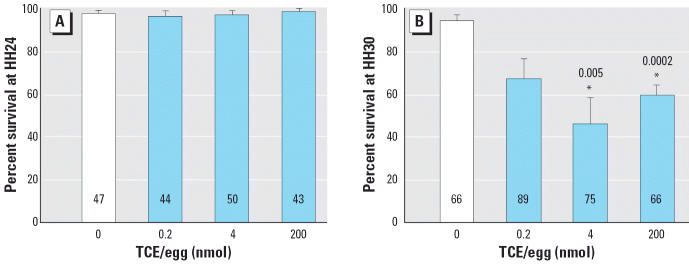
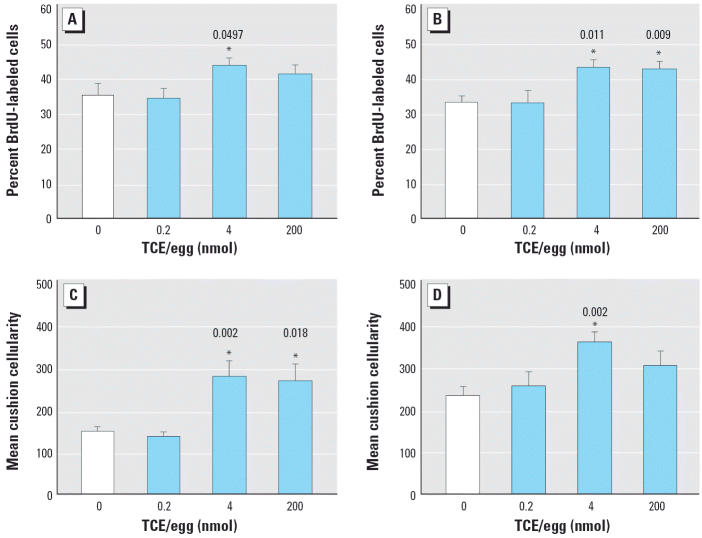
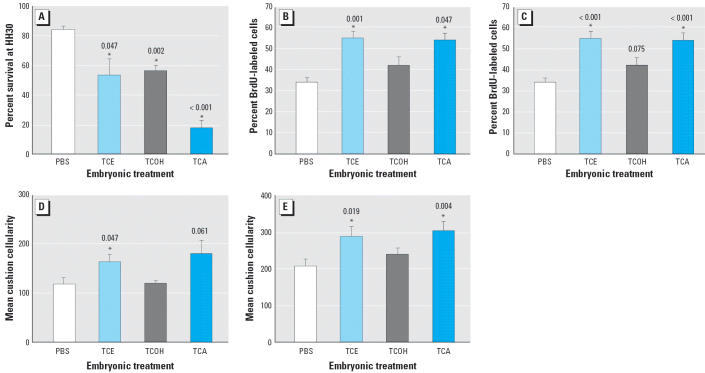
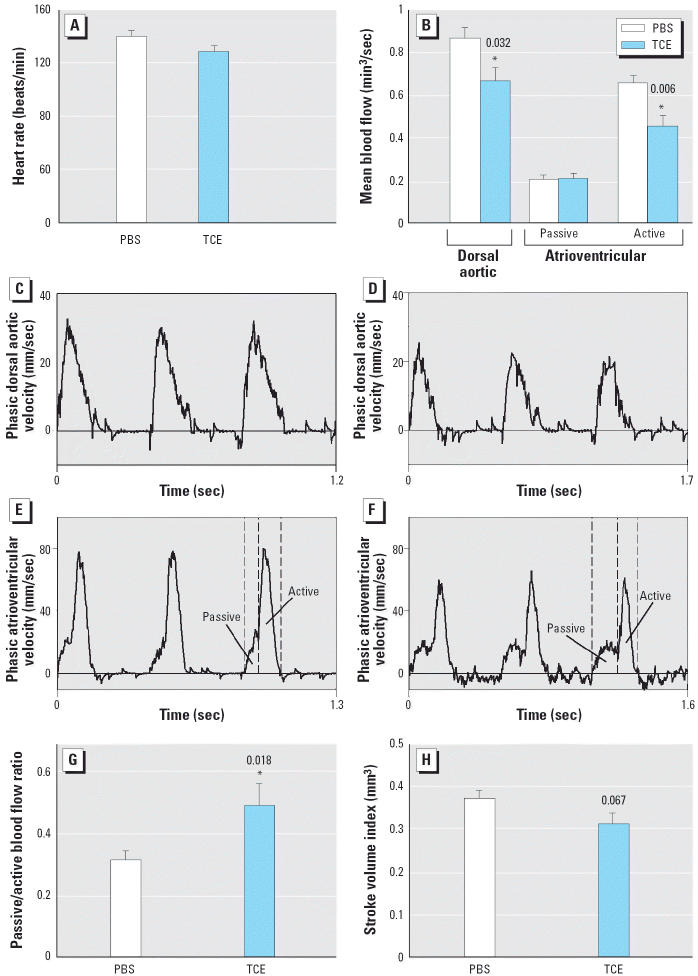
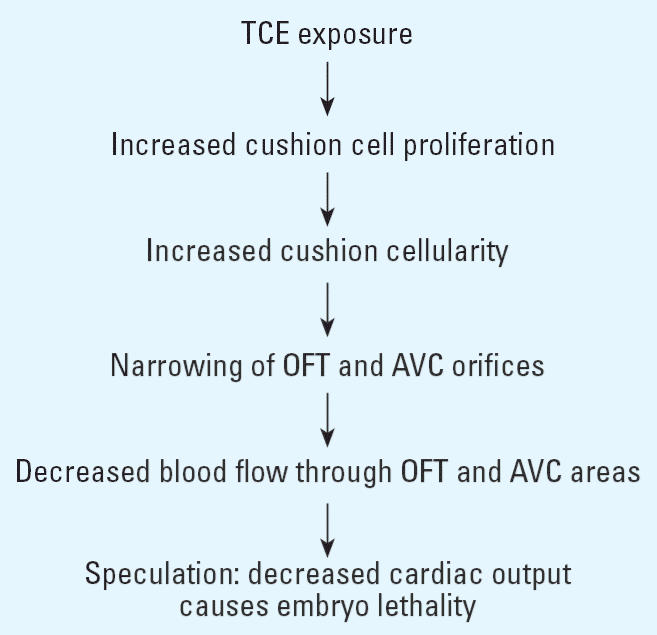
It is controversial whether trichloroethylene (TCE) is a cardiac teratogen. We exposed chick embryos to 0, 0.4, 8, or 400 ppb TCE/egg during the period of cardiac valvuloseptal morphogenesis (2-3.3 days' incubation) . Embryo survival, valvuloseptal cellularity, and cardiac hemodynamics were evaluated at times thereafter. TCE at 8 and 400 ppb/egg reduced embryo survival to day 6.25 incubation by 40-50%. At day 4.25, increased proliferation and hypercellularity were observed within the atrioventricular and outflow tract primordia after 8 and 400 ppb TCE. Doppler ultrasound revealed that the dorsal aortic and atrioventricular blood flows were reduced by 23% and 30%, respectively, after exposure to 8 ppb TCE. Equimolar trichloroacetic acid (TCA) was more potent than TCE with respect to increasing mortality and causing valvuloseptal hypercellularity. These results independently confirm that TCE disrupts cardiac development of the chick embryo and identifies valvuloseptal development as a period of sensitivity. The hypercellular valvuloseptal profile is consistent with valvuloseptal heart defects associated with TCE exposure. This is the first report that TCA is a cardioteratogen for the chick and the first report that TCE exposure depresses cardiac function. Valvuloseptal hypercellularity may narrow the cardiac orifices, which reduces blood flow through the heart, thereby compromising cardiac output and contributing to increased mortality. The altered valvuloseptal formation and reduced hemodynamics seen here are consistent with such an outcome. Notably, these effects were observed at a TCE exposure (8 ppb) that is only slightly higher than the U.S. Environmental Protection Agency maximum containment level for drinking water (5 ppb) .
Figures

References
-
- Armstrong SR, Green LC. Chlorinated hydrocarbon solvents. Clin Occup Environ Med. 2004;4:481–496. - PubMed
-
- Bove FJ, Fulcomer MC, Klotz JB, Esmart J, Dufficy EM, Savrin JE. Public drinking water contamination and birth outcomes. Am J Epidemiol. 1995;141:850–862. - PubMed
-
- Boyer AS, Finch WT, Runyan RB. Trichloroethylene inhibits development of embryonic heart valve precursors in vitro. Toxicol Sci. 2000;53:109–117. - PubMed
-
- Broekhuizen ML, Mast F, Struijk PC, van der Bie W, Mulder PG, Gittenberger-de Groot AC, et al. Hemodynamic parameters of stage 20 to 35 chick embryo. Pediatr Res. 1993;34:44–46. - PubMed
-
- Campbell KA, Hu N, Clark EB, Keller BB. Analysis of dynamic atrial dimension and function during early cardiac development in the chick embryo. Ped Res. 1992;32:333–337. - PubMed
Publication types
MeSH terms
Substances
Grants and funding
LinkOut - more resources
Full Text Sources