


Interaction of the onset of spring and elevated atmospheric CO2 on ragweed (Ambrosia artemisiifolia L.) pollen production
- PMID: 16759986
- PMCID: PMC1480488
- DOI: 10.1289/ehp.8549
Interaction of the onset of spring and elevated atmospheric CO2 on ragweed (Ambrosia artemisiifolia L.) pollen production
Abstract
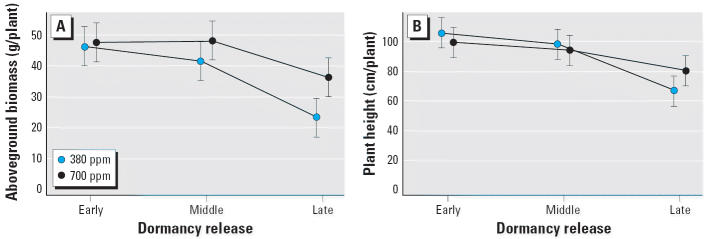
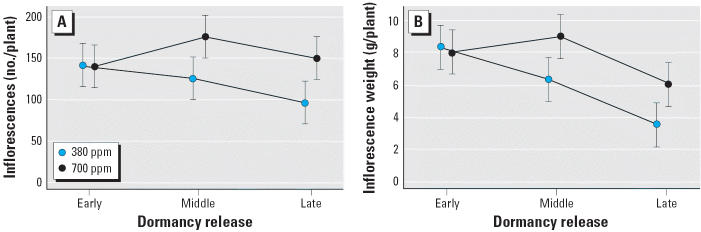
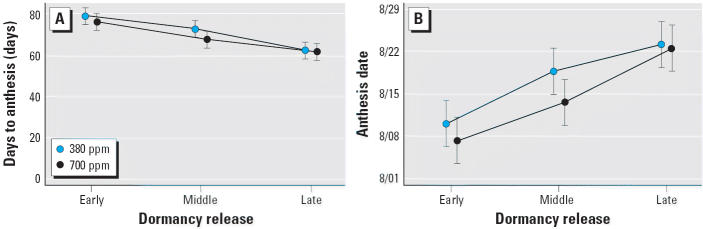
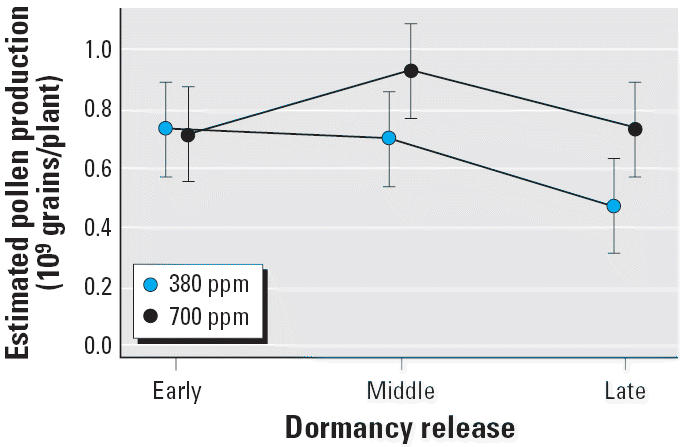
Increasing atmospheric carbon dioxide is responsible for climate changes that are having widespread effects on biological systems. One of the clearest changes is earlier onset of spring and lengthening of the growing season. We designed the present study to examine the interactive effects of timing of dormancy release of seeds with low and high atmospheric CO2 on biomass, reproduction, and phenology in ragweed plants (Ambrosia artemisiifolia L.), which produce highly allergenic pollen. We released ragweed seeds from dormancy at three 15-day intervals and grew plants in climate-controlled glass-houses at either ambient or 700-ppm CO2 concentrations, placing open-top bags over influorescences to capture pollen. Measurements of plant height and weight; inflorescence number, weight, and length; and days to anthesis and anthesis date were made on each plant, and whole-plant pollen productivity was estimated from an allometric-based model. Timing and CO2 interacted to influence pollen production. At ambient CO2 levels, the earlier cohort acquired a greater biomass, a higher average weight per inflorescence, and a larger number of influorescences; flowered earlier; and had 54.8% greater pollen production than did the latest cohort. At high CO2 levels, plants showed greater biomass and reproductive effort compared with those in ambient CO2 but only for later cohorts. In the early cohort, pollen production was similar under ambient and high CO2, but in the middle and late cohorts, high CO2 increased pollen production by 32% and 55%, respectively, compared with ambient CO2 levels. Overall, ragweed pollen production can be expected to increase significantly under predicted future climate conditions.
Figures
References
-
- Bassett IJ, Crompton CW. The biology of Canadian weeds. 11Ambrosia artemisiifolia L. and A. psilostachya DC. Can J Plant Sci. 1975;55:463–476.
-
- Bazzaz FA. The response of natural ecosystems to the rising global CO2 levels. Annu Rev Ecol Syst. 1990;21:167–196.
-
- Bazzaz FA, Garbutt K. The response of annuals in competitive neighborhoods: effects of elevated CO2. Ecology. 1988;69:937–946.
-
- Beggs PJ. Impacts of climate change on aeroallergens: past and future. Clin Exp Allergy. 2004;34:1507–1513. - PubMed
-
- Clot B. Trends in airborne pollen: an overview of 21 years of data in Neuchatel (Switzerland) Aerobiologia. 2003;19:227–234.
Publication types
MeSH terms
Substances
Grants and funding
LinkOut - more resources
Full Text Sources