Review
. 2006 Jul 1;397(1):1-14.
doi: 10.1042/BJ20060175.

The gap junction cellular internet: connexin hemichannels enter the signalling limelight

Affiliations
Review

The gap junction cellular internet: connexin hemichannels enter the signalling limelight

W Howard Evans et al. Biochem J. .

Abstract

Cxs (connexins), the protein subunits forming gap junction intercellular communication channels, are transported to the plasma membrane after oligomerizing into hexameric assemblies called connexin hemichannels (CxHcs) or connexons, which dock head-to-head with partner hexameric channels positioned on neighbouring cells. The double membrane channel or gap junction generated directly couples the cytoplasms of interacting cells and underpins the integration and co-ordination of cellular metabolism, signalling and functions, such as secretion or contraction in cell assemblies. In contrast, CxHcs prior to forming gap junctions provide a pathway for the release from cells of ATP, glutamate, NAD+ and prostaglandin E2, which act as paracrine messengers. ATP activates purinergic receptors on neighbouring cells and forms the basis of intercellular Ca2+ signal propagation, complementing that occuring more directly via gap junctions. CxHcs open in response to various types of external changes, including mechanical, shear, ionic and ischaemic stress. In addition, CxHcs are influenced by intracellular signals, such as membrane potential, phosphorylation and redox status, which translate external stresses to CxHc responses. Also, recent studies demonstrate that cytoplasmic Ca2+ changes in the physiological range act to trigger CxHc opening, indicating their involvement under normal non-pathological conditions. CxHcs not only respond to cytoplasmic Ca2+, but also determine cytoplasmic Ca2+, as they are large conductance channels, suggesting a prominent role in cellular Ca2+ homoeostasis and signalling. The functions of gap-junction channels and CxHcs have been difficult to separate, but synthetic peptides that mimic short sequences in the Cx subunit are emerging as promising tools to determine the role of CxHcs in physiology and pathology.


Figures
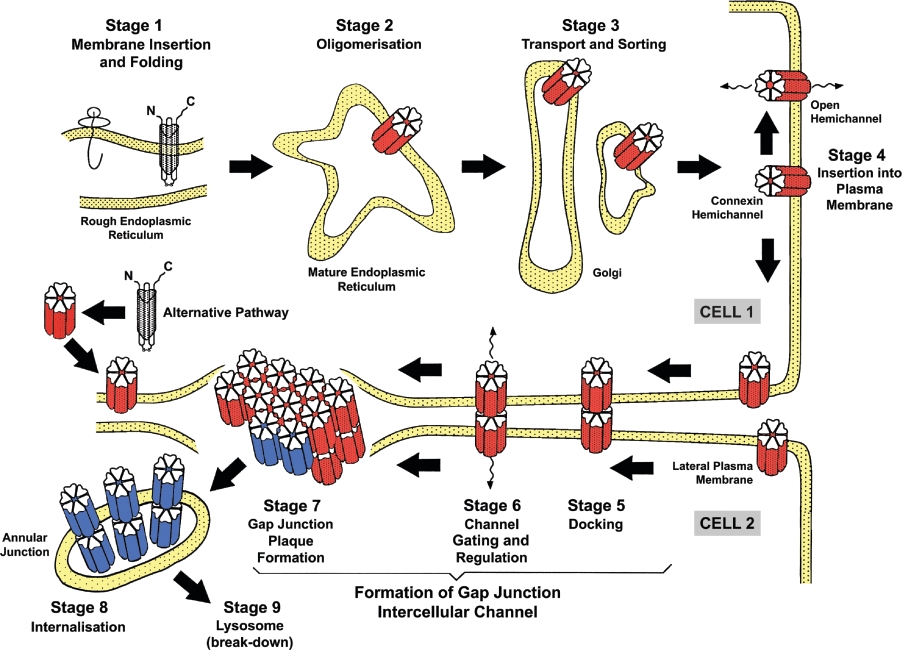
Figure 1
Figure 1. Assembly and breakdown of gap junctions emphasizing the genesis and trafficking of CxHcs
Formation of CxHcs occurs early in the secretory pathway (Stage 1) and they are transported along the secretory pathway (Stages 2 and 3), implicating regions of the endoplasmic reticulum and the Golgi apparatus. A second assembly mechanism that is poorly characterized also operates with Cx26 and possibly other connexins has been reported which does not directly feature the Golgi apparatus. CxHcs, after insertion into the plasma membrane (Stage 4), dock with partners (Stage 5) located on an attached cell, and gate to an open configuration (Stage 6), a process that may occur concurrently with the aggregation of the gap junction channels into large adhesive plaques (Stage 7). Stages 7 and 8 involve internalization of gap junctions into one of the attached cells and break down by hydrolysis in lysosomes (Stage 9).
Figure 2
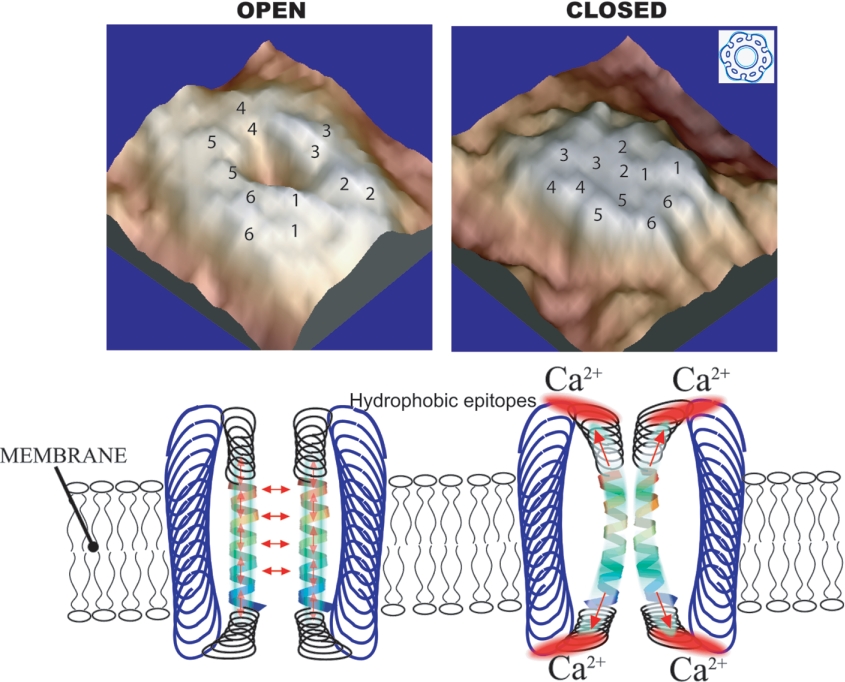
Figure 2. Model depicting extracellular Ca2+-sensitive open and closed conformations of CxHcs deduced from samples examined by atomic-force microscopy
This Figure is modified from Figures 3 and 5 of [77] and is reproduced with the permission of the authors and the publishers. © 2005 The American Society for Biochemistry and Molecular Biology (http://www.jbc.org).
Figure 3
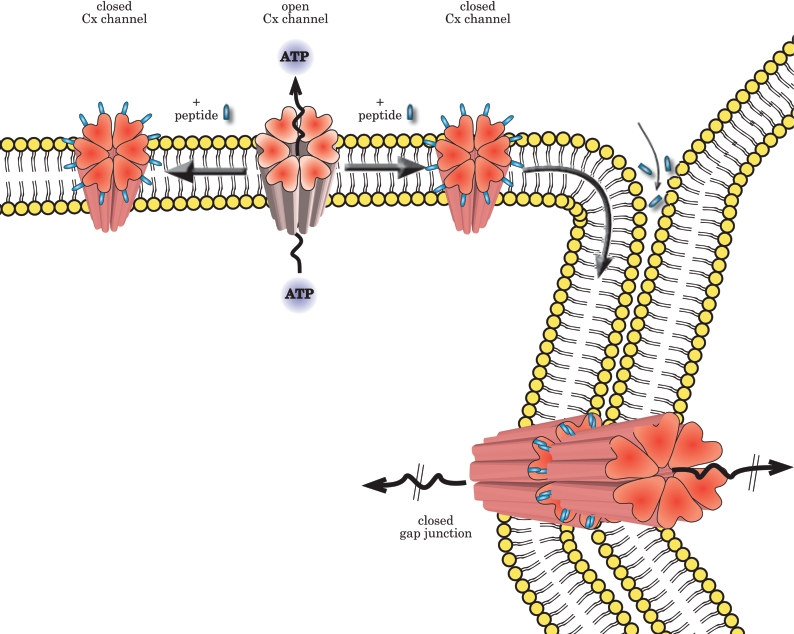
Figure 3. Proposed mechanism of action by which Cx mimetic peptides inhibit cell signalling
Within minutes of application, the peptide binds to CxHcs, lowering channel conductance and restricting, for example, ATP release. Later, as CxHcs become incorporated by accretion to the edges of gap juctions, intercellular coupling is inhibited. Cx mimetic peptides may also prevent assembly of CxHcs into newly formed functional gap junction channels, break existing gap junction channels apart or diffuse into the intercellular cleft and induce direct blockage of gap junctions. See the text for discussion.
Figure 4
Figure 4. CxHcs and Ca2+ signalling
(A) CxHcs open in response to cytoplasmic Ca2+ changes and thereby form a conduit for the release of messengers such as ATP and others; CxHcs only open in so-called ‘trigger cells’. (B) ATP diffuses into the extracellular space and activates G-protein-coupled serpentine receptors on neighbouring cells. This results in the activation of phospholipase C, the formation of InsP3 and the release of Ca2+ from the endoplamic reticulum. This pathway underlies paracrine cell–cell communication of Ca2+ signals. (C) Ca2+ signals can also be communicated by the diffusion of InsP3 or Ca2+ via gap junctions connecting cells. (D) The extracellular ATP concentration gradually decreases and the communication of Ca2+ signals stops unless another trigger cell is encountered that regenerates the ATP signal. (E) Ca2+-triggered ATP release via CxHcs may also be involved in Ca2+ oscillations in the cell via an autocrine signalling path (see the text). (F) Cytoplasmic Ca2+ changes can trigger CxHc opening, and conversely, open CxHcs may magnify Ca2+ changes by Ca2+ entry from the extracellular space.

References

    1. Willecke K., Eiberger J., Degen J., Eckardt D., Romualdi A., Guldenagel M., Deutsch U., Sohl G. Structural and functional diversity of connexin genes in the mouse and human genome. Biol. Chem. 2002;383:725–737. - PubMed
    1. White T. W., Wang H., Mui R., Litteral J., Brink P. R. Cloning and functional expression of invertebrate connexins from Halocynthia pyriformis. FEBS Lett. 2004;577:42–48. - PubMed
    1. Evans W. H., Martin P. E. Gap junctions: structure and function. Mol. Membr. Biol. 2002;19:121–136. - PubMed
    1. Saez J. C., Berthoud V. M., Branes M. C., Martinez A. D., Beyer E. C. Plasma membrane channels formed by connexins: their regulation and functions. Physiol. Rev. 2003;83:1359–1400. - PubMed
    1. Lauf U., Giepmans B. N. G., Lopez P., Braconnot S., Chen S. C., Falk M. M. Dynamic trafficking and delivery of connexons to the plasma membrane and accretion to gap junctions in living cells. Proc. Natl. Acad. Sci. U.S.A. 2002;99:10446–10451. - PMC - PubMed

LinkOut - more resources