


Modelling the force of infection for hepatitis B and hepatitis C in injecting drug users in England and Wales
- PMID: 16762050
- PMCID: PMC1524784
- DOI: 10.1186/1471-2334-6-93
Modelling the force of infection for hepatitis B and hepatitis C in injecting drug users in England and Wales
Abstract
Background: Injecting drug use is a key risk factor, for several infections of public health importance, especially hepatitis B (HBV) and hepatitis C (HCV). In England and Wales, where less than 1% of the population are likely to be injecting drug users (IDUs), approximately 38% of laboratory reports of HBV, and 95% of HCV reports are attributed to injecting drug use.
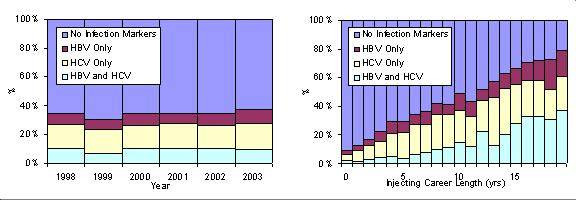
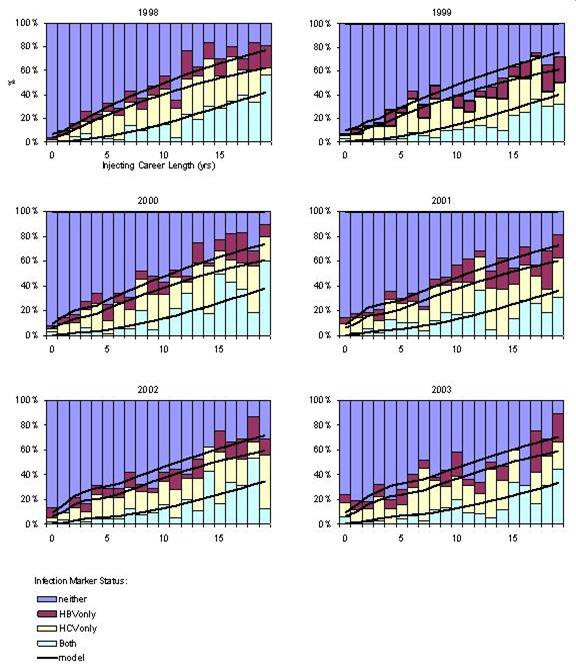
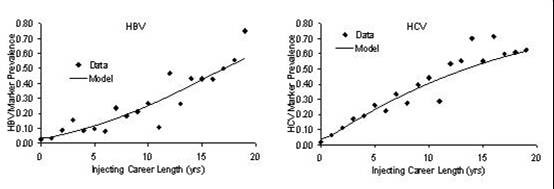
Methods: Voluntary unlinked anonymous surveys have been performed on IDUs in contact with specialist agencies throughout England and Wales. Since 1990 more than 20,000 saliva samples from current IDUs have been tested for markers of infection for HBV, HCV testing has been included since 1998. The analysis here considers those IDUs tested for HBV and HCV (n = 5,682) from 1998-2003. This study derives maximum likelihood estimates of the force of infection (the rate at which susceptible IDUs acquire infection) for HBV and HCV in the IDU population and their trends over time and injecting career length. The presence of individual heterogeneity of risk behaviour and background HBV prevalence due to routes of transmission other than injecting are also considered.
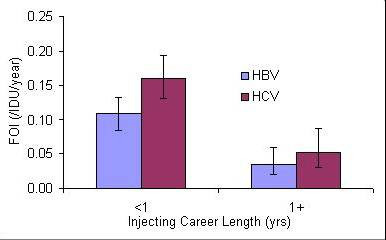
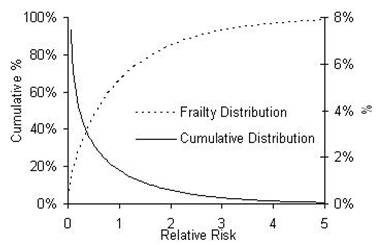
Results: For both HBV and HCV, IDUs are at greatest risk from infection in their first year of injecting (Forces of infection in new initiates 1999-2003: HBV = 0.1076 95% C.I: 0.0840-0.1327 HCV = 0.1608 95% C.I: 0.1314-0.1942) compared to experienced IDUs (Force of infection in experienced IDUs 1999-2003: HBV = 0.0353 95% C.I: 0.0198-0.0596, HCV = 0.0526 95% C.I: 0.0310-0.0863) although independently of this there is evidence of heterogeneity of risk behaviour with a small number of IDUs at increased risk of infection. No trends in the FOI over time were detected. There was only limited evidence of background HBV infection due to factors other than injecting.
Conclusion: The models highlight the need to increase interventions that target new initiates to injecting to reduce the transmission of blood-borne viruses. Although from the evidence here, identification of those individuals that engage in heightened at-risk behaviour may also help in planning effective interventions. The data and methods described here may provide a baseline for monitoring the success of public health interventions.
Figures
References
-
- Agency HP, Scotland HP, National Public Health Service for Wales. Ireland CDSCN, CRDHB. UASSG . Shooting Up; Infections among injecting drug users in the United Kingdom 2004, An update: October 2005. London, Health Protection Agency; 2005.
-
- Farrington CP. Modelling forces of infection for measles, mumps and rubella. Stat Med. 1990;9:953–967. - PubMed
-
- Noone A, Durante AJ, Brady AR, Majid F, Swan AV, Parry JV, Hart GJ, Connell JA, Perry KR, Joce RE, . HIV infection in injecting drug users attending centres in England and Wales, 1990-1991. AIDS. 1993;7:1501–1507. - PubMed
Publication types
MeSH terms
LinkOut - more resources
Full Text Sources
Medical
