


Heat stress reduces cerebral blood velocity and markedly impairs orthostatic tolerance in humans
- PMID: 16763078
- PMCID: PMC2442822
- DOI: 10.1152/ajpregu.00712.2005
Heat stress reduces cerebral blood velocity and markedly impairs orthostatic tolerance in humans
Abstract
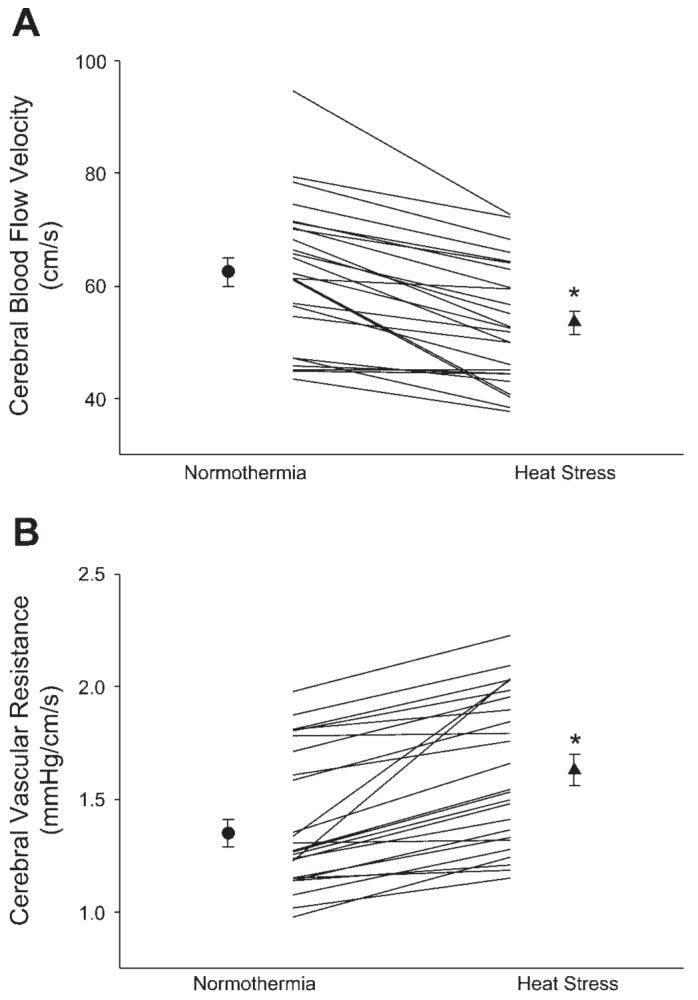
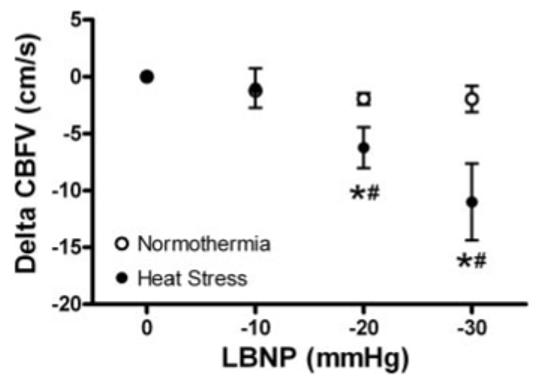
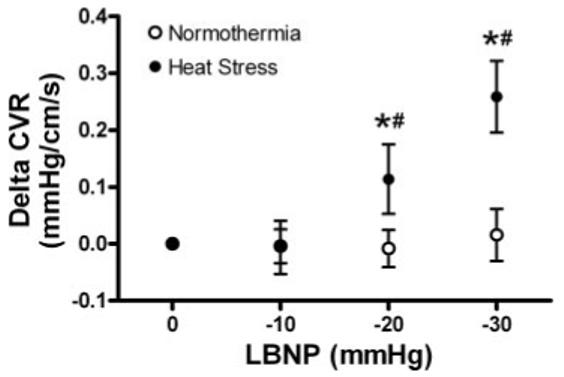
Orthostatic tolerance is reduced in the heat-stressed human. This study tested the following hypotheses: 1) whole body heat stress reduces cerebral blood velocity (CBV) and increases cerebral vascular resistance (CVR); and 2) reductions in CBV and increases in CVR in response to an orthostatic challenge will be greater while subjects are heat stressed. Fifteen subjects were instrumented for measurements of CBV (transcranial ultrasonography), mean arterial blood pressure (MAP), heart rate, and internal temperature. Whole body heating increased both internal temperature (36.4+/-0.1 to 37.3+/-0.1 degrees C) and heart rate (59+/-3 to 90+/-3 beats/min); P<0.001. Whole body heating also reduced CBV (62+/-3 to 53+/-2 cm/s) primarily via an elevation in CVR (1.35+/-0.06 to 1.63+/-0.07 mmHg.cm-1.s; P<0.001. A subset of subjects (n=8) were exposed to lower-body negative pressure (LBNP 10, 20, 30, 40 mmHg) in both normothermic and heat-stressed conditions. During normothermia, LBNP of 30 mmHg (highest level of LBNP achieved by the majority of subjects in both thermal conditions) did not significantly alter CBV, CVR, or MAP. During whole body heating, this LBNP decreased MAP (81+/-2 to 75+/-3 mmHg), decreased CBV (50+/-4 to 39+/-1 cm/s), and increased CVR (1.67+/-0.17 to 1.92+/-0.12 mmHg.cm-1.s); P<0.05. These data indicate that heat stress decreases CBV, and the reduction in CBV for a given orthostatic challenge is greater during heat stress. These outcomes reduce the reserve to buffer further decreases in cerebral perfusion before presyncope. Increases in CVR during whole body heating, coupled with even greater increases in CVR during orthostasis and heat stress, likely contribute to orthostatic intolerance.
Figures
References
-
- Allan JR, Crossley RJ. Effect of controlled elevation of body temperature on human tolerance to +G z acceleration. J Appl Physiol. 1972;33:418–420. - PubMed
-
- Bean WB, Eichna LW. Performance in relation to environmental temperature. Fed Proc. 1943;2:144–158.
-
- Blaber AP, Bondar RL, Moradshahi P, Serrador JM, Hughson RL. Inspiratory CO2 increases orthostatic tolerance during repeated tilt. Aviat Space Environ Med. 2001;72:985–991. - PubMed
-
- Cai Y, Holm S, Jenstrup M, Stromstad M, Eigtved A, Warberg J, Hojgaard L, Friberg L, Secher NH. Electrical admittance for filling of the heart during lower body negative pressure in humans. J Appl Physiol. 2000;89:1569–1576. - PubMed
-
- Crandall CG, Levine BD, Etzel RA. Effect of increasing central venous pressure during passive heating on skin blood flow. J Appl Physiol. 1999;86:605–610. - PubMed
Publication types
MeSH terms
Grants and funding
LinkOut - more resources
Full Text Sources
Medical
