


Fitness cost of LINE-1 (L1) activity in humans
- PMID: 16766655
- PMCID: PMC1480451
- DOI: 10.1073/pnas.0603334103
Fitness cost of LINE-1 (L1) activity in humans
Abstract
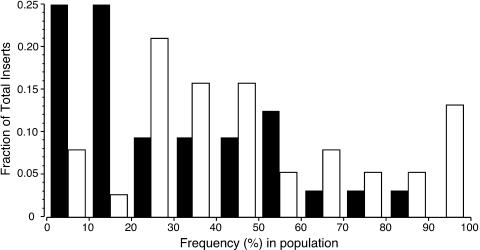
The self-replicating LINE-1 (L1) retrotransposon family is the dominant retrotransposon family in mammals and has generated 30-40% of their genomes. Active L1 families are present in modern mammals but the important question of whether these currently active families affect the genetic fitness of their hosts has not been addressed. This issue is of particular relevance to humans as Homo sapiens contains the active L1 Ta1 subfamily of the human specific Ta (L1Pa1) L1 family. Although DNA insertions generated by the Ta1 subfamily can cause genetic defects in current humans, these are relatively rare, and it is not known whether Ta1-generated inserts or any other property of Ta1 elements have been sufficiently deleterious to reduce the fitness of humans. Here we show that full-length (FL) Ta1 elements, but not the truncated Ta1 elements or SINE (Alu) insertions generated by Ta1 activity, were subject to negative selection. Thus, one or more properties unique to FL L1 elements constitute a genetic burden for modern humans. We also found that the FL Ta1 elements became more deleterious as the expansion of Ta1 has proceeded. Because this expansion is ongoing, the Ta1 subfamily almost certainly continues to decrease the fitness of modern humans.
Conflict of interest statement
Conflict of interest statement: No conflicts declared.
Figures
References
-
- International Human Genome Sorting Consortium. Nature. 2001;409:860–921. - PubMed
-
- Mouse Genome Sequence Consortium. Nature. 2002;420:520–562. - PubMed
-
- Boissinot S., Chevret P., Furano A. V. Mol. Biol. Evol. 2000;17:915–928. - PubMed
-
- Pasyukova E. G., Nuzhdin S. V., Morozova T. V., Mackay T. F. J. Hered. 2004;95:284–290. - PubMed
Publication types
MeSH terms
Grants and funding
LinkOut - more resources
Full Text Sources
