Comparative Study
. 2006 Apr;18(4):665-79.
doi: 10.1162/jocn.2006.18.4.665.

Syntactic and semantic modulation of neural activity during auditory sentence comprehension

Affiliations
Comparative Study

Syntactic and semantic modulation of neural activity during auditory sentence comprehension

Colin Humphries et al. J Cogn Neurosci. 2006 Apr.

Abstract

In previous functional neuroimaging studies, left anterior temporal and temporal-parietal areas responded more strongly to sentences than to randomly ordered lists of words. The smaller response for word lists could be explained by either (1) less activation of syntactic processes due to the absence of syntactic structure in the random word lists or (2) less activation of semantic processes resulting from failure to combine the content words into a global meaning. To test these two explanations, we conducted a functional magnetic resonance imaging study in which word order and combinatorial word meaning were independently manipulated during auditory comprehension. Subjects heard six different stimuli: normal sentences, semantically incongruent sentences in which content words were randomly replaced with other content words, pseudoword sentences, and versions of these three sentence types in which word order was randomized to remove syntactic structure. Effects of syntactic structure (greater activation to sentences than to word lists) were observed in the left anterior superior temporal sulcus and left angular gyrus. Semantic effects (greater activation to semantically congruent stimuli than either incongruent or pseudoword stimuli) were seen in widespread, bilateral temporal lobe areas and the angular gyrus. Of the two regions that responded to syntactic structure, the angular gyrus showed a greater response to semantic structure, suggesting that reduced activation for word lists in this area is related to a disruption in semantic processing. The anterior temporal lobe, on the other hand, was relatively insensitive to manipulations of semantic structure, suggesting that syntactic information plays a greater role in driving activation in this area.


Figures
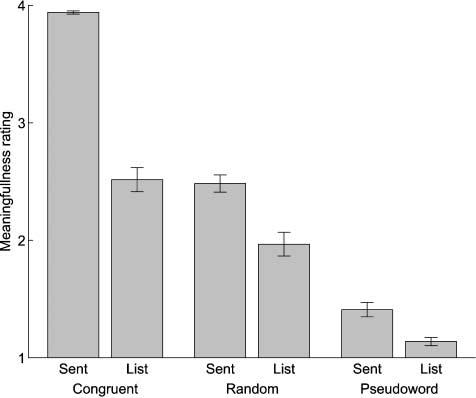
Figure 1
Figure 1
Behavioral results for stimulus meaningfulness judgments. Numbers are the mean response across subjects per condition and range from 1 (least meaningful) to 4 (most meaningful). Error bars in this and subsequent figures represent standard error of the mean across subjects.
Figure 2
Figure 2
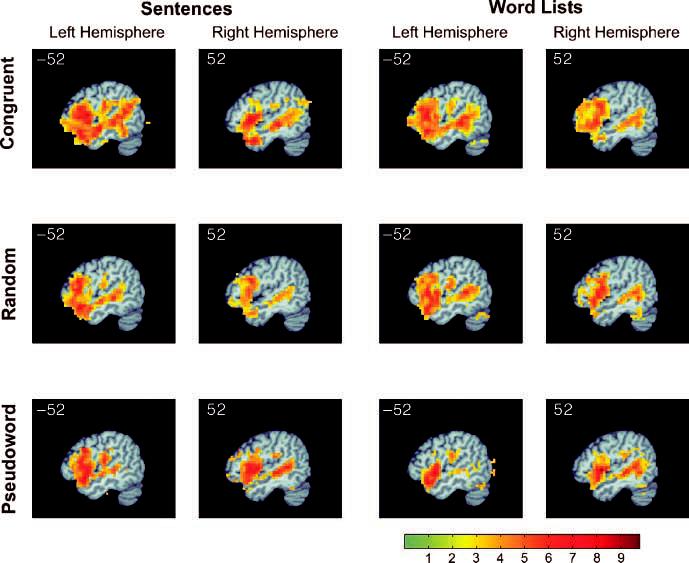
Functional activation map for each condition against resting baseline. The sagittal slice position in this and subsequent figures is shown in the upper left corner. The right hemisphere sagittal slice is at position 52 (MNI coordinates). The color scale represents t statistics from a random-effects analysis.
Figure 3
Figure 3
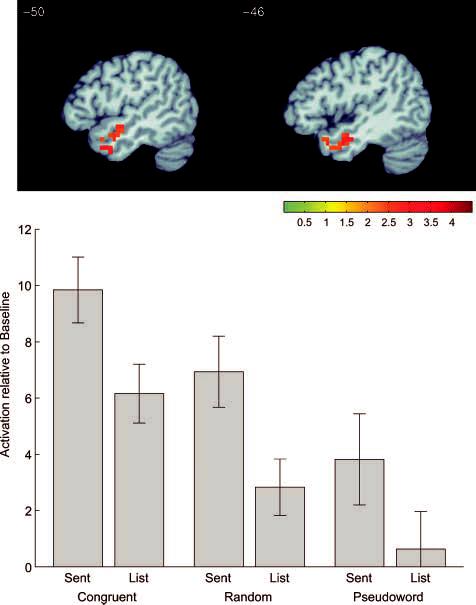
Functional activation map of the main effect of syntactic structure. Displayed voxels had greater activation levels for sentences over word lists collapsed across semantic conditions (congruent, random, pseudoword). The graph shows mean BOLD signal (in arbitrary units relative to the resting interstimulus interval) for each of the six conditions, averaged over the activated voxels and the subjects.
Figure 4
Figure 4
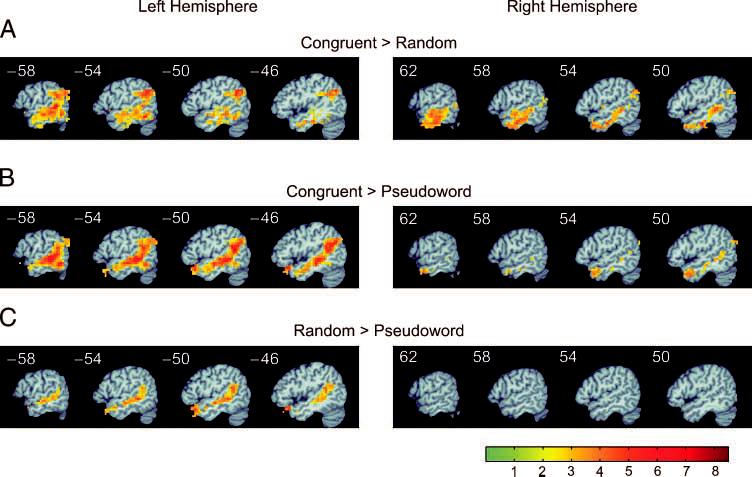
Temporal and parietal lobe functional activation maps of the main effects of semantic structure. (A) Left and right hemisphere activation for congruent over random (sentences and lists). (B) Activation for congruent over pseudoword (sentences and lists). (C) Activation for random over pseudoword (sentences and lists).
Figure 5
Figure 5
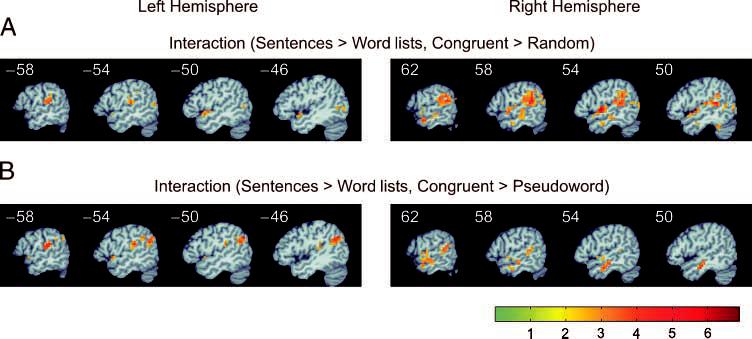
Temporal and parietal lobe functional activation map of the interaction between syntactic structure and semantics. (A) Left and right hemisphere activation for the interaction between sentences over lists and congruent over random. (B) Left and right hemisphere activation for the interaction between sentences over lists and congruent over pseudoword.
Figure 6
Figure 6
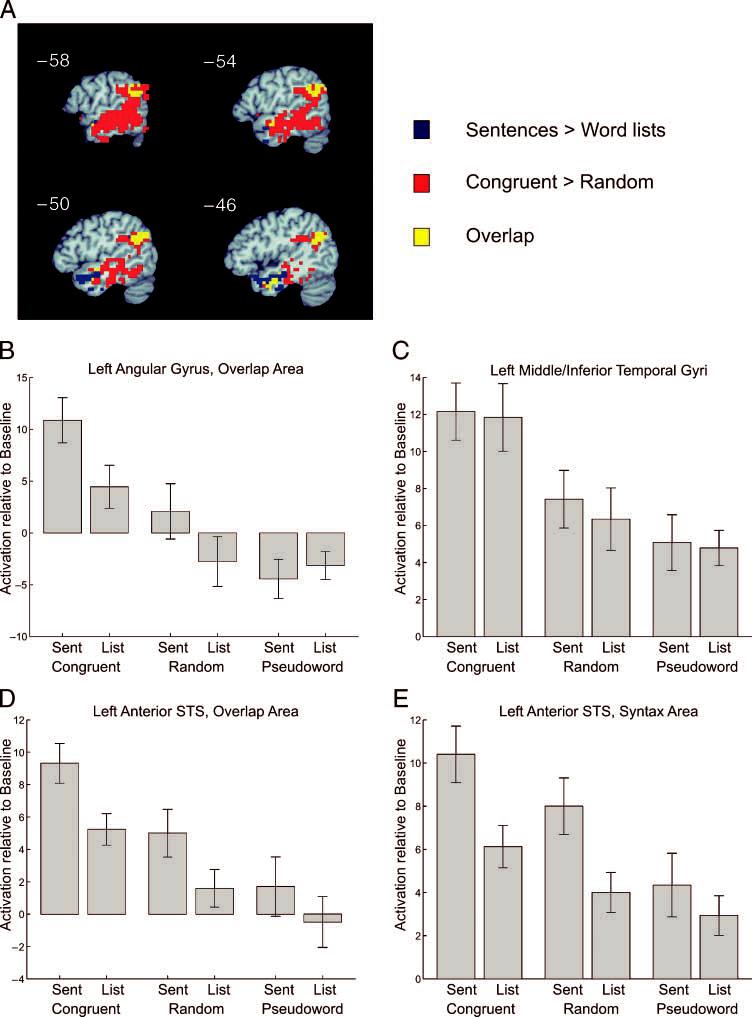
Temporal and parietal lobe effects of syntactic and semantic structure for semantically congruent and random word conditions. (A) Functional activation map of left-hemisphere areas showing an overlay of the effect of syntactic structure (sentences > word lists) in blue, the effect of semantic structure (congruent > random) in red, and overlap in yellow. (B) Plot of the mean activation levels for the voxels showing overlap between syntax and semantics (yellow) in the left angular gyrus. (C) Plot of mean activation levels for voxels showing activation for semantics (red) in the left middle temporal and inferior temporal gyri. (D) Plot of mean activation levels for voxels showing activation for both semantic and syntactic structure (yellow) in the left anterior temporal lobe. (E) Plot of mean activation levels for voxels showing activation only for syntactic structure (blue) in the left anterior temporal lobe.
Figure 7
Figure 7
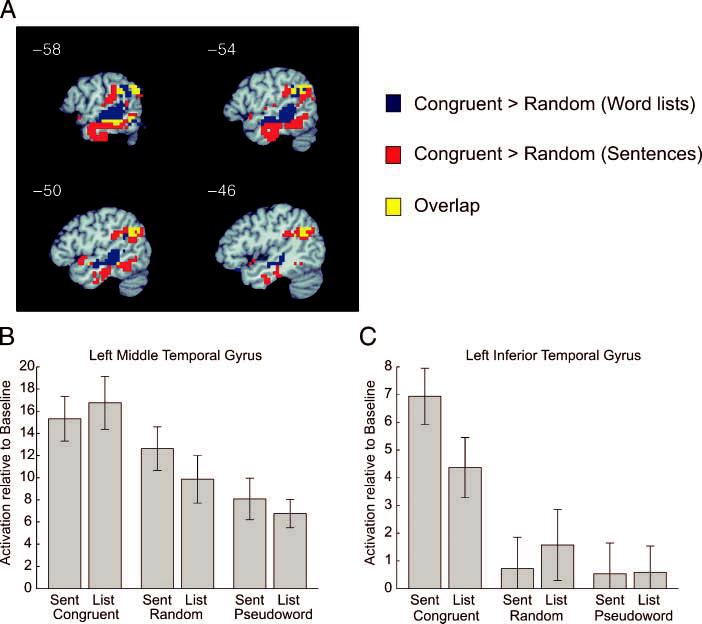
Effects of semantic structure, computed separately for sentences and word lists. (A) Functional activation map of left-hemisphere areas showing an overlay of the effect of semantics (congruent > random) for word lists in blue, the effect of semantics (congruent > random) for sentences in red, and overlap in yellow. (B) Plot of the mean activation levels for temporal lobe voxels showing a semantic effect for word lists (blue voxels) (C) Plot of mean activation levels for temporal lobe voxels showing a semantic effect for sentences (red voxels).

References

    1. Baayen RH, Piepenbrock R, Gulikers L. The CELEX lexical database. University of Pennsylvania, Linguistic Data Consortium; Philadelphia: 1995. (Version 2.5) [CD-ROM]
    1. Bavelier D, Corina D, Jezzard P, Padmanabhan S, Clark VP, Karni A, Prinster A, Braun A, Lalwani A, Rauschecker JP, Turner R, Neville H. Sentence reading: A functional MRI study at 4 tesla. Journal of Cognitive Neuroscience. 1997;9:664–686. - PubMed
    1. Berndt RS, Caramazza A. Syntactic aspects of aphasia. In: Sarno MT, editor. Acquired aphasia. Academic Press; New York: 1981. pp. 157–181.
    1. Binder JR, Frost JA, Hammeke TA, Bellgowan PS, Rao SM, Cox RW. Conceptual processing during the conscious resting state. A functional MRI study. Journal of Cognitive Neuroscience. 1999;11:80–95. - PubMed
    1. Binder JR, Frost JA, Hammeke TA, Bellgowan PSF, Springer JA, Kaufman JN, Possing ET. Human temporal lobe activation by speech and nonspeech sounds. Cerebral Cortex. 2000;10:512–528. - PubMed

Publication types