. 2006 Jun 12:6:53.
doi: 10.1186/1471-2180-6-53.

Persisters: a distinct physiological state of E. coli

Affiliations

Persisters: a distinct physiological state of E. coli

Devang Shah et al. BMC Microbiol. .

Abstract

Background: Bacterial populations contain persisters, phenotypic variants that constitute approximately 1% of cells in stationary phase and biofilm cultures. Multidrug tolerance of persisters is largely responsible for the inability of antibiotics to completely eradicate infections. Recent progress in understanding persisters is encouraging, but the main obstacle in understanding their nature was our inability to isolate these elusive cells from a wild-type population since their discovery in 1944.

Results: We hypothesized that persisters are dormant cells with a low level of translation, and used this to physically sort dim E. coli cells which do not contain sufficient amounts of unstable GFP expressed from a promoter whose activity depends on the growth rate. The dim cells were tolerant to antibiotics and exhibited a gene expression profile distinctly different from those observed for cells in exponential or stationary phases. Genes coding for toxin-antitoxin module proteins were expressed in persisters and are likely contributors to this condition.

Conclusion: We report a method for persister isolation and conclude that these cells represent a distinct state of bacterial physiology.


Figures
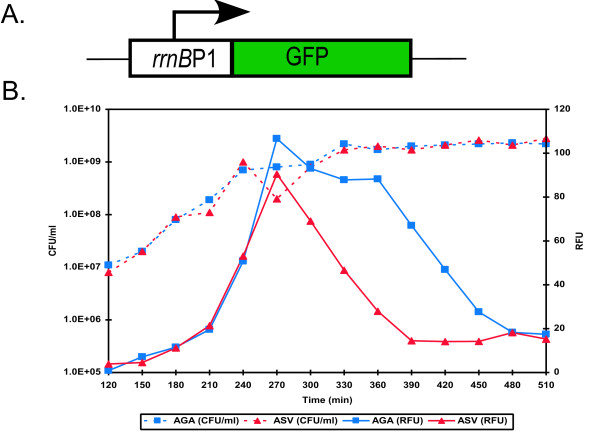
Figure 1
Figure 1
Degradable GFP expression from a ribosomal promoter in a growing culture of E. coli. (A) Graphical representation of the reporter. An unstable variant of GFP was placed downstream of a ribosomal promoter, rrnBP1. (B) Stationary phase cultures of E. coli ASV and AGA, each containing a different variant of unstable GFP, were diluted (1:1000) in fresh media and cultured with aeration at 37°C. At designated timepoints samples were removed and assayed for cell counts (CFU/ml) and fluorescence (RFU, arbitrary units).
Figure 2
Figure 2
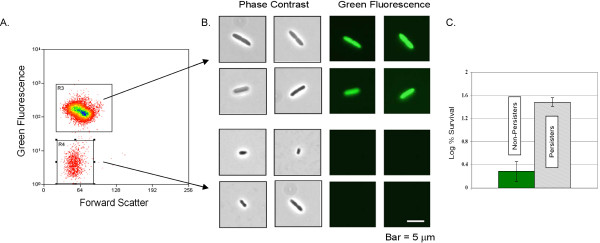
Isolation of persister cells from an exponentially growing culture. E. coli ASV cells containing this reporter cassette were grown in LB medium to mid-exponential phase (~1 × 10⁸ cells/ml) at 37°C with aeration and sorted using a high speed cell-sorter equipped with a standard GFP filter set. (A) Two populations were detected using forward light-scatter, one that fluoresced brightly (R3), and another that did not (R4). (B) The sorted populations were visualized by epifluorescent microscopy (bar, 5 μm). (C) Cells were sorted as described in (A-B). Once sorted both populations were treated with ofloxacin (5 μg/ml) for three hours, diluted and spotted onto LB agar plates for colony counts.
Figure 3
Figure 3
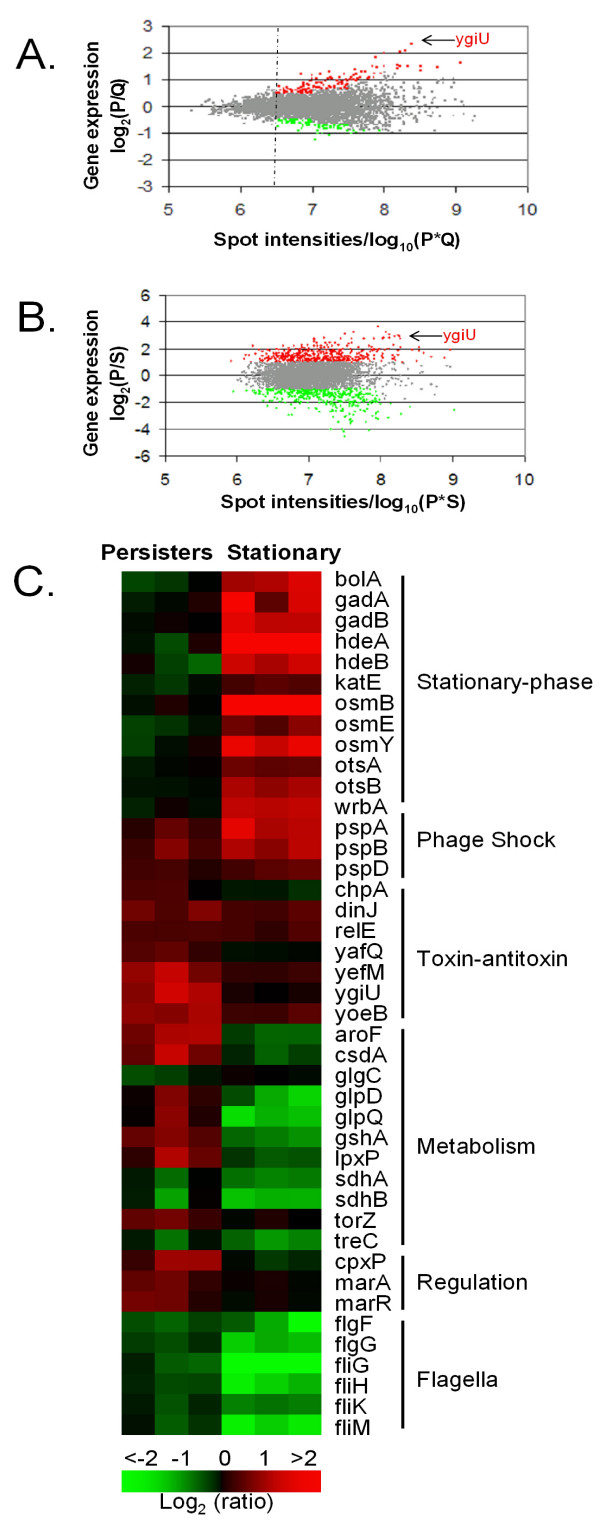
Gene expression profile of FACS isolated E. coli persisters. E. coli ASV Cells were sorted as described in legend, Fig. 2. cDNA was prepared from the total RNA and hybridized to spotted E. coli DNA microarrays [16]. Data shown are the averages of three independent biological replicates. Genes up-regulated in persisters are indicated as red and those genes which are repressed as green. The differential expressed genes are identified according to the procedures described in Materials and Methods. (A) Gene expression and spot intensities of sorted persisters (P) compared to sorted non-persisters (Q) from an exponential growth phase cell culture. (B) Gene expression and spot intensities of sorted persisters (P) compared to stationary phase (S) cells. (C) Heat map comparison of representative genes differentially expressed in persisters (P) or stationary (S) phase cells as compared to non-persisters (Q) and exponential growth phase cells (L), respectively. Genes are considered differentially expressed if the local intensity-dependent Z-score is greater than 1.96 or less than -1.96 and the expression log2 (ratio) is more than 1 or less than -1. The gene names are shown on the right, together with the functional groups.
Figure 4
Figure 4
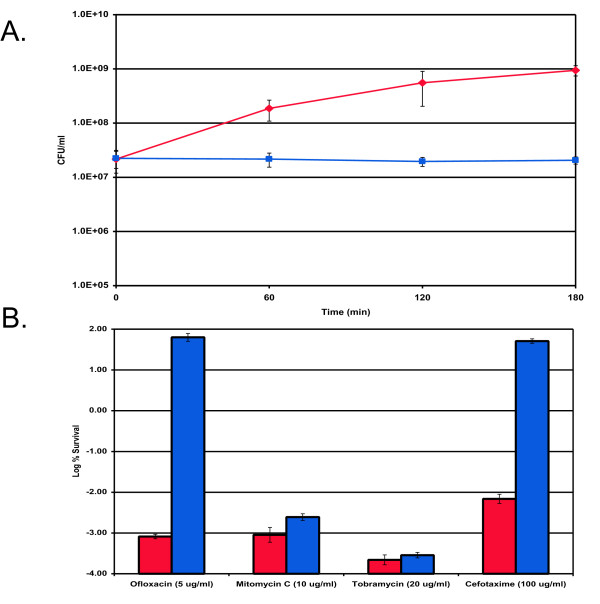
Effects of ygiU overexpression on persister formation. E. coli MG1655 cells were grown in LB medium to mid-exponential phase (~5 × 10⁷ cells/ml) at 37°C with aeration. (A) ygiU expression was induced (squares) from pTOX at T = 0 by the addition of 1 mM arabinose, and MG1655 with a blank vector (pBAD33) served as the control (diamonds). (B) Cells were cultured, and ygiU expression was induced as described in (A). After 2 h of ygiU induction, samples were removed and treated with either cefotaxime (100 μg/ml), mitomycin C (10 μg/ml), ofloxacin (5 μg/ml), or tobramycin (20 μg/ml) for 3 h at 37°C with aeration. The control (MG1655/pBAD) (red bars) was challenged at a cell density similar to that of the ygiU induced cells (blue bars).
Figure 5
Figure 5
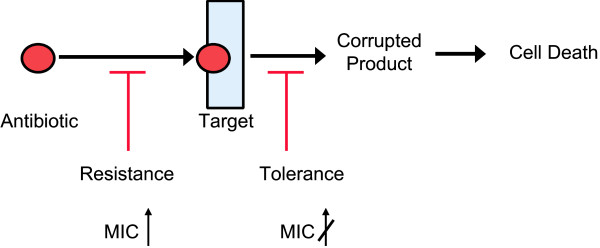
Multidrug resistance vs. Multidrug tolerance. Antibiotics normally kill cells by corrupting a particular target or function, ultimately leading to cell death. Resistance mechanisms function by preventing an antibiotic from binding to its target. This allows cells to grow in the presence of an elevated concentration of antibiotic, thereby increasing the MIC. It is proposed that the mechanism of tolerance is based on the non-lethal inhibition of antibiotic targets by specific MDT proteins. If this is the case, blocking of essential targets of antibiotics will produce a partially dormant, multidrug tolerant cell without increasing the MIC.

References

    1. Lewis K. Riddle of biofilm resistance. Antimicrob Agents Chemother. 2001;45:999–1007. doi: 10.1128/AAC.45.4.999-1007.2001. - DOI - PMC - PubMed
    1. Keren I, Kaldalu N, Spoering A, Wang Y, Lewis K. Persister cells and tolerance to antimicrobials. FEMS Microbiol Lett. 2004;230:13–18. doi: 10.1016/S0378-1097(03)00856-5. - DOI - PubMed
    1. Wiuff C, Zappala RM, Regoes RR, Garner KN, Baquero F, Levin BR. Phenotypic tolerance: antibiotic enrichment of noninherited resistance in bacterial populations. Antimicrob Agents Chemother. 2005;49:1483–1494. doi: 10.1128/AAC.49.4.1483-1494.2005. - DOI - PMC - PubMed
    1. Bigger JW. Treatment of staphylococcal infections with penicillin. Lancet. 1944;ii:497–500. doi: 10.1016/S0140-6736(00)74210-3. - DOI
    1. Moyed HS, Bertrand KP. hipA, a newly recognized gene of Escherichia coli K-12 that affects frequency of persistence after inhibition of murein synthesis. J Bacteriol. 1983;155:768–775. - PMC - PubMed

Publication types

MeSH terms

LinkOut - more resources