


From components to regulatory motifs in signalling networks
- PMID: 16769680
- PMCID: PMC3035204
- DOI: 10.1093/bfgp/ell004
From components to regulatory motifs in signalling networks
Abstract
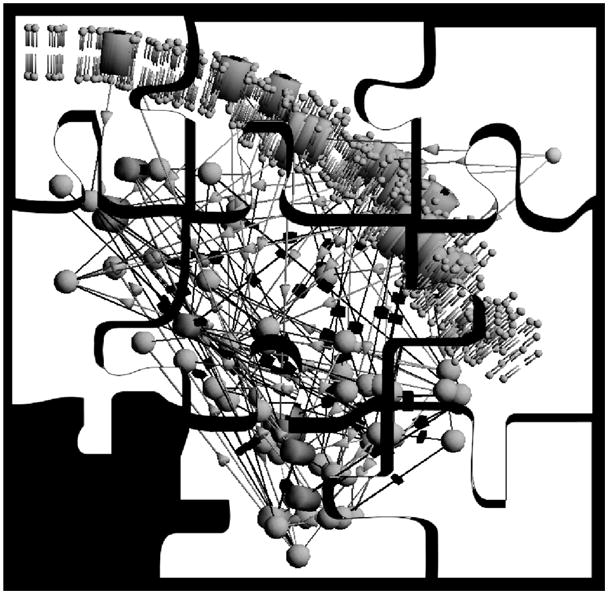
The developments in biochemistry and molecular biology over the past 30 years have produced an impressive parts list of cellular components. It has become increasingly clear that we need to understand how components come together to form systems. One area where this approach has been growing is cell signalling research. Here, instead of focusing on individual or small groups of signalling proteins, researchers are now using a more holistic perspective. This approach attempts to view how many components are working together in concert to process information and to orchestrate cellular phenotypic changes. Additionally, the advancements in experimental techniques to measure and visualize many cellular components at once gradually grow in diversity and accuracy. The multivariate data, produced by experiments, introduce new and exciting challenges for computational biologists, who develop models of cellular systems made up of interacting cellular components. The integration of high-throughput experimental results and information from legacy literature is expected to produce computational models that would rapidly enhance our understanding of the detail workings of mammalian cells.
Figures

References
-
- Zhu H, Snyder M. “Omic” approaches for unraveling signalling networks. Curr Opin Cell Biol. 2002;14:173–9. - PubMed
-
- Kitano H. Computational systems biology. Nature. 2002;420:206–10. - PubMed
-
- Ideker T, Galitski T, Hood L. A new approach to decoding life: systems biology. Annu Rev Genomics Hum Genet. 2001;2:343–72. - PubMed
-
- Eiden LE. A two-way bioinformatic street. Science. 2004;306:1437. - PubMed
Publication types
MeSH terms
Grants and funding
LinkOut - more resources
Full Text Sources
Miscellaneous