Sleep-disordered breathing after stroke: a randomised controlled trial of continuous positive airway pressure
- PMID: 16772358
- PMCID: PMC2077531
- DOI: 10.1136/jnnp.2005.086686
Sleep-disordered breathing after stroke: a randomised controlled trial of continuous positive airway pressure
Abstract
Background: Sleep-disordered breathing (SDB) is common after stroke, but it is unclear whether it should be treated.
Objective: To conduct a randomised controlled trial of continuous positive airway pressure (CPAP) after stroke.
Methods: Patients with stroke with > or = 30 apnoeas and hypopnoeas per hour ((A+H)/h) with predominant obstructive sleep apnoea or hypopnoea were randomised to either CPAP treatment or conservative treatment for 8 weeks. Outcomes were measured blind to treatment allocation at 8 weeks and 6 months after the stroke. The primary outcome was physical function on the Nottingham Extended Activities of Daily Living Scale.
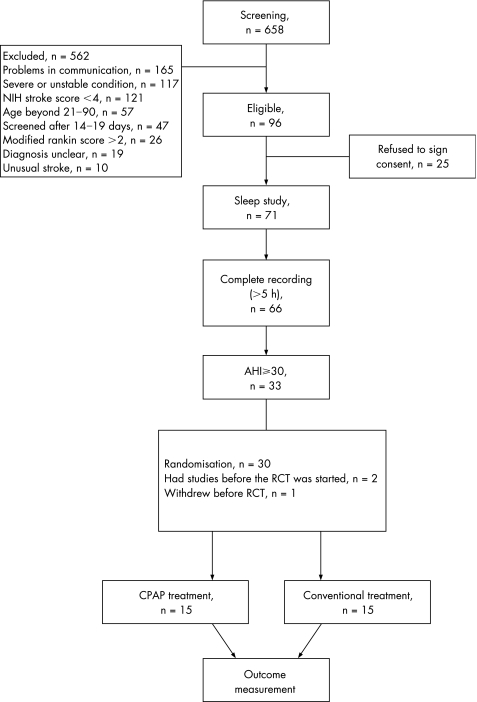
Results: Of 658 patients with stroke screened, only 71 (10.7%) were eligible and consented to a sleep study 14-19 days after stroke. 66 patients completed the sleep study (21 women; mean age 72 years), 33 (50%) had > or = 30 (A+H)/h that were predominantly obstructive. 15 were randomised to CPAP treatment and 15 to conventional treatment. Despite intensive efforts, objective use of CPAP was poor, averaging 1.4 h a night. CPAP treatment resulted in no significant improvements (p>0.1) in the primary outcome or in neurological function or sleepiness, and in poorer health status on some measures.
Conclusions: This trial showed no benefit from CPAP treatment, the relevance of the observed detrimental effects is questionable. Even in our highly selected patients with stroke, use of CPAP was poor. At present, CPAP treatment should be advocated for patients with stroke only if they have symptoms of SDB.
Conflict of interest statement
Competing interests: NJD is a medical adviser to ResMed Ltd, a company manufacturing CPAP machines.
References
-
- Bassetti C, Aldrich M S, Chervin R D.et al Sleep apnea in patients with transient ischemic attack and stroke: a prospective study of 59 patients. Neurology 1996471167–1173. - PubMed
-
- Bassetti C, Aldrich M S, Quint D. Sleep‐disordered breathing in patients with acute supra‐ and infratentorial strokes. A prospective study of 39 patients. Stroke 1997281765–1772. - PubMed
-
- Bassetti C, Aldrich M S. Sleep apnea in acute cerebrovascular diseases: final report on 128 patients. Sleep 199922217–223. - PubMed
-
- Parra O, Arboix A, Bechich S.et al Time course of sleep‐related breathing disorders in first‐ever stroke or transient ischemic attack. Am J Respir Crit Care Med 2000161375–380. - PubMed
Publication types
MeSH terms
LinkOut - more resources
Full Text Sources
Medical