. 2006 Jun 13;34(10):3189-99.
doi: 10.1093/nar/gkl419. Print 2006.

The nucleolar protein Esf2 interacts directly with the DExD/H box RNA helicase, Dbp8, to stimulate ATP hydrolysis

Affiliations

The nucleolar protein Esf2 interacts directly with the DExD/H box RNA helicase, Dbp8, to stimulate ATP hydrolysis

Sander Granneman et al. Nucleic Acids Res. .

Abstract

While 18 putative RNA helicases are involved in ribosome biogenesis in Saccharomyces cerevisiae, their enzymatic properties have remained largely biochemically uncharacterized. To better understand their function, we examined the enzymatic properties of Dpb8, a DExD/H box protein previously shown to be required for the synthesis of the 18S rRNA. As expected for an RNA helicase, we demonstrate that recombinant Dbp8 has ATPase activity in vitro, and that this activity is dependent on an intact ATPase domain. Strikingly, we identify Esf2, a nucleolar putative RNA binding protein, as a binding partner for Dbp8, and show that it enhances Dbp8 ATPase activity by decreasing the K(M) for ATP. Thus, we have uncovered Esf2 as the first example of a protein co-factor that has a stimulatory effect on a nucleolar RNA helicase. We show that Esf2 can bind to pre-rRNAs and speculate that it may function to bring Dbp8 to the pre-rRNA, thereby both regulating its enzymatic activity and guiding Dbp8 to its site of action.


Figures
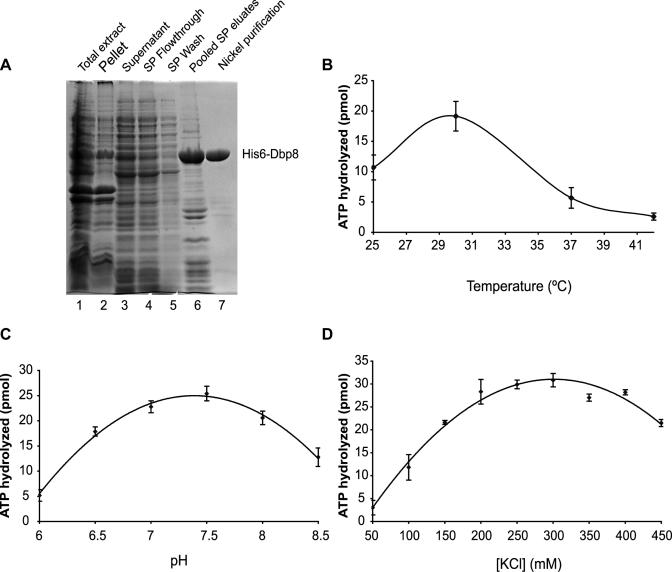
Figure 1
Figure 1
Purified recombinant Dbp8 has ATPase activity. (A) Purification of His6-Dbp8. Extracts prepared from E.coli expressing His6-Dbp8 (lane 3) was fractionated on a SP Sepharose cation exchange column. The column was extensively washed (lane 5) and proteins were eluted by applying a linear salt gradient. Fractions containing His6-Dbp8 were pooled (lane 6) and His6-Dbp8 was purified from these fractions to near homogeneity using Ni-NTA beads (lane 7). (B–D) Optimizing the temperature, pH and salt concentration for Dbp8 ATPase activity. ATP hydrolysis assays were performed at various temperatures (B); 25, 30, 37 and 42°C), different pH (C) and varying potassium chloride concentration (D) with 10 µM ATP. ATP conversion (Y-axis) was calculated after 30 min by quantifying the phosphate release. Plotted are the averages and standard errors that were derived from three independent experiments.
Figure 2
Figure 2
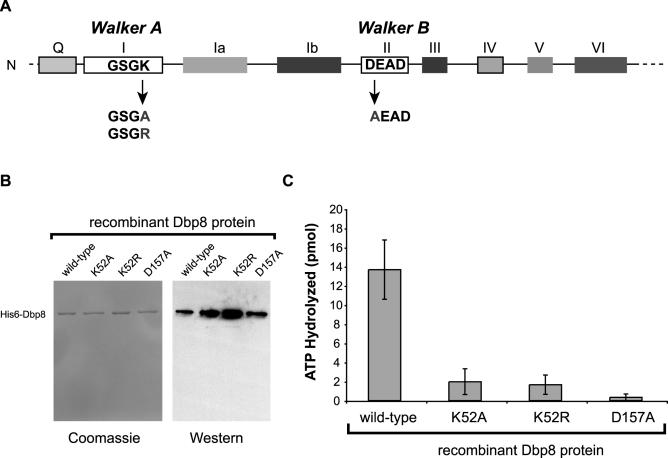
Dbp8 motif I and II mutants are defective in ATP hydrolysis in vitro. (A) Schematic representation of conserved motifs in Dbp8. The mutations that were introduced in motifs I and II are indicated by arrows. (B) SDS–PAGE analysis of purified His6-Dbp8 motif I and II mutants. Two µg of each purified protein was resolved by SDS–PAGE. Proteins were either stained with Coomassie brilliant blue (left panel) or subjected to western blot analysis (right panel) using anti-His6 antibodies. (C) Motif I and II mutants are ATPase defective. ATP hydrolysis assays were performed with 10 µM ATP, in the presence of 300 mM KCl and using 10 pmols of Dbp8 wild-type or motif I and II mutant proteins (X-axis). Mixtures were incubated for 30 min at 30°C and ATP conversion (Y-axis) was calculated after 30 min by quantifying the phosphate release. Plotted are the averages and standard errors that were derived from three independent experiments
Figure 3
Figure 3
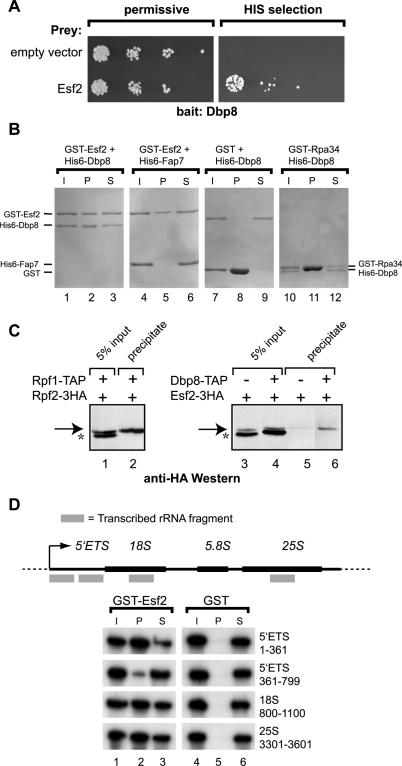
Dbp8 directly interacts with the RNA binding protein Esf2 in vivo and in vitro. (A) Dbp8 interacts with Esf2 in a yeast 2-hybrid assay. The yeast 2-hybrid host strain carrying the Esf2 bait vector and either Dbp8 prey vector or empty prey vector were serial diluted and tested for growth on permissive (+His) or selective media (−His selection). (B) Recombinant Dbp8 directly binds GST-Esf2 in GST pull-down assays. His6-Dbp8 was mixed with equimolar amounts of GST, GST-Esf2 or GST-Rpa34 and incubated on ice for 1 h. As an additional negative control, a GST pull-down assay was performed with GST-Esf2 and His6-Fap7 (24). GST-fusion proteins were precipitated using glutathione–Sepharose beads and bound proteins (‘P’; lanes 2, 5, 8 and 11) were resolved by SDS–PAGE and stained with Coomassie brilliant blue. Ten percent of the input material (‘I’, lanes 1, 4, 7 and 10) and 10% of the supernatants (‘S’, lanes 3, 6, 9 and 12) was also analyzed. (C) Esf2 associates with Dbp8 in vivo. Strains expressing various TAP and/or 3HA-tagged proteins (indicated on top by + or − signs) were grown in YP media to exponential phase. Extracts prepared from these strains were incubated with IgG beads for 1 h at 4°C. Immunoprecipitated proteins were separated by 10% SDS–PAGE and 3HA-tagged proteins were detected by western blot using mouse monoclonal anti-HA antibodies (12CA5; lanes 2, 5 and 6). As a positive control, immunoprecipitations were performed with IgG beads using a strain in which two pre-66S associated proteins were tagged (Rpf1-TAP and Rpf2-3HA; lane 2). As a negative control, a strain was used in which only Esf2 was 3HA-tagged (lane 5). Five percent of the amount of extract used for the immunoprecipitation was also analyzed (lanes 1, 3 and 4). The asterisk indicates a yeast protein that is non-specifically recognized by the anti-HA antibody. (D) GST-Esf2 directly binds RNA in vitro. GST-Esf2 or GST alone were incubated with various radiolabeled in vitro transcribed rRNA fragments that contained 5′ETS, 18S or 25S sequences (as illustrated). Complexes were precipitated using glutathione–Sepharose beads and bound RNAs were resolved by 8% denaturing PAGE and visualized by autoradiography (lanes 2 and 5). Ten percent of the input material (‘I’, lanes 1 and 4) and 10% of the supernatants (‘S’, lanes 3 and 6) were also analyzed.
Figure 4
Figure 4
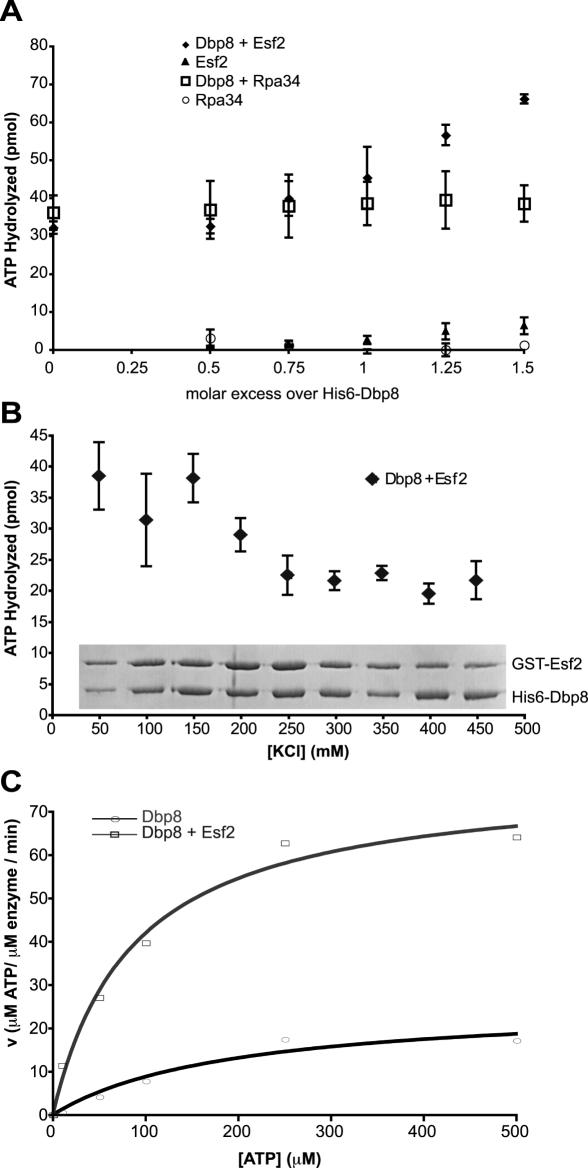
(A) Esf2 stimulates Dbp8 ATP hydrolysis activity in vitro. A total of 10 pmol of Dbp8 was incubated with various amounts of GST-Esf2 or GST-Rpa34 (0–1.5 M excess over Dbp8, X-axis) in buffers containing 200 mM KCl, for 25 min on ice to allow complex formation to occur. ATP was then added to the reaction and ATP hydrolysis (Y-axis) was measured after 30 min of incubation at 30°C. Plotted are the averages and standard errors that were derived from three independent experiments. (B) Esf2-mediated stimulation of Dbp8 ATPase activity is optimal at lower potassium chloride concentrations. ATP hydrolysis assays were performed using 5 pmol of recombinant Dbp8 and GST-Esf2 and varying salt concentrations (50–450 mM KCl). ATP hydrolysis was measured after 30 min of incubation at 30°C. Plotted are the averages and standard errors that were derived from three independent experiments. To determine if under these conditions GST-Esf2 and Dbp8 still form a complex, 300 pmols of each protein were incubated under the same conditions used for the ATP hydrolysis assay. Protein complexes were precipitated using Ni-NTA beads, resolved by SDS–PAGE and stained with Coomassie brilliant blue [Figure embedded in the graph shown in (B)]. (C) Dbp8 binding to Esf2 increases Dbp8 affinity for ATP and increases the ATP turnover rate. ATP hydrolysis assays were performed using 5 pmols of Dbp8 in the presence or absence of equimolar amounts of Esf2 in 50 mM KCl and various ATP concentrations. The initial velocities, plotted on the Y-axis, were determined by measuring the amount of ATP hydrolysis (µM) during a 3 min period (data not shown) in the presence of various [ATP] (10, 50, 100, 250 and 500 µM). The data were fitted to the Michaelis–Menten equation from which the KM and kcat were determined. Plotted are the averages derived from two independent experiments.
Figure 5
Figure 5
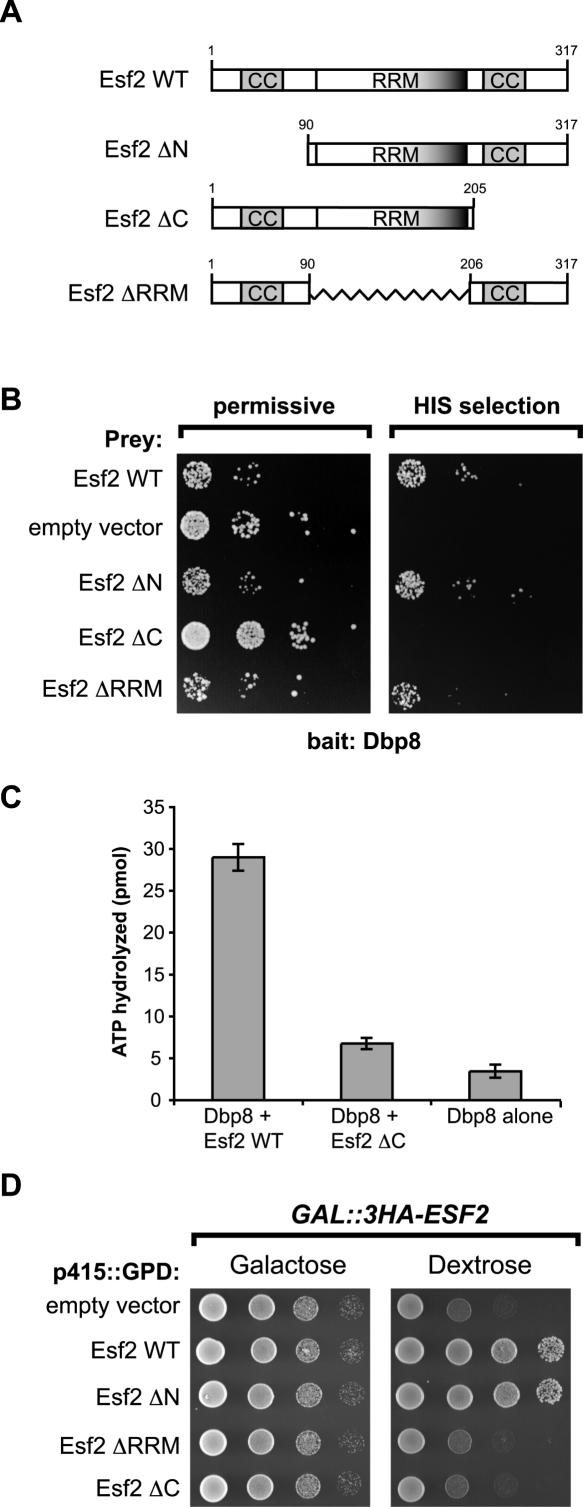
The essential C-terminal domain of Esf2 is required for binding to Dbp8 and stimulating its ATPase activity in vitro. (A) Schematic representation of the Esf2 wild-type (WT) and deletion mutants (ΔN, ΔC and ΔRRM) that were tested in the yeast two-hybrid screen for their association with Dbp8. The predicted RRM motif and coiled-coil domains are represented as boxes. The amino acid positions relevant to the deletions made are indicated. (B) The C-terminal domain of Esf2 is required for Dbp8 interaction in the yeast 2-hybrid assay. The yeast 2-hybrid host strain carrying either the Esf2 wild-type or Esf2 deletion mutants (bait) in combination with either Dbp8 (prey) or empty prey vector were serial diluted and tested for growth on permissive (+His) or selective media (His selection). (C) The C-terminal domain of Esf2 is required for stimulation of Dbp8 ATPase activity in vitro. ATP hydrolysis experiments were performed with 10 µM ATP, 5 pmol of Dbp8 and 50 mM KCl, in the presence or absence (Dbp8 alone) of 5 pmols of GST-Esf2 wild-type (WT) or GST-Esf2 ΔC. ATP hydrolysis (plotted on the Y-axis) was measured after 30 min incubation at 30°C. Graphed are the averages and standard errors derived from three independent experiments. (D) The C-terminal domain of Esf2 is essential for function in vivo. Serial dilutions (10-fold) of GAL::3HA-ESF2 strains carrying the empty vector or, p415GPD-ESF2 wild-type and mutant alleles (ΔN, ΔRRM and ΔC) were grown in synthetic galactose media (SG/R-LEU) and spotted on either galactose containing plates (left panel; SG/R-LEU) or galactose containing plates (right panel; SD-LEU).
Figure 6
Figure 6
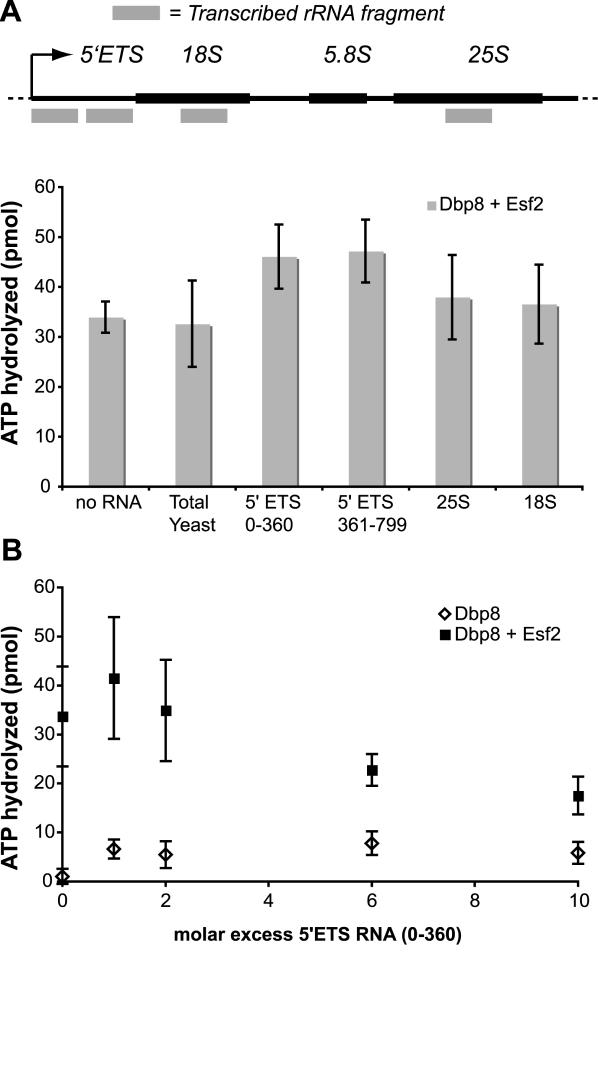
Pre-rRNA fragments stimulate Dbp8 ATPase activity in vitro. (A) In vitro transcribed fragments of the 5′ETS rRNA stimulate Dbp8 ATP hydrolysis in the presence of Esf2. ATP hydrolysis assays were carried out with 10 µM ATP, 10 pmol of Dbp8 and 10 pmol of Esf2, 1 µg/µl of total yeast RNA, 0.8 µM of ribosomal RNAs (schematically outlined on top of the graph) and 50 mM KCl. Samples were incubated at 30°C for 30 min. Plotted are the averages and standard errors derived from three independent experiments. (B) In vitro transcribed 5′ETS rRNA fragments stimulate Dbp8 ATP hydrolysis in the absence of Esf2. ATP hydrolysis experiments were performed with 10 µM ATP, 5 pmol of Dbp8 and 50 mM KCl, in the presence or absence of equimolar amounts of Esf2 and various amounts of 5′ETS rRNA (0–360 fragment; plotted on the X-axis). ATP hydrolysis (plotted on the Y-axis) was measured after 30 min incubation at 30°C. Plotted are the averages and standard errors derived from three independent experiments.

References

    1. Jankowsky E., Gross C.H., Shuman S., Pyle A.M. The DExH protein NPH-II is a processive and directional motor for unwinding RNA. Nature. 2000;403:447–451. - PubMed
    1. Jankowsky E., Gross C.H., Shuman S., Pyle A.M. Active disruption of an RNA-protein interaction by a DExH/D RNA helicase. Science. 2001;291:121–125. - PubMed
    1. Yang Q., Jankowsky E. ATP- and ADP-dependent modulation of RNA unwinding and strand annealing activities by the DEAD-box protein DED1. Biochemistry. 2005;44:13591–13601. - PubMed
    1. Fairman M.E., Maroney P.A., Wang W., Bowers H.A., Gollnick P., Nilsen T.W., Jankowsky E. Protein displacement by DExH/D ‘RNA helicases’ without duplex unwinding. Science. 2004;304:730–734. - PubMed
    1. Rocak S., Linder P. DEAD-box proteins: the driving forces behind RNA metabolism. Nature Rev. Mol. Cell. Biol. 2004;5:232–241. - PubMed

Publication types

MeSH terms