


Bile acid interactions with cholangiocytes
- PMID: 16773712
- PMCID: PMC4087571
- DOI: 10.3748/wjg.v12.i22.3553
Bile acid interactions with cholangiocytes
Abstract
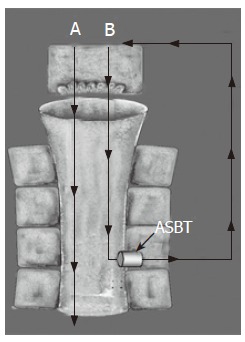
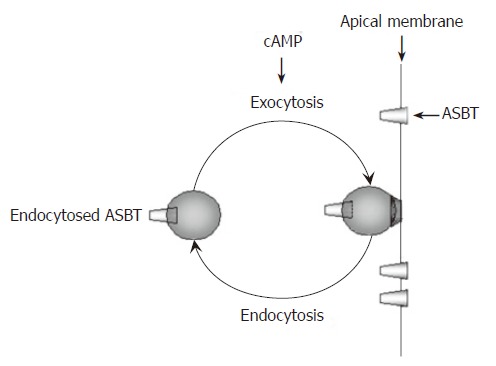
Cholangiocytes are exposed to high concentrations of bile acids at their apical membrane. A selective transporter for bile acids, the Apical Sodium Bile Acid Cotransporter (ASBT) (also referred to as Ibat; gene name Slc10a2) is localized on the cholangiocyte apical membrane. On the basolateral membrane, four transport systems have been identified (t-ASBT, multidrug resistance (MDR)3, an unidentified anion exchanger system and organic solute transporter (Ost) heteromeric transporter, Ostalpha-Ostbeta. Together, these transporters unidirectionally move bile acids from ductal bile to the circulation. Bile acids absorbed by cholangiocytes recycle via the peribiliary plexus back to hepatocytes for re-secretion into bile. This recycling of bile acids between hepatocytes and cholangiocytes is referred to as the cholehepatic shunt pathway. Recent studies suggest that the cholehepatic shunt pathway may contribute in overall hepatobiliary transport of bile acids and to the adaptation to chronic cholestasis due to extrahepatic obstruction. ASBT is acutely regulated by an adenosine 3', 5'-monophosphate (cAMP)-dependent translocation to the apical membrane and by phosphorylation-dependent ubiquitination and proteasome degradation. ASBT is chronically regulated by changes in gene expression in response to biliary bile acid concentration and inflammatory cytokines. Another potential function of cholangiocyte ASBT is to allow cholangiocytes to sample biliary bile acids in order to activate intracellular signaling pathways. Bile acids trigger changes in intracellular calcium, protein kinase C (PKC), phosphoinositide 3-kinase (PI3K), mitogen-activated protein (MAP) kinase and extracellular signal-regulated protein kinase (ERK) intracellular signals. Bile acids significantly alter cholangiocyte secretion, proliferation and survival. Different bile acids have differential effects on cholangiocyte intracellular signals, and in some instances trigger opposing effects on cholangiocyte secretion, proliferation and survival. Based upon these concepts and observations, the cholangiocyte has been proposed to be the principle target cell for bile acids in the liver.
Figures
References
-
- Strange RC. Hepatic bile flow. Physiol Rev. 1984;64:1055–1102. - PubMed
-
- Kanai S, Kitani K, Sato Y. The nature of choleresis induced by deoxycholate and its conjugates in the rabbit. Jpn J Physiol. 1989;39:907–918. - PubMed
-
- Hofmann AF. Current concepts of biliary secretion. Dig Dis Sci. 1989;34:16S–20S. - PubMed
-
- Buscher HP, Miltenberger C, MacNelly S, Gerok W. The histoautoradiographic localization of taurocholate in rat liver after bile duct ligation. Evidence for ongoing secretion and reabsorption processes. J Hepatol. 1989;8:181–191. - PubMed
-
- Alpini G, Glaser SS, Rodgers R, Phinizy JL, Robertson WE, Lasater J, Caligiuri A, Tretjak Z, LeSage GD. Functional expression of the apical Na+-dependent bile acid transporter in large but not small rat cholangiocytes. Gastroenterology. 1997;113:1734–1740. - PubMed
Publication types
MeSH terms
Substances
Grants and funding
LinkOut - more resources
Full Text Sources
Other Literature Sources
Miscellaneous
