. 2006 Sep;318(3):1330-42.
doi: 10.1124/jpet.106.105213. Epub 2006 Jun 14.

Urinary metabolite profiling reveals CYP1A2-mediated metabolism of NSC686288 (aminoflavone)

Affiliations

Urinary metabolite profiling reveals CYP1A2-mediated metabolism of NSC686288 (aminoflavone)

Chi Chen et al. J Pharmacol Exp Ther. 2006 Sep.

Abstract

NSC686288 [aminoflavone (AF)], a candidate chemotherapeutic agent, possesses a unique antiproliferative profile against tumor cells. Metabolic bioactivation of AF by drug-metabolizing enzymes, especially CYP1A monooxygenases, has been implicated as an underlying mechanism for its selective cytotoxicity in several cell culture-based studies. However, in vivo metabolism of AF has not been investigated in detail. In this study, the structural identities of 13 AF metabolites (12 of which are novel) in mouse urine or from microsomal incubations, including three monohydroxy-AFs, two dihydroxy-AFs and their sulfate and glucuronide conjugates, as well as one N-glucuronide, were determined by accurate mass measurements and liquid chromatography-tandem mass spectrometry fragmentation patterns, and a comprehensive map of the AF metabolic pathways was constructed. Significant differences between wild-type and Cyp1a2-null mice, within the relative composition of urinary metabolites of AF, demonstrated that CYP1A2-mediated regioselective oxidation was a major contributor to the metabolism of AF. Comparisons between wild-type and CYP1A2-humanized mice further revealed interspecies differences in CYP1A2-mediated catalytic activity. Incubation of AF with liver microsomes from all three mouse lines and with pooled human liver microsomes confirmed the observations from urinary metabolite profiling. Results from enzyme kinetic analysis further indicated that in addition to CYP1A P450s, CYP2C P450s may also play some role in the metabolism of AF.


Figures

Fig. 1
Fig. 1
Structure of Aminoflavone (AF). AF structure is annotated following standard nomenclature of the flavonoids.
Fig. 2
Fig. 2
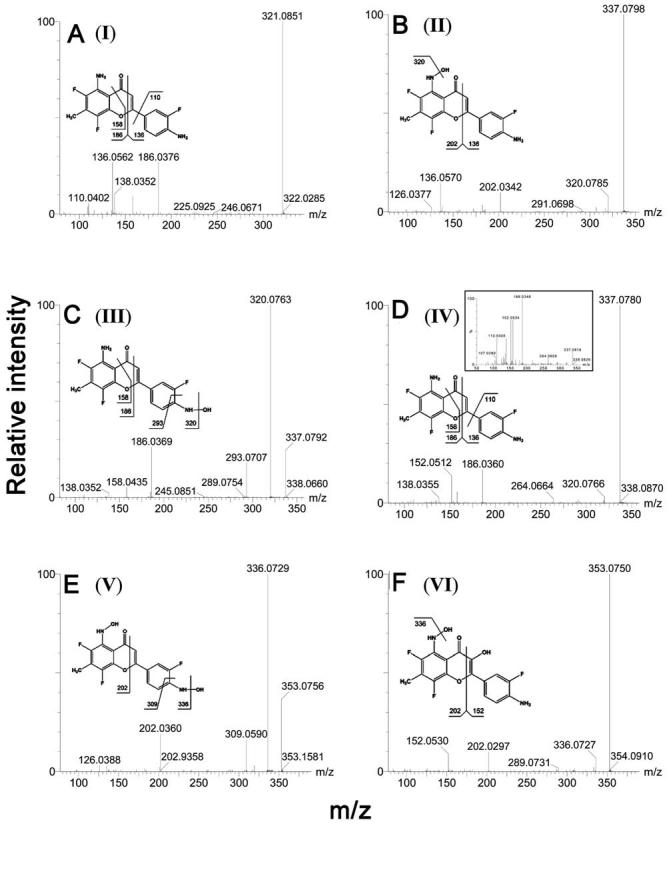
LC-MS/MS structural elucidation of phase I AF metabolites generated by microsomal incubation. Conditions for LC-MS/MS analysis and microsomal incubation were described in the Materials and Methods. MS2 fragmentation was conducted with collision energy ramping from 10 to 40 eV, except a fixed collision energy of 35eV for inlaid spectrum in Fig. 2D. A. MS2 fragmentation of AF (I). B. MS2 fragmentation of N5-hydroxy-AF (II). C. MS2 fragmentation of N4′-hydroxy-AF (III). D. MS2 fragmentation of 3-hydroxy-AF (IV). E. MS2 fragmentation of N5,N4′-dihydroxy-AF (V). F. MS2 fragmentation of 3,N5-dihydroxy-AF (VI). Major daughter ions from fragmentation were interpreted in the inlaid structural diagrams.
Fig. 3
Fig. 3
LC-MS/MS structural elucidation of major phase II metabolites of AF in urine. Urine samples from wild-type mice were collected for 24 hours after oral dosing with 50 mg/kg AF. Chromatographic and spectroscopic conditions for LC-MS/MS were described in the Materials and Methods. MS2 fragmentation was conducted with collision energy ramping from 10 to 40 eV. A. MS2 fragmentation of 3-hydroxy-AF sulfate (VIII). B. MS2 fragmentation of 3,N5-dihydroxy-AF sulfate (IX). C. MS2 fragmentation of AF-N5-glucuronide (X). D. MS2 fragmentation of N5-hydroxy-AF-N5-glucuronide (XI) with inlaid spectrum of deconjugated N5-hydroxy-AF ion. E. MS2 fragmentation of N4′-hydroxy-AF-N4′-glucuronide (XII). F. MS2 fragmentation of 3,N5-dihydroxy-AF-N5-glucuronide (XIV). Major daughter ions from fragmentation were interpreted in the inlaid structural diagrams.
Fig. 4
Fig. 4
Representative chromatograms of major AF metabolites in urine samples of wild-type (mCyp1a2+/+), Cyp1a2-null (mCyp1a2/−) and CYP1A2-humanized (hCYP1A2+/+, mCyp1a2/−) mice. Chromatographic and spectroscopic conditions for LC-MS analysis were described in the Materials and Methods. Ions within the 20 ppm range of theoretical accurate mass ([M+H]+) of AF and its metabolites (321.0851; 337.0800; 417.0368; 433.0317; 497.1172; 513.1121 and 529.1070) were extracted from each 10-min mass scan on the urine samples from three mouse lines. The identities of metabolites (I, II, VII-XIV) were presented in Table 2.
Fig. 5
Fig. 5
In vitro oxidation of AF by MLM from wild-type, Cyp1a2-null and CYP1A2-humanized mice and by pooled HLM. A. Representative chromatograms of monohydroxylated AF (337+) and dihydroxylated AF (353+) ions (II-VI). Ions within the 20 ppm range of theoretical accurate masses (337.0800 and 353.0749) were extracted from each 10-min mass scan on the samples generated by incubating 20 μM AF with 0.5 mg/ml MLMs from three mouse lines and pooled HLM. B. Relative activity of MLMs and HLM for the generation of phase I AF metabolites (II-VI). Enzymatic activity of the microsome with the highest yield of targeted metabolite was set arbitrarily as 1. Relative activity was presented as mean ± SD (n=3).
Fig. 6
Fig. 6
Relative mono-hydroxylation and di-hydroxylation activities by recombinant human P450s. A. Representative chromatograms of monohydroxylated AF (337+) and dihydroxylated AF (353+) ions (II-VI) after incubation of 20 μM AF with recombinant human CYP1A1, CYP1A2 and CYP2C19 enzymes. Ions within the 20 ppm range of theoretical accurate masses (337.0800 and 353.0749) were extracted from each 10-min mass scan on the samples generated by Supersome incubation. B. Relative activity of P450s for the generation of N5-OH-AF (II). C. Relative activity of P450s for the generation of N4′-OH-AF (III). D. Relative activity of P450s for the generation of 3-OH-AF (IV). E. Relative activity of P450s for the generation of N5,N4′-diOH-AF (V). F. Relative activity of P450s for the generation of 3,N5-diOH-AF (VI). Enzymatic activity of the P450s with the highest yield of targeted metabolite was set arbitrarily as 1. Relative activity was presented as mean ± SD (n=3).
Fig. 7
Fig. 7
Relative contribution of CYP1A2, CYP2C and CYP3A P450s to AF metabolism. AC. Enzyme kinetics of recombinant human CYP1A2 (■), CYP2C9 (○), CYP2C19 (▼) and CYP3A4 (◇) isozymes on the formation of N5-OH-AF (II), N4′-OH-AF (III) and 3-OH-AF (IV) were evaluated after the incubations with AF ranging from 200 nM to 80 μM. Relative activity was calculated as the percentage of the highest activity detected in all kinetic reactions. D. Effect of specific CYP inhibitors on HLM-mediated phase I metabolism. 10 μM of α-naphthoflavone (α-NF), 100 μM of sulfaphenazole (SUL) or 100 μM of mephenytoin (MEPH) was pre-incubated with HLM before adding 20 μM of AF. Catalytic activity of HLM for the formation of each phase I metabolite (II, III and IV) was set arbitrarily as 1. Relative activity was presented as mean ± SD (n=3).
Fig. 8
Fig. 8
Major in vivo AF metabolism pathways. Both phase I and phase II metabolizing enzymes can convert AF (I), collectively or separately, into more hydrophilic metabolites. P450-mediated oxidation reactions at C3, N5 and N4 positions transform AF to three monohydroxylated metabolites (II-IV), which can be further metabolized to two dihydroxylated metabolites (V and VI). Among these reactions, 3-hydroxylation is CYP1A2-selective. Besides direct N-conjugation of AF (I) to metabolite X, UDP-glucuronosyltransferases (UGT) can also convert phase I metabolites (II, III, V, and VII) into glucuronides (XI, XII, XIII, and XIV), respectively. Furthermore, cytosolic sulfotransferases (SULT) can metabolize phase I metabolites (II, IV, and VI) to sulfates (VII, VIII, and IX), respectively. Solid line represents phase I oxidation reaction, and dashed line for phase II conjugation reaction. Thicker line symbolizes the pathway to major urinary metabolites in one or all mouse lines in this study, and thinner line for the pathway to minor urinary metabolites.

References

    1. Akama T, Ishida H, Kimura U, Gomi K, Saito H. Structure-activity relationships of the 7-substituents of 5,4′-diamino-6,8,3′-trifluoroflavone, a potent antitumor agent. J Med Chem. 1998;41:2056–2067. - PubMed
    1. Akama T, Ishida H, Shida Y, Kimura U, Gomi K, Saito H, Fuse E, Kobayashi S, Yoda N, Kasai M. Design and synthesis of potent antitumor 5,4′-diaminoflavone derivatives based on metabolic considerations. J Med Chem. 1997;40:1894–1900. - PubMed
    1. Akama T, Shida Y, Sugaya T, Ishida H, Gomi K, Kasai M. Novel 5-aminoflavone derivatives as specific antitumor agents in breast cancer. J Med Chem. 1996;39:3461–3469. - PubMed
    1. Buters JT, Tang BK, Pineau T, Gelboin HV, Kimura S, Gonzalez FJ. Role of CYP1A2 in caffeine pharmacokinetics and metabolism: studies using mice deficient in CYP1A2. Pharmacogenetics. 1996;6:291–296. - PubMed
    1. Butler MA, Iwasaki M, Guengerich FP, Kadlubar FF. Human cytochrome P-450PA (P-450IA2), the phenacetin O-deethylase, is primarily responsible for the hepatic 3-demethylation of caffeine and N-oxidation of carcinogenic arylamines. Proc Natl Acad Sci U S A. 1989;86:7696–7700. - PMC - PubMed

Publication types

LinkOut - more resources