


doi: 10.1128/JVI.00329-06.
Active viremia in rotavirus-infected mice
Affiliations
- PMID: 16775359
- PMCID: PMC1488936
- DOI: 10.1128/JVI.00329-06
Item in Clipboard
Active viremia in rotavirus-infected mice
J Virol.
2006 Jul.
Abstract
Rotavirus circulates extraintestinally in animals used as models for rotavirus infection and in children. Rotavirus infection in mice was used to define host or viral factors that affect rotavirus viremia. Antigenemia was observed with homologous and heterologous rotaviruses, and neither age nor mouse strain genetics altered the occurrence of rotavirus antigenemia or viremia. Rotavirus RNA and infectious virus were present in sera and associated with the plasma fraction of blood in all infected mice. These findings indicate that antigenemia/viremia occurs routinely in rotavirus infections and imply that infectious rotavirus has access to any extraintestinal cell within contact of blood.
Figures
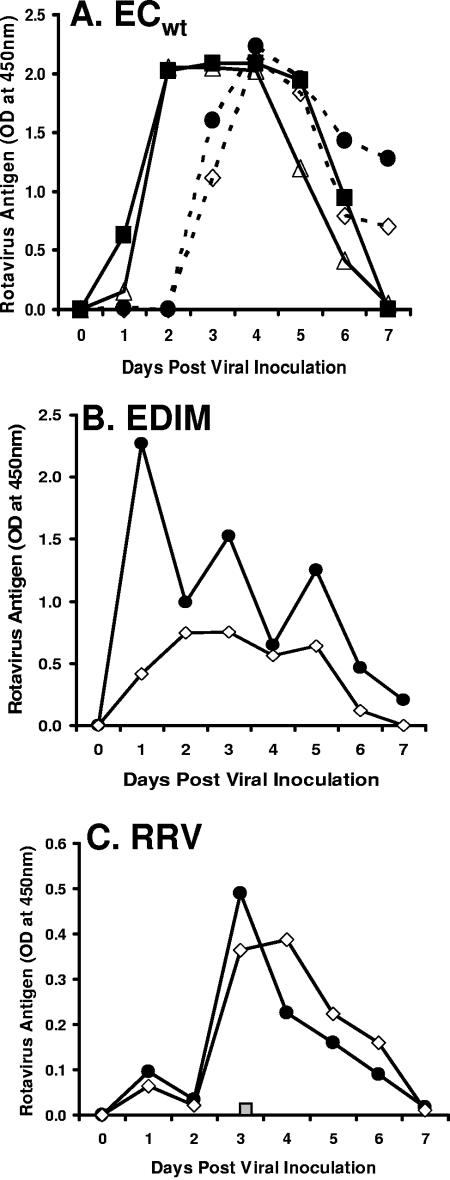
Rotavirus antigenemia is not rotavirus strain dependent. Rotavirus naïve adult CD-1 mice were orally inoculated on day 0 with the indicated strains of rotavirus. Mice were sacrificed at the indicated time points and 10% (wt/vol) fecal suspensions (squares and circles) and undiluted sera (open diamonds and open triangles) analyzed for rotavirus antigens by ELISA. Points represent average values for each time point (n = 3 to 5). A. Mice were inoculated with either 10 ID50 (dashed lines) or 105 ID50 (solid lines) ECwt. B. Mice were inoculated with 104 ID50 EDIM. C. Mice were inoculated with 10 ID50 RRV. The gray box indicates mice inoculated with inactivated RRV (n = 3).

Detection of rotavirus antigens. A. Six litters of 5-day-old naïve CD-1 pups were randomized (6 to 8 mice/litter) and administered either phosphate-buffered saline (PBS) (white bars, n = 3 litters) or 105 ID50 ECwt (black bars, n = 3 litters). Four days after inoculation, the intestines and the blood from each litter were pooled, gut homogenates or sera recovered, respectively, and samples analyzed for rotavirus antigens by ELISA. Bars represent average values of samples pooled from each of three litters ± the standard deviation. B. Naïve adult CD-1 mice were orally inoculated with 105 ID50 ECwt (black bars) or PBS (white bars). Three days after inoculation, whole blood was collected in EDTA-containing collection tubes for each mouse to prevent clotting. Cells were recovered by low-speed centrifugation after a washing and cell lysates made by addition of 150 μl PBS to each tube followed by three freeze-thaw cycles. Plasma and cell fractions were analyzed by ELISA for the presence of rotavirus antigens. Each bar represents the average value from three mice ± the standard deviation.
References
-
- Blutt, S. E., C. D. Kirkwood, V. Parreno, K. L. Warfield, M. Ciarlet, M. K. Estes, K. Bok, R. F. Bishop, and M. E. Conner. 2003. Rotavirus antigenaemia and viraemia: a common event? Lancet 362:1445-1449. - PubMed
-
- Blutt, S. E., K. L. Warfield, C. M. O'Neal, M. K. Estes, and M. E. Conner. 2006. Host, viral, and vaccine factors that determine protective efficacy induced by rotavirus and virus-like particles (VLPs). Vaccine 24:1170-1179. - PubMed
-
- Brown, K. A., and P. A. Offit. 1998. Rotavirus-specific proteins are detected in murine macrophages in both intestinal and extraintestinal lymphoid tissues. Microb. Pathog. 24:327-331. - PubMed
-
- Burns, J. W., A. A. Krishnaney, P. T. Vo, R. V. Rouse, L. J. Anderson, and H. B. Greenberg. 1995. Analyses of homologous rotavirus infection in the mouse model. Virology 207:143-153. - PubMed
Publication types
MeSH terms
Substances
Grants and funding
LinkOut - more resources
Full Text Sources
Other Literature Sources
Medical
