


The influence of MMP-14, TIMP-2 and MMP-2 expression on breast cancer prognosis
- PMID: 16776850
- PMCID: PMC1557730
- DOI: 10.1186/bcr1503
The influence of MMP-14, TIMP-2 and MMP-2 expression on breast cancer prognosis
Abstract
Introduction: Matrix metalloproteinase (MMP)-2 is very active at degrading extracellular matrix. It is under the influence of an activator, membrane type 1 MMP (MMP-14), and the tissue inhibitor of metalloproteases (TIMP)-2. We hypothesized that the individual expression of these three markers or their balance may help to predict breast cancer prognosis.
Methods: MMP-2, MMP-14 and TIMP-2 expression has been evaluated by 35S mRNA in situ hybridization on paraffin material of 539 breast cancers without distant metastasis at diagnosis and with a median follow-up of 9.2 years.
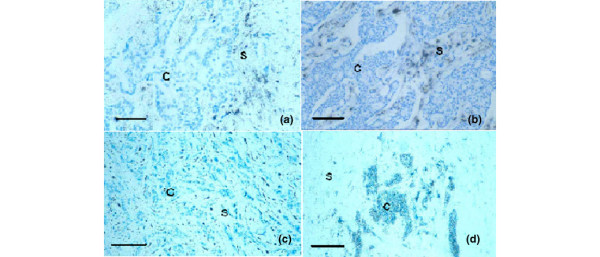
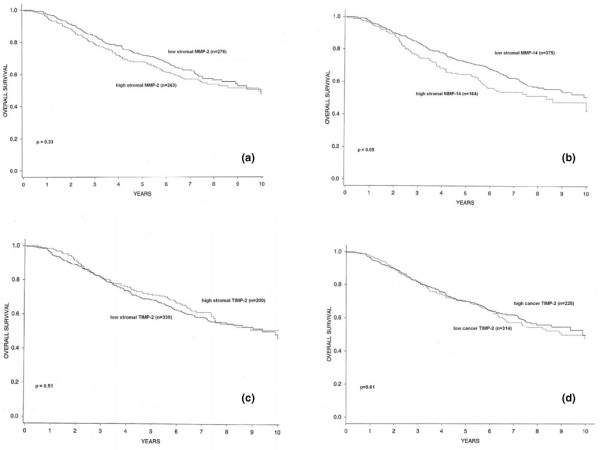
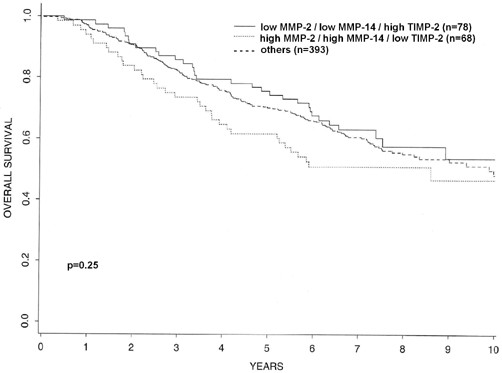
Results: MMP-2 and MMP-14 mRNA was detected primarily in reactive stromal cells whereas TIMP-2 mRNA was expressed by both stromal and cancer cells. Of the three molecules, an adjusted Cox model revealed that high MMP-14 mRNA (> or = 10% cells) alone predicted a significantly shorter overall survival (p = 0.031) when adjusted for clinical factors (tumor size and number of involved lymph nodes). Prognostic significance was lost when further adjusted for Her-2/neu and urokinase-type plasminogen activator (p = 0.284). Furthermore, when all three components were analyzed together, the survival was worst for patients with high MMP-2/high MMP-14/low TIMP-2 (5 year survival = 60%) and best with low MMP-2/low MMP-14/high TIMP-2 (5 year survival = 74%), but the difference did not reach statistical significance (p = 0.3285).
Conclusion: Of the MMP-14/TIMP-2/MMP-2 complex, MMP-14 was the factor most significantly associated with the outcome of breast cancer and was an independent factor of poor overall survival when adjusted for clinical prognostic factors, but not for certain ancillary markers.
Figures
References
-
- Brown PD, Giavazzi R. Matrix metalloproteinase inhibition: a review of anti-tumour activity. Ann Oncol. 1995;6:967–974. - PubMed
-
- Bigg HF, Morrison CJ, Butler GS, Bogoyevitch MA, Wang Z, Soloway PD, Overall CM. Tissue inhibitor of metalloproteinases-4 inhibits but does not support the activation of gelatinase A via efficient inhibition of membrane type 1-matrix metalloproteinase. Cancer Res. 2001;61:3610–3618. - PubMed
Publication types
MeSH terms
Substances
LinkOut - more resources
Full Text Sources
Other Literature Sources
Medical
Research Materials
Miscellaneous
