


Species richness changes lag behind climate change
- PMID: 16777739
- PMCID: PMC1560312
- DOI: 10.1098/rspb.2006.3484
Species richness changes lag behind climate change
Abstract
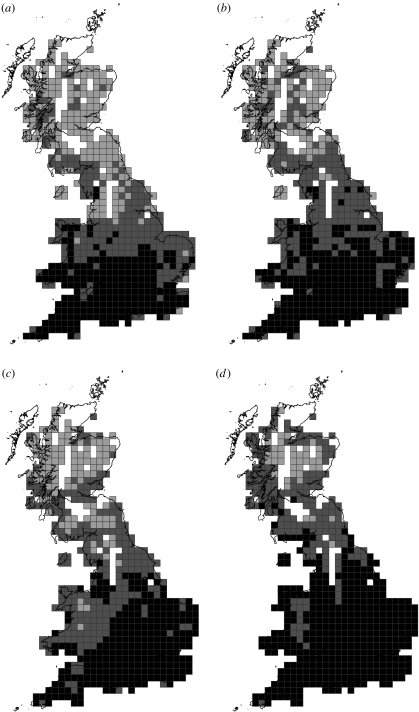
Species-energy theory indicates that recent climate warming should have driven increases in species richness in cool and species-poor parts of the Northern Hemisphere. We confirm that the average species richness of British butterflies has increased since 1970-82, but much more slowly than predicted from changes of climate: on average, only one-third of the predicted increase has taken place. The resultant species assemblages are increasingly dominated by generalist species that were able to respond quickly. The time lag is confirmed by the successful introduction of many species to climatically suitable areas beyond their ranges. Our results imply that it may be decades or centuries before the species richness and composition of biological communities adjusts to the current climate.
Figures
References
-
- Asher J, Warren M, Fox R, Harding P, Jeffcoate G, Jeffcoate S. Oxford University Press; Oxford, UK: 2001. The millennium atlas of butterflies in Britain and Ireland.
-
- Bryant S.R, Thomas C.D, Bale J.S. Nettle-feeding nymphalid butterflies: temperature, development and distribution. Ecol. Entomol. 1997;22:390–398. doi:10.1046/j.1365-2311.1997.00082.x - DOI
-
- Corke D. Lopinga Books; Ipswich, UK: 1997. The butterflies of Essex.
-
- Fuller M. Pisces Publications; Oxford, UK: 1995. The butterflies of Wiltshire: their history, status and distribution 1982–1994.
-
- Genner M.J, Sims D.W, Wearmouth V.J, Southall E.J, Southward A.J, Henderson P.A, Hawkins S.J. Regional climatic warming drives long-term community changes of British marine fish. Proc. R. Soc. B. 2004;271:655–661. doi:10.1098/rspb.2003.2651 - DOI - PMC - PubMed
Publication types
MeSH terms
LinkOut - more resources
Full Text Sources
Other Literature Sources
Molecular Biology Databases
