Outcomes of endoscopic surgery compared with open surgery for carpal tunnel syndrome among employed patients: randomised controlled trial
- PMID: 16777857
- PMCID: PMC1482334
- DOI: 10.1136/bmj.38863.632789.1F
Outcomes of endoscopic surgery compared with open surgery for carpal tunnel syndrome among employed patients: randomised controlled trial
Abstract
Objectives: To compare endoscopic and open carpal tunnel release surgery among employed patients with carpal tunnel syndrome.
Design and setting: Randomised controlled trial at a single orthopaedic department.
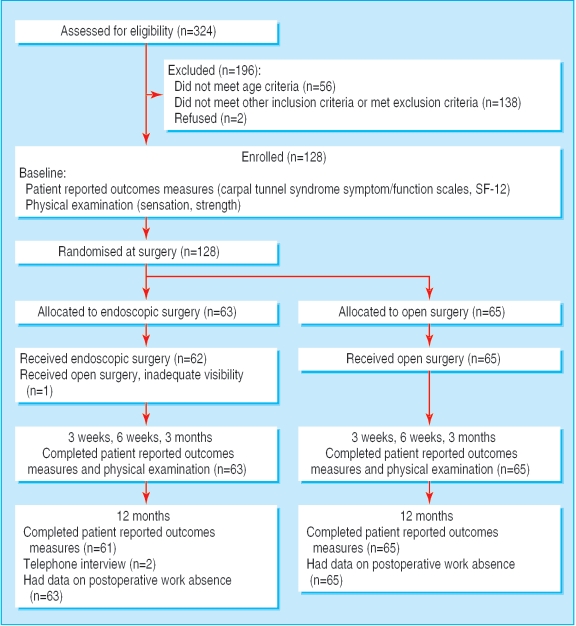
Participants: 128 employed patients aged 25-60 years with clinically diagnosed and electrophysiologically confirmed idiopathic carpal tunnel syndrome.
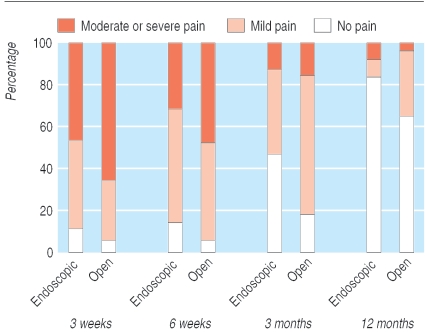
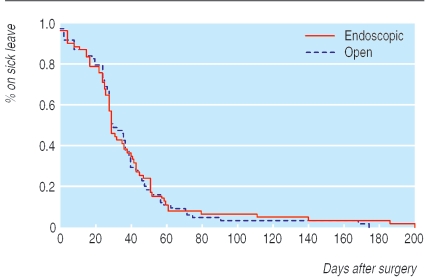
Main outcome measures: The primary outcome was severity of postoperative pain in the scar or proximal palm and the degree to which pain or tenderness limits activities, each rated on a 4 point scale, transformed into a combined score of 0 (none) to 100 (severe pain or tenderness causing severe activity limitation). The secondary outcomes were length of postoperative work absence, severity of symptoms of carpal tunnel syndrome and functional status scores, SF-12 quality of life score, and hand sensation and strength (blinded examiner); follow-up at three and six weeks and three and 12 months.
Results: 63 patients were allocated to endoscopic surgery and 65 patients to open surgery, with no withdrawals or dropouts. Pain in the scar or proximal palm was less prevalent or severe after endoscopic surgery than after open surgery but the differences were generally small. At three months, pain in the scar or palm was reported by 33 patients (52%) in the endoscopic group and 53 patients (82%) in the open group (number needed to treat 3.4, 95% confidence interval 2.3 to 7.7) and the mean score difference for severity of pain in scar or palm and limitation of activity was 13.3 (5.3 to 21.3). No differences between the groups were found in the other outcomes. The median length of work absence after surgery was 28 days in both groups. Quality of life measures improved substantially.
Conclusions: In carpal tunnel syndrome, endoscopic surgery was associated with less postoperative pain than open surgery, but the small size of the benefit and similarity in other outcomes make its cost effectiveness uncertain.
Figures
Comment in
-
The diagnosis and treatment of carpal tunnel syndrome.BMJ. 2006 Jun 24;332(7556):1463-4. doi: 10.1136/bmj.332.7556.1463. BMJ. 2006. PMID: 16793786 Free PMC article. No abstract available.
References
-
- Owings MF, Kozak LJ. Ambulatory and inpatient procedures in the United States, 1996. National Center for Health Statistics. Vital Health Stat 1998;13: www.cdc.gov/nchs/data/series/sr_13/sr13_139.pdf (accessed 25 May 2006). - PubMed
-
- Gerritsen AA, De Vet HC, Scholten RJ, Bertelsmann FW, de Krom MC, Bouter LM. Splinting vs surgery in the treatment of carpal tunnel syndrome: a randomized controlled trial. JAMA (2002);288: 1245-51. - PubMed
-
- Bureau of Labor Statistics. Lost worktime injuries and illnesses: characteristics and resulting days away from work, 2001. USDL 03-138. Washington, DC: Bureau of Labor Statistics, 2003: www.bls.gov/iif/oshwc/osh/case/osnr0017.pdf (accessed 1 Jun 2006).
-
- Katz JN, Amick BC, III, Keller R, Fossel AH, Ossman J, Soucie V, et al. Determinants of work absence following surgery for carpal tunnel syndrome. Am J Ind Med (2005);47: 120-30. - PubMed
-
- Chow JC. Endoscopic release of the carpal ligament: a new technique for carpal tunnel syndrome. Arthroscopy (1989);5: 19-24. - PubMed
Publication types
MeSH terms
LinkOut - more resources
Full Text Sources
Medical