


MASCAL: RFID tracking of patients, staff and equipment to enhance hospital response to mass casualty events
- PMID: 16779042
- PMCID: PMC1560691
MASCAL: RFID tracking of patients, staff and equipment to enhance hospital response to mass casualty events
Abstract
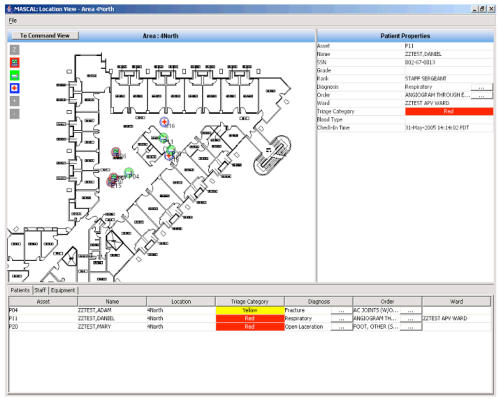
Most medical facilities practice managing the large numbers of seriously injured patients expected during catastrophic events. During mass casualty events, as the demands on the healthcare team increase, and the challenges faced by managers escalate, workflow bottlenecks begin to develop and system capacity decreases. This paper describes MASCAL, an integrated software-hardware system designed to enhance management of resources at a hospital during a mass casualty situation. MASCAL uses active 802.11b asset tags to track patients, equipment and staff during the response to a disaster. The system integrates tag position information with data from personnel databases, medical information systems, registration applications and the US Navy's TACMEDCS triage application in a custom visual disaster management environment. MASCAL includes interfaces for a hospital command center, local area managers (emergency room, operating suites, radiology, etc.) and registration personnel. MASCAL is an operational system undergoing functional evaluation at the Naval Medical Center, San Diego, CA.
Figures
References
-
- Chan TC, Killeen J, Griswold W, Lenert L. Information technology and emergency medical care during disasters. Acad Emerg Med. 2004;11(11):1229–36. - PubMed
-
- Noordergraaf GJ, Bouman JH, van den Brink EJ, van de Pompe C, Savelkoul TJ. Development of computer-assisted patient control for use in the hospital setting during mass casualty incidents. Am J Emerg Med. 1996;14(3):257–61. - PubMed
-
- Bouman JH, Schouwerwou RJ, Van der Eijk KJ, van Leusden AJ, Savelkoul TJ. Computerization of patient tracking and tracing during mass casualty incidents. Eur J Emerg Med. 2000;7(3):211–6. - PubMed
-
- Rafalski E, Zun L. Using GIS to monitor emergency room use in a large urban hospital in Chicago. J Med Syst. 2004;28(3):311–9. - PubMed
-
- Laurent C, Beaucourt L. Instant Electronic Patient Data Input During Emergency Response in Major Disaster Setting: Report on the Use of a Rugged Wearable (Handheld) Device and the Concept of Information Flow throughout the Deployment of the Disaster Response upon Hospital Admission. Stud Health Technol Inform. 2005;111:290–3. - PubMed
Publication types
MeSH terms
LinkOut - more resources
Full Text Sources
Other Literature Sources
Medical