


The relative roles of three DNA repair pathways in preventing Caenorhabditis elegans mutation accumulation
- PMID: 16783005
- PMCID: PMC1569771
- DOI: 10.1534/genetics.106.059840
The relative roles of three DNA repair pathways in preventing Caenorhabditis elegans mutation accumulation
Abstract
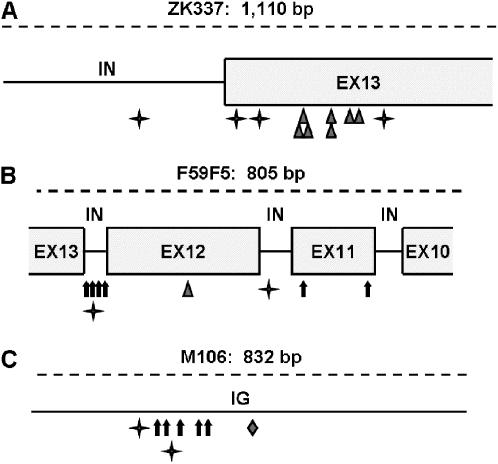
Mutation is a central biological process whose rates and spectra are influenced by a variety of complex and interacting forces. Although DNA repair pathways are generally known to play key roles in maintaining genetic stability, much remains to be understood about the relative roles of different pathways in preventing the accumulation of mutations and the extent of heterogeneity in pathway-specific repair efficiencies across different genomic regions. In this study we examine mutation processes in base excision repair-deficient (nth-1) and nucleotide excision repair-deficient (xpa-1) Caenorhabditis elegans mutation-accumulation (MA) lines across 24 regions of the genome and compare our observations to previous data from mismatch repair-deficient (msh-2 and msh-6) and wild-type (N2) MA lines. Drastic variation in both average and locus-specific mutation rates, ranging two orders of magnitude for the latter, was detected among the four sets of repair-deficient MA lines. Our work provides critical insights into the relative roles of three DNA repair pathways in preventing C. elegans mutation accumulation and provides evidence for the presence of pathway-specific DNA repair territories in the C. elegans genome.
Figures


References
-
- Al Tassan, N., N. H. Chmiel, J. Maynard, N. Fleming, A. L. Livingston et al., 2002. Inherited variants of MYH associated with somatic G:C→A:T mutations in colorectal tumors. Nat. Genet. 30: 227–232. - PubMed
-
- Alseth, I., L. Eide, M. Pirovano, T. Rognes, E. Seeberg et al., 1999. The Saccharomyces cerevisiae homologues of endonuclease III from Escherichia coli, Ntg1 and Ntg2, are both required for efficient repair of spontaneous and induced oxidative DNA damage in yeast. Mol. Cell. Biol. 19: 3779–3787. - PMC - PubMed
-
- Altschul, S. F., W. Gish, W. Miller, E. W. Myers and E. J. Lipman, 1990. Basic local alignment search tool. J. Mol. Biol. 215: 403–410. - PubMed
Publication types
MeSH terms
Substances
Associated data
- Actions
- Actions
- Actions
- Actions
- Actions
- Actions
- Actions
- Actions
- Actions
- Actions
- Actions
- Actions
- Actions
- Actions
- Actions
- Actions
- Actions
- Actions
- Actions
- Actions
- Actions
- Actions
- Actions
- Actions
- Actions
- Actions
- Actions
- Actions
- Actions
- Actions
- Actions
- Actions
- Actions
- Actions
- Actions
Grants and funding
LinkOut - more resources
Full Text Sources
Other Literature Sources
Molecular Biology Databases
Miscellaneous
