


Comparative Study
doi: 10.1534/genetics.106.059527.
Epub 2006 Jun 18.
Parallel genetic architecture of parallel adaptive radiations in mimetic Heliconius butterflies
Affiliations
- PMID: 16783007
- PMCID: PMC1569775
- DOI: 10.1534/genetics.106.059527
Item in Clipboard
Comparative Study
Parallel genetic architecture of parallel adaptive radiations in mimetic Heliconius butterflies
Genetics.
2006 Sep.
Abstract
It is unknown whether homologous loci underlie the independent and parallel wing pattern radiations of Heliconius butterflies. By comparing the locations of color patterning genes on linkage maps we show that three loci that act similarly in the two radiations are in similar positions on homologous chromosomes.
Figures
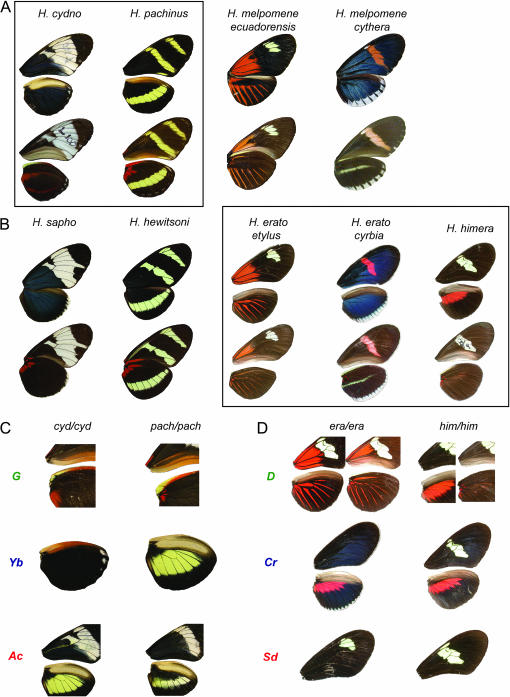
Mimicry and mimicry genes in Heliconius butterflies. (A) Four phenotypes (dorsal, top; ventral, bottom) from three species belonging to one major Heliconius clade. H. cydno and H. pachinus (shown in a box) were crossed to study color pattern genetics from this clade. (B) Five phenotypes from four species belonging to the second Heliconius clade are shown below their respective comimics; H. himera does not have a corresponding comimic. Crosses between H. himera and each of the two H. erato races (shown in a box) were used to study color pattern genetics in this clade (Tobler et al. 2005; Kapan et al. 2006). (C) Effects of alternative alleles at three color-patterning loci that distinguish H. cydno and H. pachinus: G controls whether the ventral base of the fore and hind wings is red or brown, Yb controls the presence or absence of melanic scales on the hind wing, and Ac controls the presence or absence of melanic scales on the proximal portions of both the fore and the hind wings. (D) Effects of alternative alleles at three color-patterning loci that distinguish H. erato and H. himera: D controls the distribution of red/orange scales on the wings (DetDet vs. DhiDhi shown), Cr controls the placement of melanic scales on the fore and hind wings (CrcyCrcy vs. CrhiCrhi shown), and Sd controls the portion of the forewing that is covered in melanic scales (SdetSdet vs. SdhiSdhi shown).
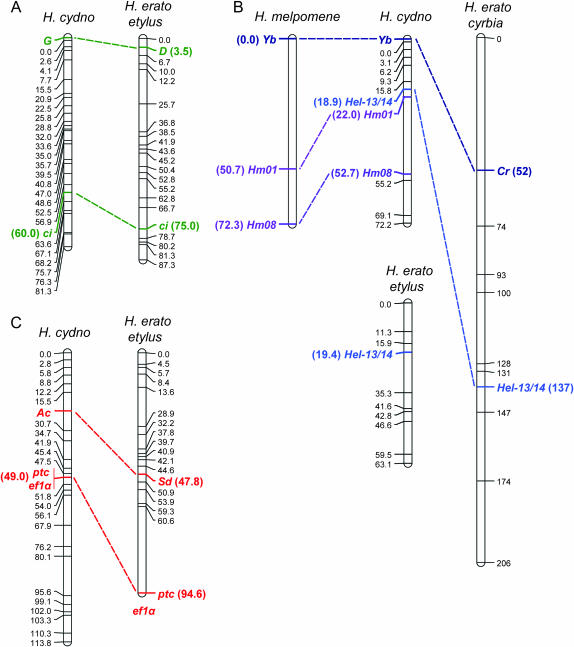
Comparative genetic mapping of mimicry genes in Heliconius. (A) H. cydno color-patterning gene G and H. erato D are both syntenic with anchor locus ci. (B) H. cydno color-patterning gene Yb and H. erato Cr are both syntenic with anchor locus Hel-13/14. The H. erato cyrbia linkage group containing Hel-13/14 (Tobler et al. 2005) is substantially longer than that of H. erato etylus (Kapan et al. 2006), suggesting that distances may be artificially inflated in the former. H. cydno Yb is also syntenic with microsatellite loci Hm01 and Hm08, which are linked to Yb in crosses between races of sister species H. melpomene (Jiggins et al. 2005; Joron et al. 2006). (C) H. cydno color-patterning gene Ac and H. erato Sd are both syntenic with anchor loci ptc and ef1α. Although ef1α is syntenic with ptc and Sd in H. erato etylus, its exact position is unknown (Kapan et al. 2006). H. erato maps were estimated using backcross or F2 broods derived from crosses between H. himera and either H. erato cyrbia (for the linkage group with Cr) as described in Tobler et al. (2005) or H. erato etylus (for linkage groups with D and Sd) as described in Kapan et al. (2006). The H. melpomene Yb linkage group was mapped using F2 broods derived from crosses between H. m. cythera and H. m. melpomene as described in Jiggins et al. (2005) and Joron et al. (2006). For H. cydno, we used segregation data from 33 H. pachinus (female) × H. cydno (male) F1 hybrids (pseudotestcross design) to map amplified fragment length polymorphism (AFLP) loci, microsatellite loci, and single-copy nuclear loci that were heterozygous in the H. cydno male parent (Kronforst et al. 2006). We typed ci, Hel-13/14, Hm01, and Hm08 using PCR product length variation and ptc and eflα using single-nucleotide polymorphisms. We then scored 65 F2 offspring for allelic variation at color-patterning loci and a subset of the mapped markers and used these data to locate the positions of color-patterning loci G, Yb, and Ac. Completely linked AFLP loci in opposite phases were used to score each F2 individual as marker present (homozygous or heterozygous for the H. cydno allele) or marker absent (homozygous for the H. pachinus allele) while AFLP loci without a linked marker in the opposite phase were scored as marker present or missing data. Using likelihood we assigned each H. cydno color-patterning locus to the interval with the highest probability, but we did not estimate approximate positions within intervals. We also used likelihood to estimate placement support limits (∼95% confidence intervals) for each of the loci in both studies (Kapan et al. 2006). Mapping was performed with Joinmap 3.0 (Van Ooijen and Voorrips 2001) and Mapmaker/Exp 3.0 (Lincoln et al. 1993) using the Haldane mapping function and maps were drawn with MapChart 2.1 (Voorrips 2002). Markers are labeled with their position, in centimorgans, and homologous loci are highlighted.
References
-
- Brown, K. S., T. C. Emmel, P. J. Eliazar and E. Suomalainen, 1992. Evolutionary patterns in chromosome numbers in neotropical Lepidoptera I: chromosomes of the Heliconiini (family Nymphalidae: subfamily Nymphalinae). Hereditas 117: 109–125. - PubMed
-
- Brunetti, C. R., J. E. Selegue, A. Monteiro, V. French, P. M. Brakefield et al., 2001. The generation and diversification of butterfly eyespot color patterns. Curr. Biol. 11: 1578–1585. - PubMed
-
- Colosimo, P. F., K. E. Hosemann, S. Balabhadra, G. Villarreal, M. Dickson et al., 2005. Widespread parallel evolution in sticklebacks by repeated fixation of ectodysplasin alleles. Science 307: 1928–1933. - PubMed
-
- Gilbert, L. E., 2003. Adaptive novelty through introgression in Heliconius wing patterns: evidence for shared genetic “tool box” from synthetic hybrid zones and a theory of diversification, pp. 281–318 in Ecology and Evolution Taking Flight: Butterflies as Model Systems, edited by C. L. Boggs, W. B. Watt and P. R. Ehrlich. University of Chicago Press, Chicago.
Publication types
MeSH terms
Substances
LinkOut - more resources
Full Text Sources
