


Genetic mapping in a natural population of collared flycatchers (Ficedula albicollis): conserved synteny but gene order rearrangements on the avian Z chromosome
- PMID: 16783008
- PMCID: PMC1569790
- DOI: 10.1534/genetics.106.058917
Genetic mapping in a natural population of collared flycatchers (Ficedula albicollis): conserved synteny but gene order rearrangements on the avian Z chromosome
Abstract
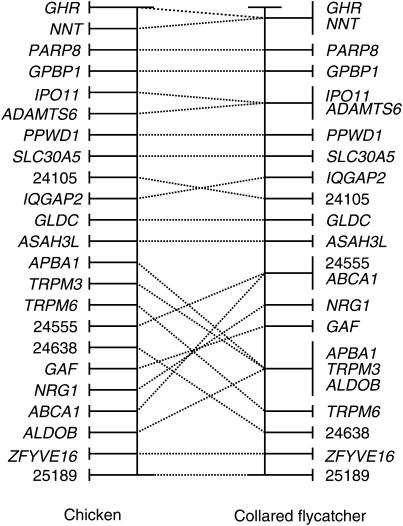
Data from completely sequenced genomes are likely to open the way for novel studies of the genetics of nonmodel organisms, in particular when it comes to the identification and analysis of genes responsible for traits that are under selection in natural populations. Here we use the draft sequence of the chicken genome as a starting point for linkage mapping in a wild bird species, the collared flycatcher - one of the most well-studied avian species in ecological and evolutionary research. A pedigree of 365 flycatchers was established and genotyped for single nucleotide polymorphisms in 23 genes selected from (and spread over most of) the chicken Z chromosome. All genes were also found to be located on the Z chromosome in the collared flycatcher, confirming conserved synteny at the level of gene content across distantly related avian lineages. This high degree of conservation mimics the situation seen for the mammalian X chromosome and may thus be a general feature in sex chromosome evolution, irrespective of whether there is male or female heterogamety. Alternatively, such unprecedented chromosomal conservation may be characteristic of most chromosomes in avian genome evolution. However, several internal rearrangements were observed, meaning that the transfer of map information from chicken to nonmodel bird species cannot always assume conserved gene orders. Interestingly, the rate of recombination on the Z chromosome of collared flycatchers was only approximately 50% that of chicken, challenging the widely held view that birds generally have high recombination rates.
Figures
References
-
- Aitken, N., S. Smith, C. Schwarz and P. A. Morin, 2004. Single nucleotide polymorphism (SNP) discovery in mammals: a targeted-gene approach. Mol. Ecol. 13: 1423–1431. - PubMed
-
- Alatalo, R. V., A. Lundberg and C. Glynn, 1986. Female pied flycatchers choose territory quality and not male characteristics. Nature 323: 152–153.
-
- Bed'Hom, B., P. Coullin, Z. Guillier-Gencik, S. Moulin, A. Bernheim, et al. 2003. Characterization of the atypical karyotype of the black-winged kite Elanus caeruleus (Falconiformes: Accipitridae) by means of classical and molecular cytogenetic techniques. Chromosome Res. 11: 335–343. - PubMed
-
- Bell, P. A., S. Chaturvedi, C. A. Gelfand, C. Y. Huang, M. Kochersperger et al., 2002. SNPstream UHT: ultra-high throughput SNP genotyping for pharmacogenomics and drug discovery. BioTechniques (Suppl.): 70–72, 74, 76–77. - PubMed
-
- Bisoni, L., L. Batlle-Morera, A. P. Bird, M. Suzuki and H. A. McQueen, 2005. Female-specific hyperacetylation of histone H4 in the chicken Z chromosome. Chromosome Res. 13: 205–214. - PubMed
Publication types
MeSH terms
Associated data
- Actions
- Actions
- Actions
- Actions
- Actions
- Actions
- Actions
- Actions
- Actions
- Actions
- Actions
- Actions
- Actions
- Actions
- Actions
- Actions
- Actions
- Actions
- Actions
- Actions
- Actions
- Actions
- Actions
- Actions
- Actions
- Actions
- Actions
- Actions
- Actions
- Actions
- Actions
- Actions
- Actions
- Actions
- Actions
- Actions
- Actions
- Actions
- Actions
- Actions
- Actions
- Actions
- Actions
- Actions
- Actions
- Actions
- Actions
- Actions
LinkOut - more resources
Full Text Sources
