. 2006 Jun 20:6:100.
doi: 10.1186/1471-2334-6-100.

In vitro antimicrobial activity of natural toxins and animal venoms tested against Burkholderia pseudomallei

Affiliations

In vitro antimicrobial activity of natural toxins and animal venoms tested against Burkholderia pseudomallei

R Perumal Samy et al. BMC Infect Dis. .

Abstract

Background: Burkholderia pseudomallei are the causative agent of melioidosis. Increasing resistance of the disease to antibiotics is a severe problem in treatment regime and has led to intensification of the search for new drugs. Antimicrobial peptides are the most ubiquitous in nature as part of the innate immune system and host defense mechanism.

Methods: Here, we investigated a group of venoms (snakes, scorpions and honey bee venoms) for antimicrobial properties against two strains of Gram-negative bacteria Burkholderia pseudomallei by using disc-diffusion assay for in vitro susceptibility testing. The antibacterial activities of the venoms were compared with that of the isolated L-amino acid oxidase (LAAO) and phospholipase A2 (PLA2s) enzymes. MICs were determined using broth dilution method. Bacterial growth was assessed by measurement of optical density at the lowest dilutions (MIC 0.25 mg/ml). The cell viability was measured using tetrazolium salts (XTT) based cytotoxic assay.

Results: The studied venoms showed high antimicrobial activity. The venoms of C. adamanteus, Daboia russelli russelli, A. halys, P. australis, B. candidus and P. guttata were equally as effective as Chloramphenicol and Ceftazidime (30 microg/disc). Among those tested, phospholipase A2 enzymes (crotoxin B and daboiatoxin) showed the most potent antibacterial activity against Gram-negative (TES) bacteria. Naturally occurring venom peptides and phospholipase A2 proved to possess highly potent antimicrobial activity against Burkholderia pseudomallei. The XTT-assay results showed that the cell survival decreased with increasing concentrations (0.05-10 mg/mL) of Crotalus adamanteus venom, with no effect on the cell viability evident at 0.5 mg/mL.

Conclusion: This antibacterial profile of snake venoms reported herein will be useful in the search for potential antibacterial agents against drug resistant microorganisms like B. pseudomallei.


Figures
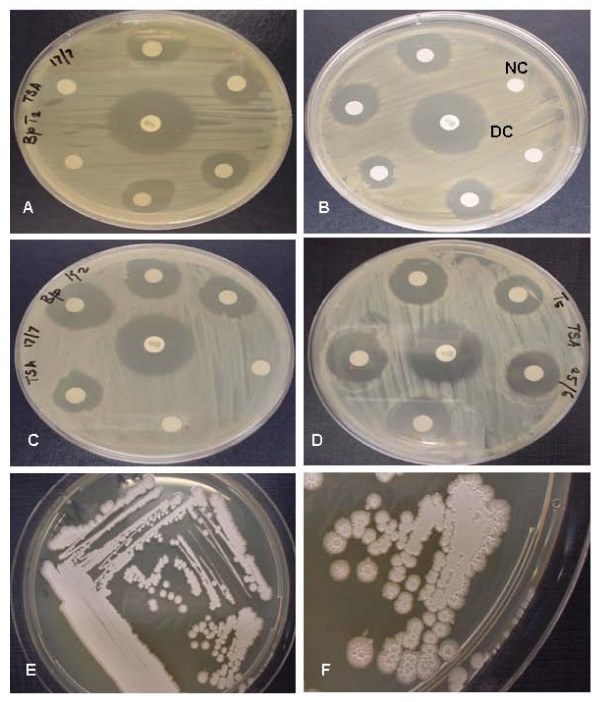
Figure 1
Figure 1
Antimicrobial activities of crude venoms (each disc contained 20 μl of 100 μg/ml) of different snake species tested against gram-negative Burkholderia pseudomallei. Following 24 h incubation at 37°C, zone of inhibition given by each venom was compared with that of the standard drug chloramphenicol (30 μg/disc). Inhibition zones against Burkholderia pseudomallei given by venoms of: (A) Daboia russelli russelli, (B) Agkistrodon halys, (C) Crotalus adamanteus, (D) Bitis gabonicarhinoceros. Rough wrinkled morphological features of gram-negative Burkholderia pseudomallei bacteria were grown on Tryptic Soy agar plates at 37°C. (E) bacilli after 36 h incubation, (F) prominent bacilli after 72 h incubation.
Figure 2
Figure 2
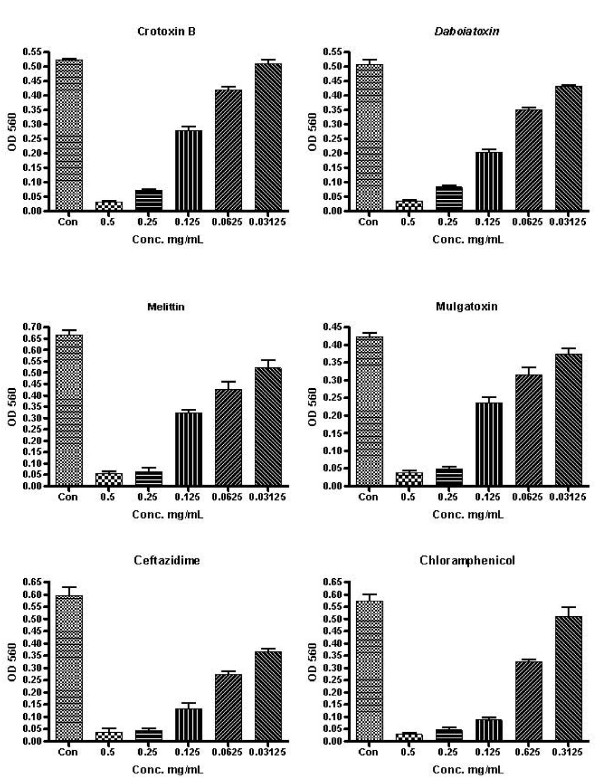
Phospholipase A2 activity against pathogen from patients with KHW. Micro-dilution technique was used to test the MICs of PLA2s as compared to that of the antibiotics. The values are the optical density read at 560 nm (means ± S.D.) from a single experiment performed in triplicates.
Figure 3
Figure 3
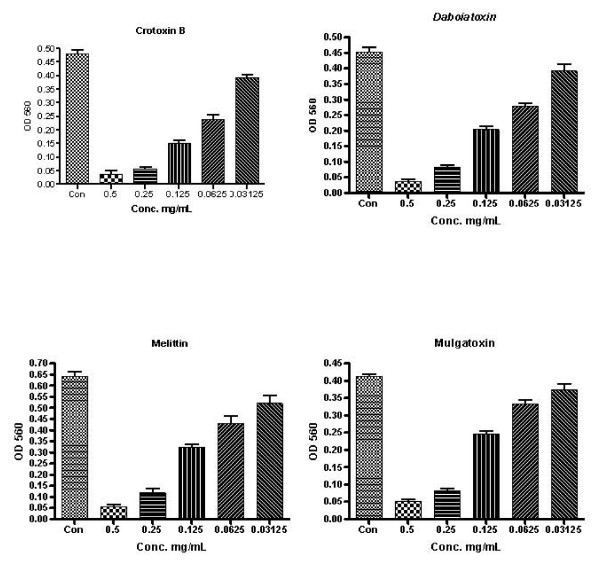
Phospholipase A2activity against pathogen from patients with TES. Micro-dilution technique was used to test the MICs of PLA2s as compared to that of the antibiotics. The values are the optical density read at 560 nm (means ± S.D.) from a single experiment performed in triplicates.
Figure 4
Figure 4
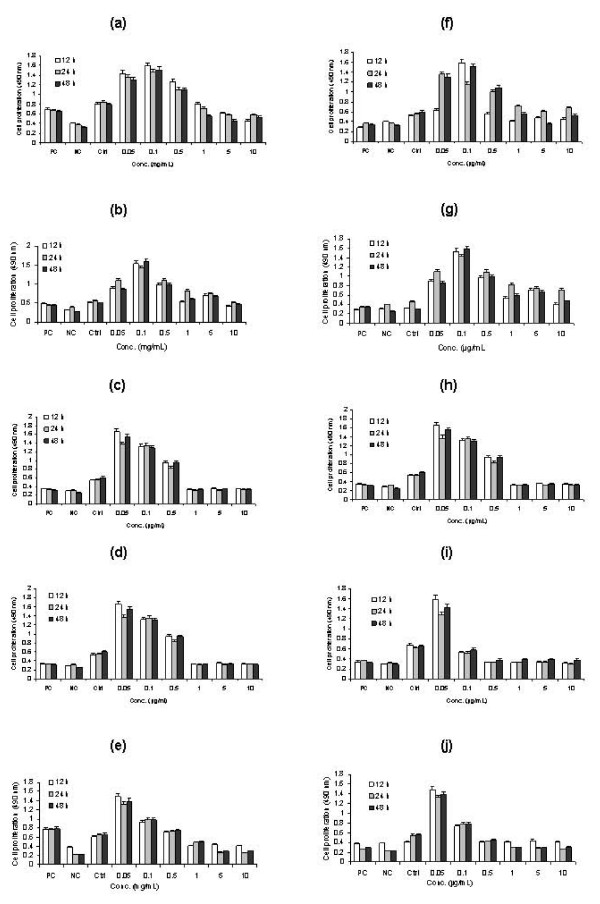
Cell proliferation (U-937 Human macrophage cell line) was determined by XTT assay to evaluate the cytotoxic effect of different venoms (a – e) and PLA2s (f – j) exposed at different time intervals. (a) South American rattlesnake (Crotalus adamanteus), (b) Russells viper (Daboia russelli russelli), (c) King brown (Pseudechis australis), (d) Pallas (Agkistrodon halys) (e) Speckled brown (Pseudechis guttata) (f) Crotoxin B (Crotalus durissus terrificus), (g) Daboiatoxin (Daboia russelli russelli), (h) Melittin (Apis mellifera), (i) Mulgatoxin (Pseudechis australis) (j) Crotoxin A (Crotalus durissus terrificus). Macrophages were incubated with varying concentrations of venoms (0.05 – 10 mg/ml) and PLA2s (0.05 – 10 μg/ml).
Figure 5
Figure 5
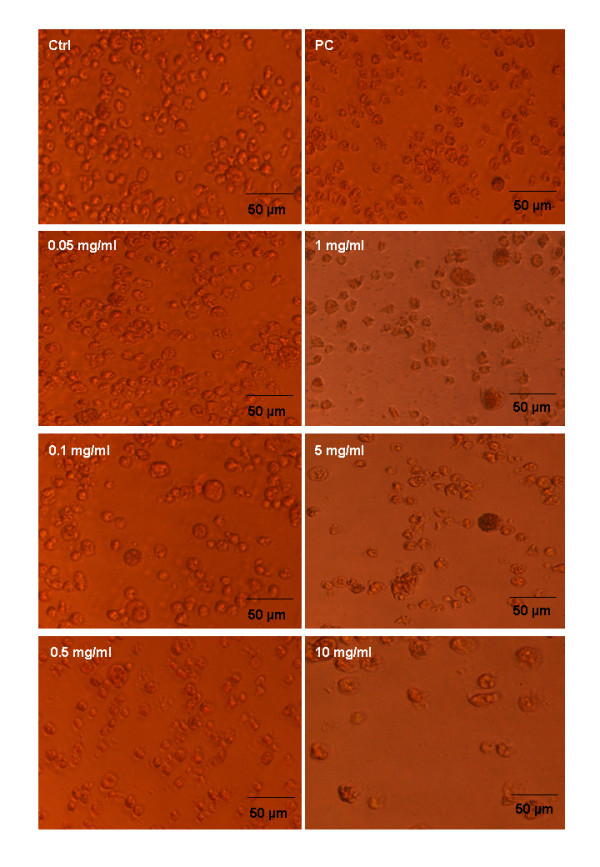
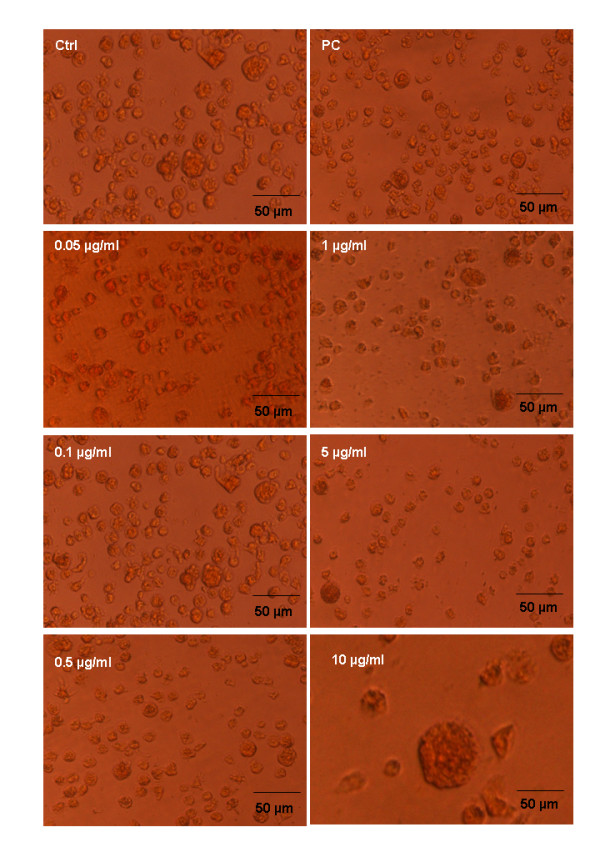
Morphological changes of U-937 Human macrophage cell line after exposure to Crotalus adamanteus venom at different concentrations. (Ctrl) macrophage supplemented with medium without any treatment served as control; (PC), cells exposed with ceftazidime as a positive control. Macrophages were incubated with venom at different (0.05–10 mg/mL) concentrations (Other photos not shown).
Figure 6
Figure 6
Morphological changes of U-937 Human macrophage cell line after exposure to PLA2s at varying concentrations (0.05–10 μg/mL). (Ctrl), control macrophages supplemented with medium without any treatment; (PC), cells exposed with ceftazidime as a positive control.
Figure 7
Figure 7
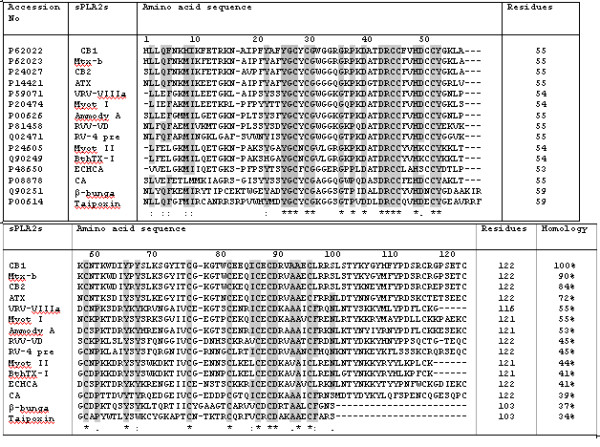
Comparison of the amino acid sequences of Crotoxin basic chain 1, CB1 [Crotalus durissus terrificus] phospholipase A2 enzymes (Phosphatidylcholine 2-acylhydrolase) with other PLA2s of Mojave toxin basic chain, Mtx-b [Crotalus scutulatus scutulatus], Crotoxin basic chain 2, CB2 [Crotalus durissus terrificus], Agkistrotoxin, ATX [Agkistrodon halys], VRV-PL-VIIIa [Daboia russelli pulchella], BOTAS (Myotoxin I) Bothrops asper (Terciopelo), ATXA, ammodytoxin A precursor [Vipera ammodytes ammodytes]; RVV-VD [Daboia russelli russelli]; RV-4 precursor [Daboia russelli siamensis], BOTAS (Myotoxin II) [Bothrops asper], BOTJR (BthTX-I) [Bothrops jararacussu], ECHCA (Ecarpholin S) [Echis carinatus (Saw-scaled viper)], Crotoxin acid chain precursor (CA) [Crotalus durissus terrificus], β-bungarotoxin A6 chain precursor [Bungarus multicinctus (Many-banded krait)] and OXYSC taipoxin alpha chain [Oxyuranus scutellatus scutellatus] and completely conserved residues in all sequences are bolded and marked by asterisks. The gaps are inserted in the sequences in order to attain maximum homology.
Figure 8
Figure 8
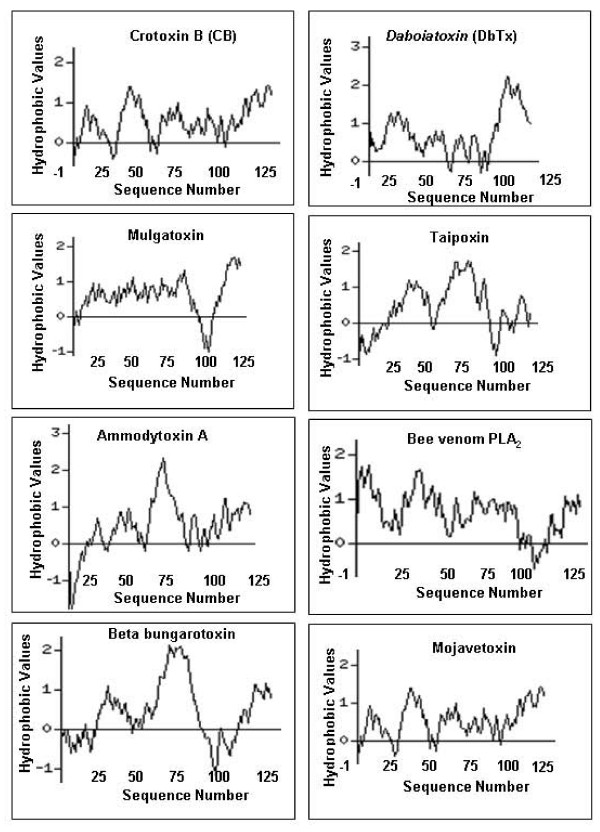
Hydropathic profiles of phospholipase A2 enzyme such as crotoxin b, daboiatoxin, mulgatoxin, taipoxin, ammodytoxin A, bee venom PLA2, beta-bungarotoxin and mojavetoxin were calculated by using the kyte-doolittle method.

References

    1. Chaowagul W, White NJ, Dance DAB, Wattanagoon Y, Naigowit P, Davis TME, Looareesuwan S, Pitakwatchara N. Melioidosis: a major cause of community acquired septicemia in northeastern Thailand. J Infect Dis. 1989;159:890–899. - PubMed
    1. Yabuuchi E, Arakawa M. Burkholderia pseudomallei and melioidosis: be aware in temperate area. Microbiol Immunol. 1993;37:823–836. - PubMed
    1. Puthucheary SD, Parasakthi N, Lee MK. Septicaemic melioidosis: a review of 50 cases from Malaysia. Trans Roy Soc Trop Med Hyg. 1992;86:683–685. doi: 10.1016/0035-9203(92)90191-E. - DOI - PubMed
    1. White NJ. Melioidosis. Lancet. 2003;361:1715–1722. doi: 10.1016/S0140-6736(03)13374-0. - DOI - PubMed
    1. Currie BJ, Fisher DA, Howard DM. Endemic melioidosis in tropical northern Australia a 10 year perspective study and review of the literature. Clin Infect Dis. 2000;31:981–986. doi: 10.1086/318116. - DOI - PubMed

Publication types

MeSH terms

LinkOut - more resources