. 2006 Jun 27;103(26):9982-7.
doi: 10.1073/pnas.0602081103. Epub 2006 Jun 19.

The B30.2 domain of pyrin, the familial Mediterranean fever protein, interacts directly with caspase-1 to modulate IL-1beta production

Affiliations

The B30.2 domain of pyrin, the familial Mediterranean fever protein, interacts directly with caspase-1 to modulate IL-1beta production

Jae Jin Chae et al. Proc Natl Acad Sci U S A. .

Abstract

Familial Mediterranean fever (FMF) is a recessively inherited autoinflammatory disorder with high carrier frequencies in the Middle East. Pyrin, the protein mutated in FMF, regulates caspase-1 activation and consequently IL-1beta production through cognate interaction of its N-terminal PYRIN motif with the ASC adaptor protein. However, the preponderance of mutations reside in pyrin's C-terminal B30.2 domain. Here we demonstrate direct interaction of this domain with caspase-1. In lysates from cells not expressing ASC, reciprocal GST pull-downs demonstrated the interaction of pyrin with the p20 and p10 catalytic subunits of caspase-1. Coimmunoprecipitations of pyrin and caspase-1 from THP-1 human monocytic cells were consistent with the interaction of endogenous proteins. The C-terminal B30.2 domain of pyrin is necessary and sufficient for the interaction, and binding was reduced by FMF-associated B30.2 mutations. Full-length pyrin attenuated IL-1beta production in cells transfected with a caspase-1/IL-1beta construct, an effect diminished by FMF-associated B30.2 mutations and in B30.2 deletion mutants. Modeling of the crystal structure of caspase-1 with the deduced structure of the pyrin B30.2 domain corroborated both the interaction and the importance of M694V and M680I pyrin mutations. Consistent with a net inhibitory effect of pyrin on IL-1beta activation, small interfering RNA (siRNA)-mediated pyrin knockdown in THP-1 cells augmented IL-1beta production in response to bacterial LPS. Moreover, the IL-1 receptor antagonist anakinra suppressed acute-phase proteins in a patient with FMF and amyloidosis. Our data support a direct, ASC-independent effect of pyrin on IL-1beta activation and suggest heightened IL-1 responsiveness as one factor selecting for pyrin mutations.


Conflict of interest statement

Conflict of interest statement: No conflicts declared.

Figures
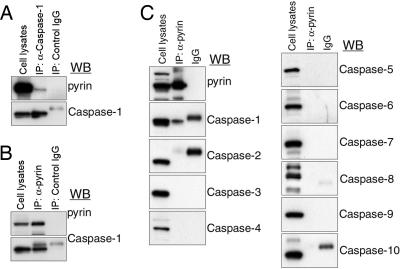
Fig. 1.
Fig. 1.
The interaction of human pyrin with caspase-1. (A) Lysates from THP-1 cells expressing endogenous pyrin and caspase-1 were immunoprecipitated with anti-caspase-1 Ab or control IgG. Cell lysates and eluted proteins were subjected to Western blotting with a polyclonal Ab against the N-terminal 374 aa of human pyrin (Upper) or anti-caspase-1 Ab (Lower). IP, immunoprecipitation; WB, Western blot. (B) Lysates from THP-1 cells were immunoprecipitated with anti-pyrin Ab or control IgG. Cell lysates and eluted proteins were analyzed by Western blotting with anti-pyrin Ab (Upper) or anti-caspase-1 Ab (Lower). (C) Lysates from THP-1 cells were immunoprecipitated with anti-pyrin Ab. Lysates, eluted proteins, and control IgG were electrophoresed, followed by Western blotting with anti-pyrin Ab or Abs against caspase-1 to caspase-10.
Fig. 2.
Fig. 2.
The interaction of pyrin with the catalytic subunits of caspase-1. (A) RT-PCR analysis was performed on total RNA from LPS-treated mouse monocytes (first lane), PT67 cells (second lane), and distilled water control (DW, third lane) by using primers specific to mouse ASC (Upper) and mouse GAPDH (Lower). (B) The full-length, combined p20p10 fragment and p20 subunit of human caspase-1 (all with myc epitope tags) were cotransfected into PT67 cells with GST vector (first three lanes) or GST-fused human pyrin (last three lanes). Lysates were subjected to GST pull-down assay followed by Western blotting with anti-myc and anti-GST Abs (Top and Middle). Expression of caspase-1 is shown in Bottom (cell lysates). (C) Pyrin was cotransfected into PT67 cells with GST vector (first lane) or GST-fused p20 (second lane), p10 (third lane), or the CARD (fourth lane) of caspase-1, and lysates were analyzed as in B.
Fig. 3.
Fig. 3.
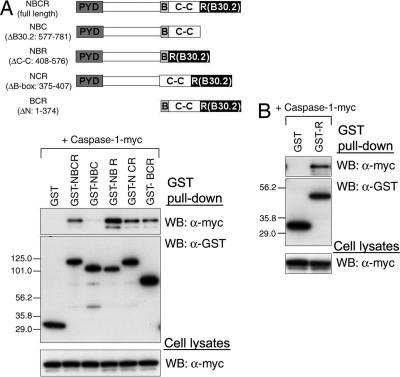
Interaction of the B30.2 domain of human pyrin with caspase-1. (A) Human caspase-1 was cotransfected into PT67 cells with various N-terminal GST-fused pyrin-expressing constructs depicted in the schematic, as indicated. PYD, pyrin domain; B, B-box zinc finger domain; C-C, coiled-coil domain; R, B30.2 domain. Lysates were analyzed as in Fig. 2B. (B) Caspase-1 was cotransfected with GST vector (first lane) or GST-fused B30.2 domain of pyrin. Lysates were analyzed as in Fig. 2B.
Fig. 4.
Fig. 4.
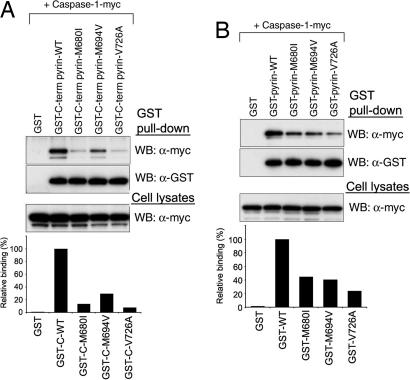
The binding of the B30.2 domain of human pyrin to caspase-1 is reduced by FMF-associated mutations. (A) Myc-tagged human caspase-1 was cotransfected with GST-fused WT or FMF-associated mutant C-terminal (amino acids 375–781) pyrin into PT67 cells and analyzed as in Fig. 2B. Densitometric analysis of α-myc bands, normalized to the α-myc bands in cell lysates, is shown in the histogram below. (B) Myc-tagged caspase-1 was cotransfected with GST-fused WT or FMF-associated mutant full-length pyrin into PT67 cells and analyzed as in A.
Fig. 5.
Fig. 5.
Inhibition of caspase-1-mediated IL-1β processing by human pyrin. (A) pIRES-IL1β/ICE or pIRES-ICE (3 μg) was cotransfected with various amounts of empty vector, WT, or FMF-associated mutant full-length pyrin into PT67 cells. After 48 h, cell culture medium was changed with fresh medium. Cell culture supernatants were collected 3 h later and assayed for IL-1β by ELISA. Data represent the mean ± SE from five complete independent experiments. ∗, P < 0.05; ∗∗, P < 0.005; ∗∗∗, P < 0.0005. Western blots demonstrating increasing amounts of the transfected pyrin proteins are shown below. (B) Three micrograms of pIRES-IL1β/ICE, pIRES-IL1β, or pIRES-ICE were cotransfected with 2 μg of empty vector, WT, or FMF-associated mutant full-length pyrin into PT67 cells, and cell culture supernatants were collected and analyzed as in A. In the fifth lane, the caspase-1 inhibitor z-WEHD-fmk was added (at 20 μM) to the culture medium. Data represent the mean ± SE from three replicate experiments. Western blots for the three transfected proteins are shown in Middle. Bottom is a histogram of the amount inhibition of IL-1β in the culture supernatants relative to the inhibition with z-WEHD-fmk.
Fig. 6.
Fig. 6.
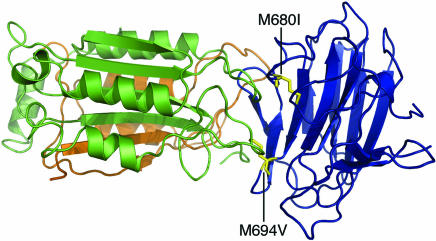
A model for the interaction of pyrin with caspase-1. A model for the B30.2 domain of pyrin (blue) was docked to the crystal structure of caspase-1 (p20, green; p10, brown). Two common mutations that cause FMF (M694V and M680I, yellow) are located in the putative binding interface.
Fig. 7.
Fig. 7.
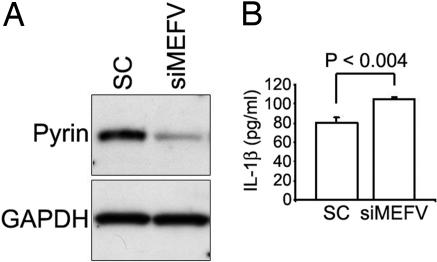
Knockdown of endogenous pyrin in THP-1 cells. Cells were transfected with MEFV siRNA or a scrambled sequence dsRNA control and after 72 h were stimulated with 100 ng/ml LPS for 4 h. (A) Western blot of cell lysates probed with Abs to pyrin or GAPDH. (B) ELISA of culture supernatants for IL-1β. Data represent the mean ± SE for three replicate cultures. Data are from a representative experiment from six independent transfections.

References

    1. Galon J., Aksentijevich I., McDermott M. F., O’Shea J. J., Kastner D. L. Curr. Opin. Immunol. 2000;12:479–486. - PubMed
    1. Stojanov S., Kastner D. L. Curr. Opin. Rheumatol. 2005;17:586–599. - PubMed
    1. Kastner D. L., Aksentijevich I. Arthritis and Allied Conditions. In: Koopman W. J., Moreland L. W., editors. Philadelphia: Lippincott Williams and Wilkins; 2005. pp. 1411–1461.
    1. International FMF Consortium. Cell. Vol. 90. 1997. pp. 797–807. - PubMed
    1. French FMF Consortium. Nat. Genet. 1997;17:25–31. - PubMed

MeSH terms