. 2006 Jul 5;103(27):10224-10229.
doi: 10.1073/pnas.0603968103. Epub 2006 Jun 20.

Reversible lysine acetylation controls the activity of the mitochondrial enzyme acetyl-CoA synthetase 2

Affiliations

Reversible lysine acetylation controls the activity of the mitochondrial enzyme acetyl-CoA synthetase 2

Bjoern Schwer et al. Proc Natl Acad Sci U S A. .

Abstract

We report that human acetyl-CoA synthetase 2 (AceCS2) is a mitochondrial matrix protein. AceCS2 is reversibly acetylated at Lys-642 in the active site of the enzyme. The mitochondrial sirtuin SIRT3 interacts with AceCS2 and deacetylates Lys-642 both in vitro and in vivo. Deacetylation of AceCS2 by SIRT3 activates the acetyl-CoA synthetase activity of AceCS2. This report identifies the first acetylated substrate protein of SIRT3. Our findings show that a mammalian sirtuin directly controls the activity of a metabolic enzyme by means of reversible lysine acetylation. Because the activity of a bacterial ortholog of AceCS2, called ACS, is controlled via deacetylation by a bacterial sirtuin protein, our observation highlights the conservation of a metabolic regulatory pathway from bacteria to humans.


Figures
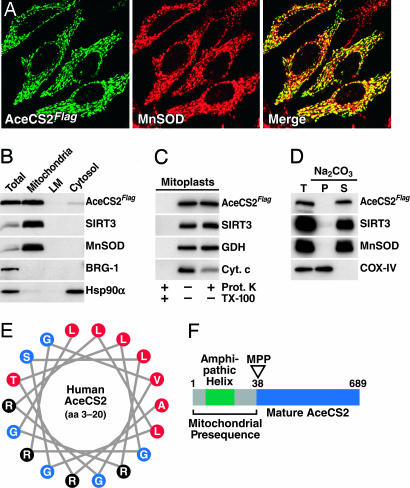
Fig. 1.
Fig. 1.
Human AceCS2 is a soluble mitochondrial matrix protein. (A) Mitochondrial localization of human AceCS2Flag in HeLa cells. (B) Equal amounts (30 μg) of total cell extract (Total), mitochondria, light membranes (LM), and cytosolic proteins were analyzed by immunoblotting. (C) Submitochondrial localization of AceCS2Flag. (D) AceCS2Flag is a soluble protein. Mitochondria were isolated and either directly solubilized in SDS sample buffer (T, total) or extracted with sodium carbonate (Na2CO3, pH 11.5). The alkaline extract was separated into a membrane fraction (P, pellet) and a fraction containing sodium carbonate soluble proteins (S, supernatant) by ultracentrifugation. (E) The N terminus of human AceCS2 contains an amphipathic α-helix. A region of AceCS2 (amino acids 3–20) predicted by computational secondary structure analysis to form an α-helix was plotted as a helical wheel. Black, basic residues; red, hydrophobic residues; blue, neutral residues. (F) Illustration of the mitochondrial presequence and cleavage site of human AceCS2 as determined by N-terminal protein sequencing and liquid chromatography-tandem MS analysis. For details, see text. MPP, mitochondrial matrix processing peptidase.
Fig. 2.
Fig. 2.
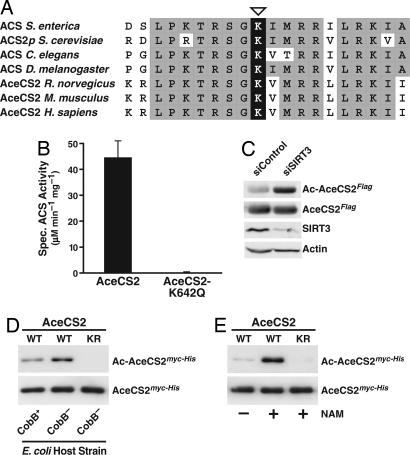
The conserved active-site lysine of human AceCS2 is subject to reversible acetylation. (A) Multiple sequence alignment of the active-site region of acetyl-CoA synthetases from different species and human AceCS2. The active-site lysine is marked by an open triangle. (B) Lys-642 is critical for AceCS2 function. AceCS2HA or AceCS2-K642QHA were expressed in HEK293 cells and immunoprecipitated, and the specific acetyl-CoA synthetase (ACS) activity was determined. Data are means + SD from three independent acetyl-CoA synthetase activity assays. (C) Reduction of endogenous SIRT3 levels increases the acetylation level of AceCS2Flag. Double-stranded siRNAs directed against human SIRT3 (siSIRT3) or firefly luciferase GL3 (siControl) were transfected into HEK293 cells stably expressing AceCS2Flag. Acetylation of immunoprecipitated AceCS2Flag was analyzed by immunoblotting with antibodies to acetylated lysine (Ac-AceCS2Flag). Membranes were stripped and reprobed for total AceCS2 amounts (AceCS2Flag). Immunoblotting of total cell extracts with α-SIRT3 and α-actin antibodies confirmed the efficiency and specificity of the siRNA treatment. (D) Removal or inhibition of the sirtuin CobB results in hyperacetylation of the active-site lysine of human AceCS2 in bacteria. Equal amounts of purified human myc-His-tagged AceCS2 (WT) or AceCS2-K642R (KR) from CobB or CobB+ E. coli were analyzed by immunoblotting with an acetyl-lysine-specific antibody (Ac-AceCS2myc-His). Blots were stripped and reprobed with α-myc antibodies to show total levels of AceCS2 (AceCS2myc-His). (E) Inhibition of bacterial sirtuins by NAM during expression of recombinant human AceCS2 protein causes hyperacetylation of human AceCS2 at Lys-642. Equal amounts of the purified recombinant proteins were analyzed as in D.
Fig. 3.
Fig. 3.
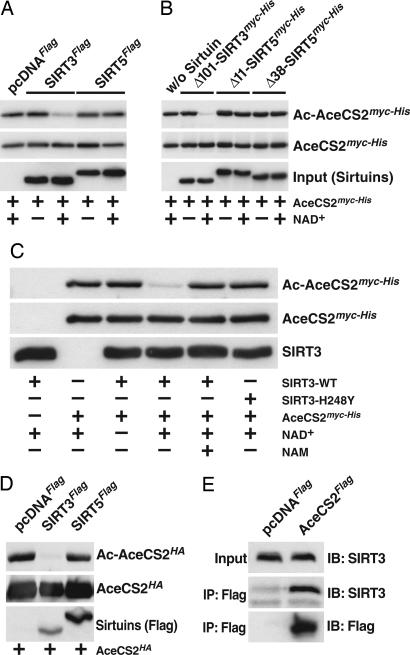
SIRT3 but not SIRT5 deacetylates AceCS2. (A) Recombinant human AceCS2myc-His purified from NAM-treated E. coli was incubated with Flag-tagged SIRT3 or SIRT5 immunoprecipitated from HEK293 cells. As a control, α-Flag immunoprecipitates from pcDNAFlag-expressing HEK293 cells were used in the reactions (left lane). Deacetylation reactions were incubated in the presence or absence of NAD+. All reactions were carried out in the presence of trichostatin A. Reactions were stopped by the addition of SDS sample buffer, boiled, and analyzed by immunoblotting. Acetylated AceCS2myc-His was detected with acetyl-lysine-specific antibodies (Ac-AceCS2myc-His). Blots were stripped and probed for total levels of AceCS2 with α-myc antibodies (AceCS2myc-His). The presence of Flag-tagged SIRT3 and SIRT5 was verified by immunoblotting with α-Flag antibodies {bottom blot [Input (Sirtuins)]}. (B) Recombinant human AceCS2 purified from NAM-treated E. coli was incubated with purified recombinant sirtuins in the presence or absence of NAD+ and in the presence of trichostatin A and analyzed as described in A. Recombinant SIRT3 or SIRT5 proteins were detected by probing with α-myc-antibodies {bottom blot [Input (Sirtuins)]}. (C) SIRT3, but not a catalytically inactive mutant of SIRT3, deacetylates AceCS2 in vitro. Deacetylation assays were performed and analyzed as described above. Where indicated, NAM was included during the incubation. (D) Overexpression of SIRT3 decreases the acetylation of ectopically expressed AceCS2. COS-1 cells were cotransfected with AceCS2HA and pcDNAFlag, SIRT3Flag, or SIRT5Flag. Acetylation of immunoprecipitated AceCS2HA was analyzed by immunoblotting with antibodies to acetylated lysine (Ac-AceCS2HA). Membranes were stripped and reprobed for total AceCS2 amounts (AceCS2HA) by probing with an α-hemagglutinin antibody. The expression of SIRT3Flag and SIRT5Flag in the total cell lysate was verified by immunoblotting with α-Flag antibodies [Sirtuins (Flag)]. (E) AceCS2 and SIRT3 coimmunoprecipitate from cells. α-Flag immune complexes from HEK293 cell lines stably expressing AceCS2Flag or an empty Flag-control vector (pcDNAFlag) were analyzed for the presence of endogenous SIRT3.
Fig. 4.
Fig. 4.
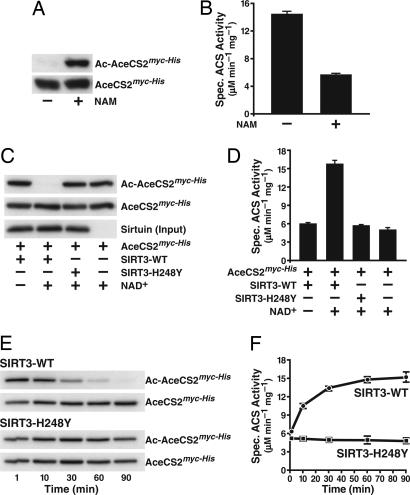
Acetylation of Lys-642 controls the acetyl-CoA synthetase activity of human AceCS2. (A) Recombinant human AceCS2 was expressed in bacteria in the presence or absence of NAM. Acetylation levels and total amounts of AceCS2 were analyzed by immunoblotting with acetyl-lysine-specific antibodies or α-myc antibodies. (B) Specific activity of purified AceCS2 expressed in the presence or absence of NAM. The data are means + SD from three independent experiments. (C) NAD+-dependent deacetylation of AceCS2 by SIRT3 but not by SIRT3-H248Y. The bottom blot indicates that equal amounts of SIRT3 or SIRT3-H248Y were added to the deacetylation reactions. (D) Deacetylation of AceCS2 by SIRT3 activates its acetyl-CoA synthetase activity. Equal amounts of AceCS2 were incubated in the absence or presence of SIRT3 or a catalytically inactive SIRT3 mutant (SIRT3-H248Y). Where indicated, NAD+ was added during the incubation. The deacetylation reaction was stopped by the addition of NAM, and the specific activity of AceCS2 was determined. Data are means + SD from three independent activity determinations. (E) Time-dependent activation of AceCS2 by SIRT3. Recombinant human AceCS2 purified from NAM-treated bacteria was incubated with recombinant SIRT3 or SIRT3-H248Y. Samples were brought to 32°C, and NAD+ was added. At the indicated time points, aliquots of the reaction were removed, mixed with NAM, and incubated on ice. The immunoblots show the progressive deacetylation of AceCS2 by SIRT3 but not by SIRT3-H248Y. (F) The specific activity of AceCS2 after incubation with recombinant SIRT3 or SIRT3-H248Y for the indicated time was determined. Means ± SD from three independent activity assays are shown.
Fig. 5.
Fig. 5.
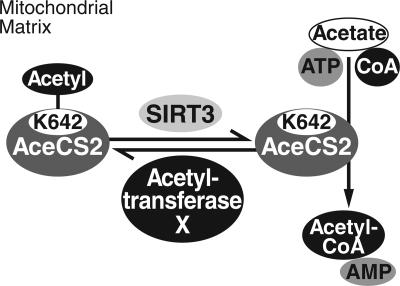
Schematic illustration of AceCS2 regulation by reversible lysine acetylation of Lys-642. Deacetylation of AceCS2 by SIRT3 activates its acetyl-CoA synthetase activity. The identity of the protein acetyltransferase of AceCS2 is unknown and is therefore labeled Acetyltransferase X.

References

    1. Han K. K., Martinage A. Int. J. Biochem. 1992;24:19–28. - PubMed
    1. Yang X. J. BioEssays. 2004;26:1076–1087. - PubMed
    1. Kaeberlein M., McVey M., Guarente L. Genes Dev. 1999;13:2570–2580. - PMC - PubMed
    1. Tissenbaum H. A., Guarente L. Nature. 2001;410:227–230. - PubMed
    1. Lin S. J., Defossez P. A., Guarente L. Science. 2000;289:2126–2128. - PubMed

Publication types

MeSH terms