. 2006 Jul;188(13):4918-25.
doi: 10.1128/JB.00162-06.

Interactions between Streptomyces coelicolor and Bacillus subtilis: Role of surfactants in raising aerial structures

Affiliations

Interactions between Streptomyces coelicolor and Bacillus subtilis: Role of surfactants in raising aerial structures

Paul D Straight et al. J Bacteriol. 2006 Jul.

Abstract

Using mixed-species cultures, we have undertaken a study of interactions between two common spore-forming soil bacteria, Bacillus subtilis and Streptomyces coelicolor. Our experiments demonstrate that the development of aerial hyphae and spores by S. coelicolor is inhibited by surfactin, a lipopeptide surfactant produced by B. subtilis. Current models of aerial development by sporulating bacteria and fungi postulate a role for surfactants in reducing surface tension at air-liquid interfaces, thereby removing the major barrier to aerial growth. S. coelicolor produces SapB, an amphipathic peptide that is surface active and required for aerial growth on certain media. Loss of aerial hyphae in developmental mutants can be rescued by addition of purified SapB. While a surfactant from a fungus can substitute for SapB in a mutant that lacks aerial hyphae, not all surfactants have this effect. We show that surfactin is required for formation of aerial structures on the surface of B. subtilis colonies. However, in contrast to this positive role, our experiments reveal that surfactin acts antagonistically by arresting S. coelicolor aerial development and causing altered expression of developmental genes. Our observations support the idea that surfactants function specifically for a given organism regardless of their shared ability to reduce surface tension. Production of surfactants with antagonistic activity could provide a powerful competitive advantage during surface colonization and in competition for resources.


Figures
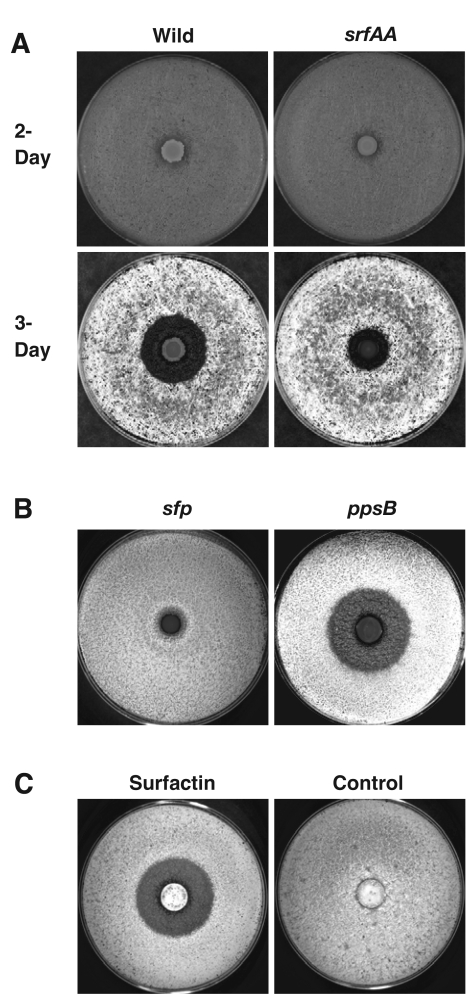
FIG. 1.
FIG. 1.
B. subtilis inhibits aerial hyphal development by S. coelicolor through the action of surfactin. Agar petri dishes covered with a lawn of S. coelicolor spores were spotted with 2.5 μl of an overnight culture of B. subtilis. B. subtilis colonies are visible as discreet spots in the center of the plate. Plates were incubated for 2 to 3 days at 30°C. (A) After 2 days at 30°C, comparison of a wild-type strain (left) with an srfAA mutant strain (right) reveals no inhibition of substrate mycelial growth (2-day). After 3 days, aerial hyphae appear as a hairy, white surface on the agar plate. Aerial hyphae do not form surrounding the wild-type B. subtilis colony (3-day). Surrounding the srfAA mutant colony, aerial growth is largely unimpeded. (B) Inhibition of aerial growth requires Sfp (left), an enzyme needed for the synthesis of surfactin and plipastatin lipopeptides. A ppsB (plipastatin) mutant strain inhibits aerial development to the same degree as the wild-type strain. (C) Purified surfactin (10 μg/μl in ethanol) placed on a Whatman filter circle is sufficient for inhibition of aerial development. The control filter contains only ethanol.
FIG. 2.
FIG. 2.
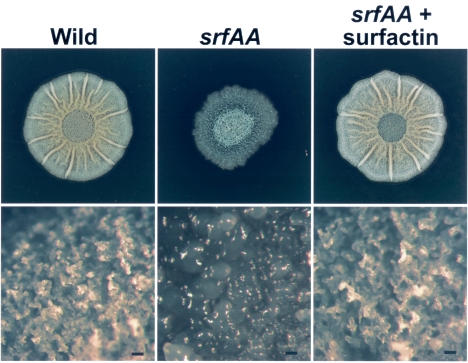
Development of fruiting-body-like aerial projections on the surface of a B. subtilis colony requires surfactin. (Top) Colonies of wild-type and srfAA mutant strains were spotted onto MSgg plates that were pretreated by spotting directly on the plate either 50 μl of 100% ethanol (Wild and srfAA) or 50 μl of a 10-μg/μl surfactin solution in 100% ethanol (srfAA + surfactin). Wild-type morphology is restored to the srfAA mutant strain upon addition of purified surfactin. (Bottom) Higher magnification of the colony surfaces from the top panels shows that surfactin is sufficient to restore fruiting bodies to a srfAA mutant. The wild-type strain of B. subtilis (left) produces aerial projections. The surfactin-deficient srfAA mutant strain (center) has a smooth colony surface lacking aerial projections. When 50 μl of a 10-μg/μl solution of purified surfactin is added to the plate, aerial projections are formed by the srfAA mutant strain. Bars, 100 μm.
FIG. 3.
FIG. 3.
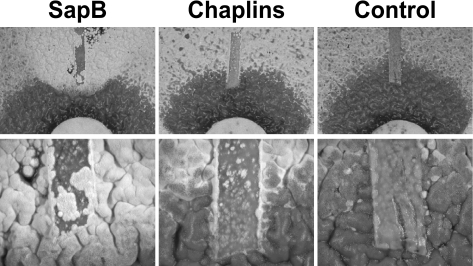
The balding effect of surfactin is overcome by addition of SapB and chaplin protein extract. SapB (left) and TFA-extracted chaplins (center) were added to nylon filters placed at the edge of the surfactin-inhibited bald zone. DMSO (right) was added as a control. Treatment with SapB restores aerial growth to an area within the surfactin-treated zone surrounding the filter strip. Treatment with the chaplin extract is weakly but detectably effective in overcoming surfactin-induced balding. The control strip (right) shows no effect on inhibition of aerial growth from surfactin treatment. Top, plate photographs; bottom, high magnification (×80).

References

    1. Atlas, R., and R. Bartha. 1998. Microbial ecology: fundamentals and application. Benjamin/Cummings Publishing, San Francisco, Calif.
    1. Branda, S. S., J. E. Gonzalez-Pastor, S. Ben-Yehuda, R. Losick, and R. Kolter. 2001. Fruiting body formation by Bacillus subtilis. Proc. Natl. Acad. Sci. USA 98:11621-11626. - PMC - PubMed
    1. Chater, K. F. 1993. Genetics of differentiation in Streptomyces. Annu. Rev. Microbiol. 47:685-713. - PubMed
    1. Chater, K. F. 1989. Multilevel regulation of Streptomyces differentiation. Trends Genet. 5:372-377. - PubMed
    1. Chater, K. F. 2001. Regulation of sporulation in Streptomyces coelicolor A32: a checkpoint multiplex? Curr. Opin. Microbiol. 4:667-673. - PubMed

Publication types

MeSH terms

Substances

LinkOut - more resources