. 2006 Jul;188(13):4942-51.
doi: 10.1128/JB.00298-06.

Functional identification of conjugation and replication regions of the tetracycline resistance plasmid pCW3 from Clostridium perfringens

Affiliations

Functional identification of conjugation and replication regions of the tetracycline resistance plasmid pCW3 from Clostridium perfringens

Trudi L Bannam et al. J Bacteriol. 2006 Jul.

Abstract

Clostridium perfringens causes fatal human infections, such as gas gangrene, as well as gastrointestinal diseases in both humans and animals. Detailed molecular analysis of the tetracycline resistance plasmid pCW3 from C. perfringens has shown that it represents the prototype of a unique family of conjugative antibiotic resistance and virulence plasmids. We have identified the pCW3 replication region by deletion and transposon mutagenesis and showed that the essential rep gene encoded a basic protein with no similarity to any known plasmid replication proteins. An 11-gene conjugation locus containing 5 genes that encoded putative proteins with similarity to proteins from the conjugative transposon Tn916 was identified, although the genes' genetic arrangements were different. Functional genetic studies demonstrated that two of the genes in this transfer clostridial plasmid (tcp) locus, tcpF and tcpH, were essential for the conjugative transfer of pCW3, and comparative analysis confirmed that the tcp locus was not confined to pCW3. The conjugation region was present on all known conjugative plasmids from C. perfringens, including an enterotoxin plasmid and other toxin plasmids. These results have significant implications for plasmid evolution, as they provide evidence that a nonreplicating Tn916-like element can evolve to become the conjugation locus of replicating plasmids that carry major virulence genes or antibiotic resistance determinants.


Figures
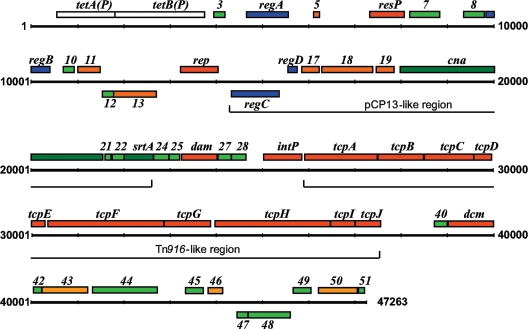
FIG. 1.
FIG. 1.
Genetic organization of pCW3. The first T of the −35 box of the promoter for the tetAB(P) operon (24), which encodes tetracycline resistance, was designated nucleotide number 1. ORFs on the sense and complementary strands are indicated above and below the plasmid line, respectively. Genes with unknown functions are indicated by their designated pCW3 gene number, putative conjugation genes as tcp genes, and putative regulatory genes as reg genes. The labeled bars indicate regions with either similarity to a locus present on pCP13 or genes whose products have low-level similarity to Tn916 conjugation proteins. Colors indicate the gene product's function: red, DNA metabolism (replication, recombination, DNA transfer, and modification); dark green, membrane and surface associated; yellow, miscellaneous metabolism; orange, conserved hypothetical; light green, unknown; white, antibiotic resistance; and blue, regulation.
FIG. 2.
FIG. 2.
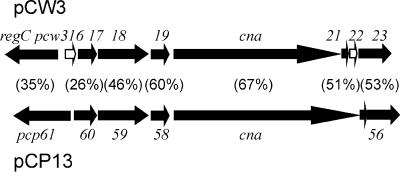
Genetic comparison of the cna locus. Depicted are the arrangement and coding orientation of the genes surrounding the cna gene within both pCW3 and pCP13. The percentages of amino acid sequence identities between the encoded proteins are shown in parentheses. Genes present only on pCW3 are filled in with white.
FIG. 3.
FIG. 3.
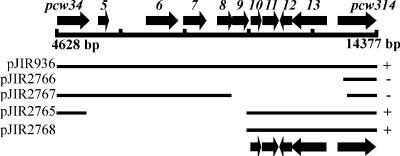
Localization of the pCW3 plasmid replication region. Shown at the top is the genetic organization of the relevant 9.8-kb ClaI fragment of pCW3. At the bottom, the line diagrams denote the region of pCW3 contained within each of the depicted plasmids. A plus sign indicates that the plasmid replicates independently in C. perfringens; a minus sign indicates that the plasmid does not replicate independently in C. perfringens.
FIG. 4.
FIG. 4.
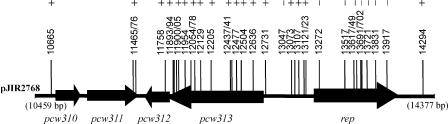
Identification of the rep gene. The arrows indicate the pCW3-derived genes within the cloned insert of pJIR2768. Vertical lines with numbers represent independent EZ::TN insertion mutants within pJIR2768. Insertion derivatives are named by corresponding base pairs within the pCW3 sequence. A plus sign indicates that the EZ::TN-containing pJIR2768 derivative plasmid replicates independently in C. perfringens; a minus sign indicates that the EZ::TN-containing pJIR2768 derivative plasmid does not replicate independently in C. perfringens.
FIG. 5.
FIG. 5.
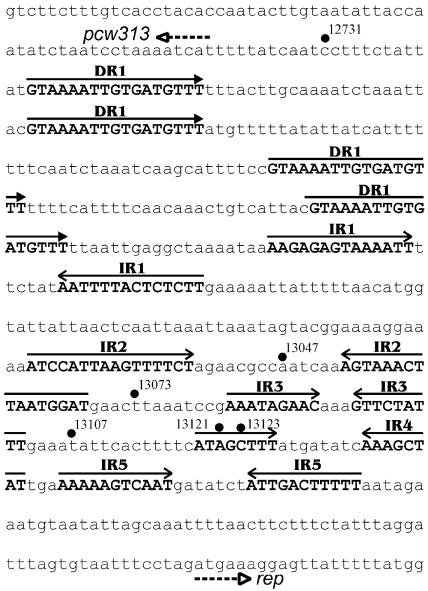
Repeated elements in the intergenic region between the pcw313 and rep genes. Depicted is the pCW3 nucleotide sequence from bp 12661 to 13260. Closed arrowheads denote the four copies of the identical direct repeats (DR1). The open-headed arrows depict the five pairs of perfect inverted repeats (IR1 to IR5). Shaded circles highlight insertion sites of EZ::TN derivatives in this region. The dotted line shows the location of the pcw313 and rep genes.
FIG. 6.
FIG. 6.
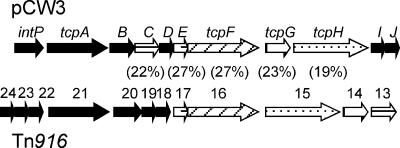
Genetic comparison of the transfer-related regions of pCW3 and Tn916. Numbers in parentheses denote the percentages of amino acid sequence identity between the encoded proteins. Related genes are shaded in a similar manner. Genes shaded black encode proteins with no similarity.
FIG. 7.
FIG. 7.
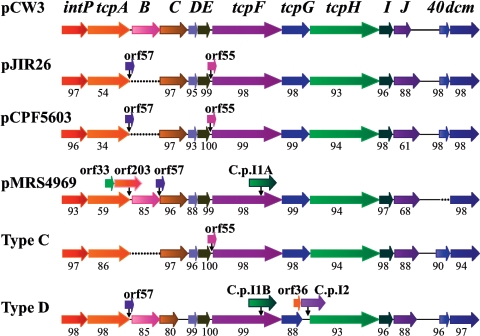
Comparative analysis of the intP to dcm region. The genetic organization of this region within pCW3 is depicted at the top of the diagram. The genetic maps of the tcp regions of the tetracycline resistance plasmid pJIR26 and the CPE-derived plasmid pMRS4969 were determined as part of this study, and that of pCPF5603 is from Miyamoto et al. (36). The comparative maps of the equivalent regions from type C and type D toxin plasmids were derived from data from The Institute for Genomic Research (see the text). Insertions with respect to the pCW3 sequence are indicated by arrows above the linear maps. Deletions with respect to the pCW3 sequence are depicted by dotted lines. Related genes are shaded in a similar manner. Percentages indicate amino acid sequence identity to the equivalent pCW3 homologue.

References

    1. Abraham, L. J., and J. I. Rood. 1985. Cloning and analysis of the Clostridium perfringens tetracycline resistance plasmid, pCW3. Plasmid 13:155-162. - PubMed
    1. Abraham, L. J., and J. I. Rood. 1987. Identification of Tn4451 and Tn4452, chloramphenicol resistance transposons from Clostridium perfringens. J. Bacteriol. 169:1579-1584. - PMC - PubMed
    1. Abraham, L. J., A. J. Wales, and J. I. Rood. 1985. Worldwide distribution of the conjugative Clostridium perfringens tetracycline resistance plasmid, pCW3. Plasmid 14:37-46. - PubMed
    1. Adams, V., I. S. Lucet, D. Lyras, and J. I. Rood. 2004. DNA binding properties of TnpX indicate that different synapses are formed in the excision and integration of the Tn4451 family. Mol. Microbiol. 53:1195-1207. - PubMed
    1. Adams, V., D. Lyras, K. A. Farrow, and J. I. Rood. 2002. The clostridial mobilisable transposons. Cell. Mol. Life Sci. 59:2033-2043. - PMC - PubMed

Publication types

Associated data

LinkOut - more resources