


Molecular cloning of a Trypanosoma cruzi cell surface casein kinase II substrate, Tc-1, involved in cellular infection
- PMID: 16790765
- PMCID: PMC1489715
- DOI: 10.1128/IAI.00045-06
Molecular cloning of a Trypanosoma cruzi cell surface casein kinase II substrate, Tc-1, involved in cellular infection
Abstract
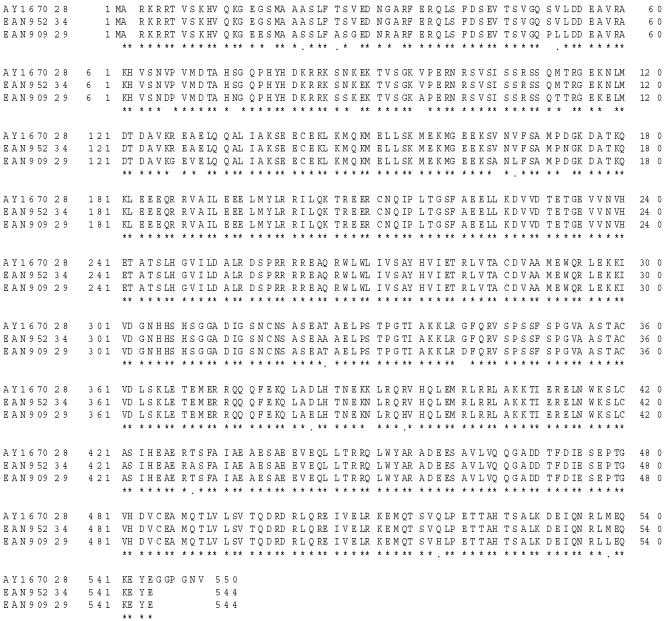
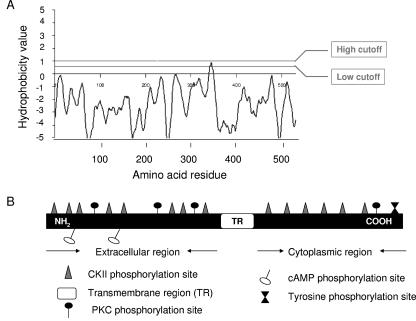
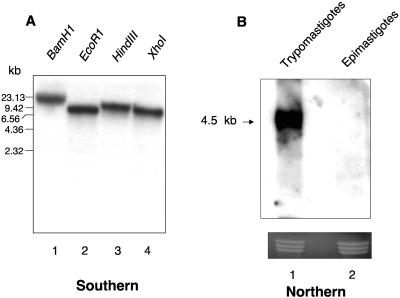
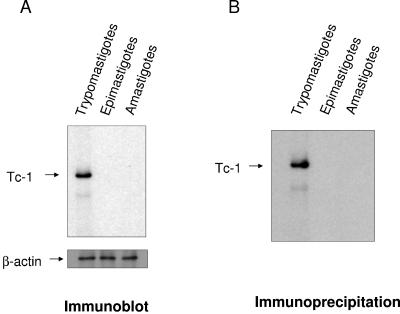
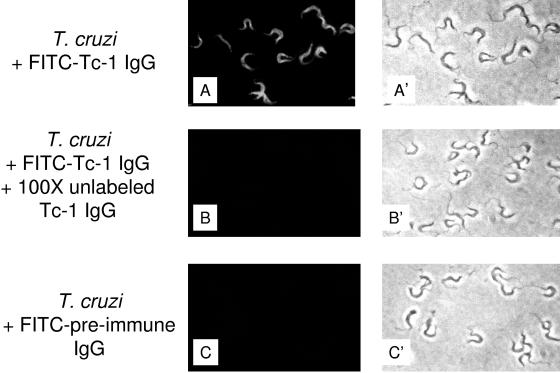
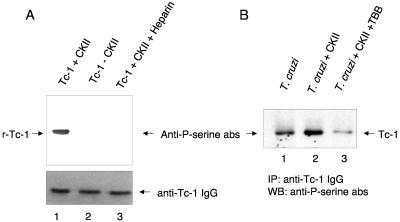
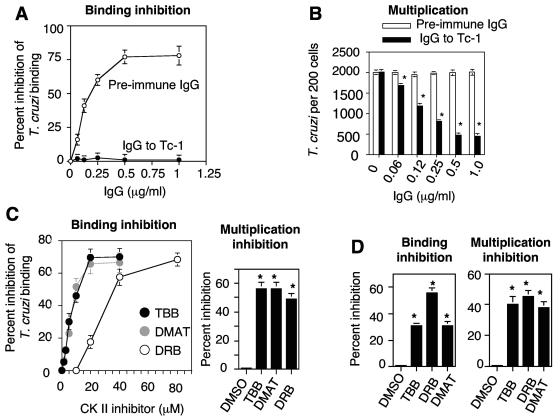
In this work, we report the cloning and characterization of the first cell surface casein kinase II (CKII) substrate (Tc-1) of Trypanosoma cruzi, the causative agent of Chagas' disease. Analysis of the gene sequence revealed a 1,653-bp open reading frame coding for 550 amino acid residues. Northern blot analysis showed a 4.5-kb transcript that is expressed in invasive trypomastigotes but not in noninvasive epimastigote forms of T. cruzi. Southern blot analysis indicates that Tc-1 is a single-copy gene. At the amino acid level, Tc-1 displayed 95% and 99% identity to two hypothetical proteins recently reported by the T. cruzi genome project. Analysis of the translated amino acid sequence indicates that the Tc-1 gene has a putative transmembrane domain with multiple cytoplasmic and extracellular CKII phosphosites. Exogenous human CKII was able to phosphorylate serine residues on both recombinant Tc-1 and Tc-1 of intact trypomastigotes. This phosphorylation was inhibited by the CKII inhibitors heparin and 4,5,6,7,-tetrabromo-2-azabenzimidazole. Immunoblots of solubilized trypomastigotes, epimastigotes, and amastigotes probed with anti-recombinant Tc-1 immunoglobulin G revealed a 62-kDa protein that is expressed only in infective trypomastigotes. Immunoprecipitation of labeled surface proteins of trypomastigotes indicated that the 62-kDa protein is a surface protein, and we found that the protein is uniformly distributed on the surface of trypomastigotes by direct immunofluorescence. Antibodies to Tc-1 effectively blocked trypomastigote invasion of host cells and consequently reduced parasite load. Preincubation of either trypomastigotes or myoblasts with CKII inhibitors blocked T. cruzi infection. Thus, for the first time, we describe a cell surface CKII substrate of a protozoan parasite that is phosphorylated by human CKII and that is involved in cellular infection.
Figures
References
-
- Burleigh, B. B., and A. M. Woolsey. 2002. Cell signaling and Trypanosoma cruzi invasion. Cell. Microbiol. 4:701-711. - PubMed
-
- El-Sayed, N. M., P. J. Myler, G. Blandin, M. Berriman, J. Crabtree, G. Aggarwal, E. Caler, H. Renauld, E. A. Worthey, C. Hertz-Fowler, E. Ghedin, C. Peacock, D. C. Bartholomeu, B. J. Haas, A. N. Tran, J. R. Wortman, U. C. Alsmark, S. Angiuoli, A. Anupama, J. Badger, F. Bringaud, E. Cadag, J. M. Carlton, G. C. Cerqueira, T. Creasy, A. L. Delcher, A. Djikeng, T. M. Embley, C. Hauser, A. C. Ivens, S. K. Kummerfeld, J. B. Pereira-Leal, D. Nilsson, J. Peterson, S. L. Salzberg, J. Shallom, J. C. Silva, J. Sundaram, S. Westenberger, O. White, S. E. Melville, J. E. Donelson, B. Andersson, K. D. Stuart, and N. Hall. 2005. Comparative genomics of trypanosomatid parasitic protozoa. Science 309:404-409. - PubMed
Publication types
MeSH terms
Substances
Associated data
- Actions
Grants and funding
- T32 HL007737/HL/NHLBI NIH HHS/United States
- MD 000104/MD/NIMHD NIH HHS/United States
- HL 007737/HL/NHLBI NIH HHS/United States
- G12 RR003032/RR/NCRR NIH HHS/United States
- GM 08037/GM/NIGMS NIH HHS/United States
- RR 003032/RR/NCRR NIH HHS/United States
- S21 MD000104/MD/NIMHD NIH HHS/United States
- S06 GM008037/GM/NIGMS NIH HHS/United States
- T32 AI007281/AI/NIAID NIH HHS/United States
- F31 AI056667/AI/NIAID NIH HHS/United States
- AI 056667/AI/NIAID NIH HHS/United States
- GM 05994/GM/NIGMS NIH HHS/United States
- AI 07281/AI/NIAID NIH HHS/United States
LinkOut - more resources
Full Text Sources
Other Literature Sources
