


Issues in estimating risks and rates in sports injury research
- PMID: 16791309
- PMCID: PMC1472638
Issues in estimating risks and rates in sports injury research
Abstract
Objective: To describe 3 measures of incidence used in sports injury epidemiology.
Background: To promote safety in sports, athletic trainers must be able to accurately interpret and apply injury data and statistics. Doing so allows them to more efficiently articulate this information to school administrators in recommending increases in medical resources, such as more personnel, better services, and safer facilities and equipment.
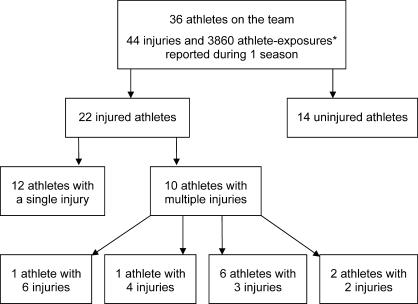
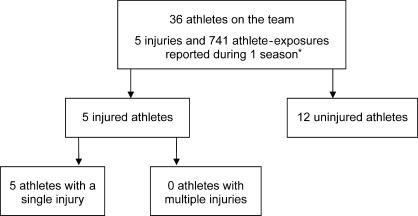
Description: Using data from a study of high school sports injuries, we review incidence rates, epidemiologic incidence proportions, and clinical incidence. The incidence rate is the number of injuries divided by the number of athlete-exposures and is based on the epidemiologic concept of person-time at risk. It accounts for variation in exposure between athletes and teams and is widely used by researchers. The epidemiologic incidence proportion is the number of injured athletes divided by the number of athletes at risk. It is a valid estimator of average injury risk, yet it is rarely used in sports injury epidemiology to communicate information about such risks to nonscientists. Clinical incidence is a hybrid between the epidemiologic incidence proportion and the incidence rate in that it uses the number of injuries in the numerator but the number of athletes at risk in the denominator. It has been widely used in research on high school football injury but is neither a valid estimator of risk nor a true rate.
Advantages: Athletic trainers who understand the causes of and risk factors for sport-related injury are better positioned to make safe return-to-play decisions and decrease the likelihood of reinjury in athletes.
Figures
References
-
- Rothman KJ, Greenland S. Measures of disease frequency. In: Rothman KJ, Greenland S, eds. Modern Epidemiology. 2nd ed. Philadelphia, PA: Lippincott Williams & Wilkins; 1998:29–46 .
-
- Weaver NL, Mueller FO, Kalsbeek WD, Bowling JM. The North Carolina high school athletic injury study: design and methodology. Med Sci Sports Exerc. 1999;31:176–182. - PubMed
-
- Schulz MR, Marshall SW, Yang J, Mueller FO, Weaver NL, Bowling JM. A prospective cohort study of injury incidence and risk factors in North Carolina high school competitive cheerleaders. Am J Sports Med. 2004;32:396–405. - PubMed
-
- Yang J, Marshall SW, Bowling JM, Runyan CW, Mueller FO, Lewis MA. Use of discretionary protective equipment and rate of lower extremity injury in high school athletes. Am J Epidemiol. 2005;161:511–519. - PubMed
LinkOut - more resources
Full Text Sources