


Circular instead of hierarchical: methodological principles for the evaluation of complex interventions
- PMID: 16796762
- PMCID: PMC1540434
- DOI: 10.1186/1471-2288-6-29
Circular instead of hierarchical: methodological principles for the evaluation of complex interventions
Abstract
Background: The reasoning behind evaluating medical interventions is that a hierarchy of methods exists which successively produce improved and therefore more rigorous evidence based medicine upon which to make clinical decisions. At the foundation of this hierarchy are case studies, retrospective and prospective case series, followed by cohort studies with historical and concomitant non-randomized controls. Open-label randomized controlled studies (RCTs), and finally blinded, placebo-controlled RCTs, which offer most internal validity are considered the most reliable evidence. Rigorous RCTs remove bias. Evidence from RCTs forms the basis of meta-analyses and systematic reviews. This hierarchy, founded on a pharmacological model of therapy, is generalized to other interventions which may be complex and non-pharmacological (healing, acupuncture and surgery).
Discussion: The hierarchical model is valid for limited questions of efficacy, for instance for regulatory purposes and newly devised products and pharmacological preparations. It is inadequate for the evaluation of complex interventions such as physiotherapy, surgery and complementary and alternative medicine (CAM). This has to do with the essential tension between internal validity (rigor and the removal of bias) and external validity (generalizability).
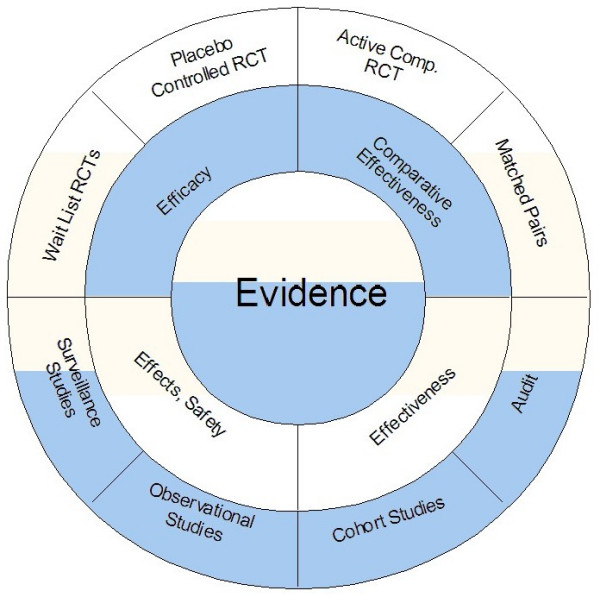
Summary: Instead of an Evidence Hierarchy, we propose a Circular Model. This would imply a multiplicity of methods, using different designs, counterbalancing their individual strengths and weaknesses to arrive at pragmatic but equally rigorous evidence which would provide significant assistance in clinical and health systems innovation. Such evidence would better inform national health care technology assessment agencies and promote evidence based health reform.
Figures
References
-
- Therapy Conferences on. The use of placebos in therapy. New York Journal of Medicine. 1946;46:1718–1727. - PubMed
-
- Reilly D, Taylor MA. The evidence profile. The mulitdimensional nature of proof. Complementary Therapies in Medicine. 1993;1:11–12.
Publication types
MeSH terms
Substances
LinkOut - more resources
Full Text Sources
