. 2006 Jul 5;103(27):10497-10502.
doi: 10.1073/pnas.0600913103. Epub 2006 Jun 23.

Deletion of the neuropeptide Y (NPY) Y1 receptor gene reveals a regulatory role of NPY on catecholamine synthesis and secretion

Affiliations

Deletion of the neuropeptide Y (NPY) Y1 receptor gene reveals a regulatory role of NPY on catecholamine synthesis and secretion

Cláudia Cavadas et al. Proc Natl Acad Sci U S A. .

Abstract

The contribution of neuropeptide Y (NPY), deriving from adrenal medulla, to the adrenosympathetic tone is unknown. We found that in response to NPY, primary cultures of mouse adrenal chromaffin cells secreted catecholamine, and that this effect was abolished in cultures from NPY Y(1) receptor knockout mice (Y(1)-/-). Compared with wild-type mice (Y(1)+/+), the adrenal content and constitutive release of catecholamine were increased in chromaffin cells from Y(1)-/- mice. In resting animals, catecholamine plasma concentrations were higher in Y(1)-/- mice. Comparing the adrenal glands of both genotypes, no differences were observed in the area of the medulla, cortex, and X zone. The high turnover of adrenal catecholamine in Y(1)-/- mice was explained by the enhancement of tyrosine hydroxylase (TH) activity, although no change in the affinity of the enzyme was observed. The molecular interaction between the Y(1) receptor and TH was demonstrated by the fact that NPY markedly inhibited the forskolin-induced luciferin activity in Y(1) receptor-expressing SK-N-MC cells transfected with a TH promoter sequence. We propose that NPY controls the release and synthesis of catecholamine from the adrenal medulla and consequently contributes to the sympathoadrenal tone.


Conflict of interest statement

Conflict of interest statement: No conflicts declared.

Figures
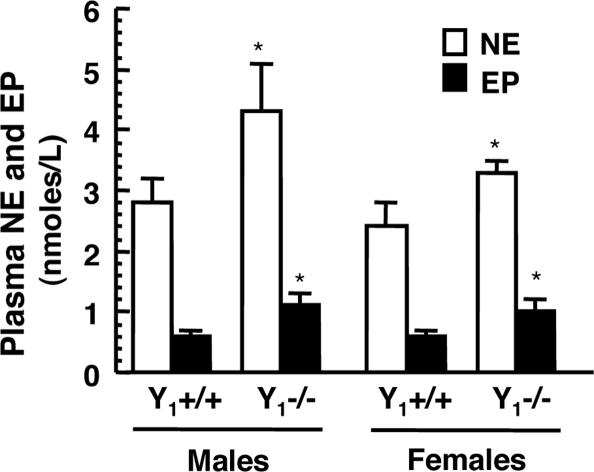
Fig. 1.
Fig. 1.
Plasma NE and EP concentrations are higher in Y1−/− compared with Y1+/+ mice. Plasma catecholamine was measured in seven or eight mice of each gender and each genotype. ∗, P < 0.05 compared with Y1+/+ mice.
Fig. 2.
Fig. 2.
Y1, Y2, and Y5 receptor mRNAs are present in a mouse adrenal gland by RT-PCR. Similar findings were obtained in two additional adrenal glands. Samples without RNA were included as negative controls (not shown).
Fig. 3.
Fig. 3.
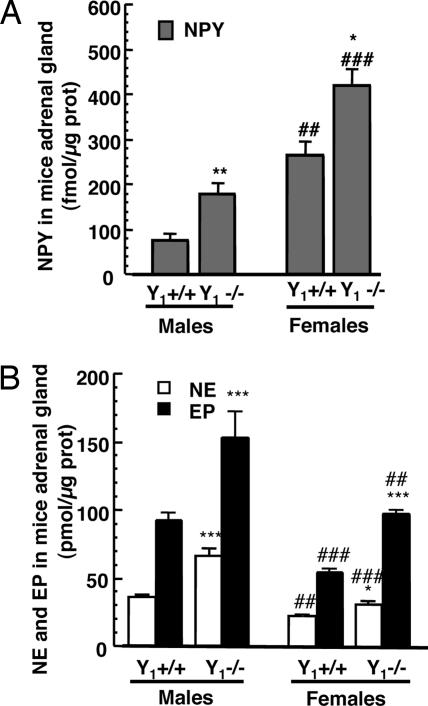
NPY (A) and NE and EP (B) contents in adrenal gland of control (Y1+/+) and Y1−/− mice. Results (mean ± SEM; n = 6–8) are expressed as pmol NE or EP (B) or fmol NPY (A) per microgram of protein. ∗, P < 0.05; ∗∗, P < 0.01; ∗∗∗, P < 0.001 compared with adrenals of Y1+/+ mice; ##, P < 0.01; ###, P < 0.001 compared with adrenals from males.
Fig. 4.
Fig. 4.
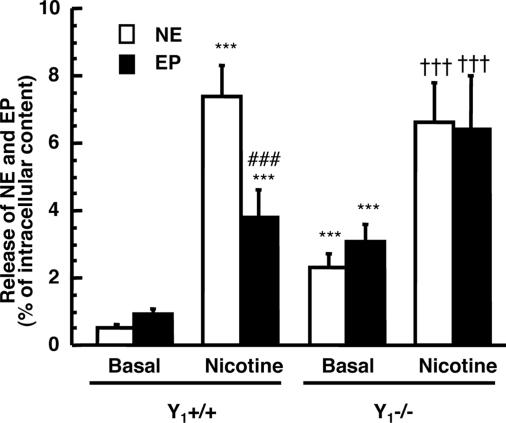
Basal and stimulated catecholamine (NE and EP) release from chromaffin cells obtained from adrenals of control mice (Y1+/+) and Y1 knockout mice (Y1−/−). ∗∗∗, P < 0.001 compared with basal release from Y1+/+ chromaffin cells; ###, P < 0.001 compared with NE released with nicotine; †††, P < 0.001 compared with basal release from Y1−/− chromaffin cells.
Fig. 5.
Fig. 5.
NPY, PYY, and [31Leu,34Pro]NPY increase NE and EP release from chromaffin cells obtained from control mice (Y1+/+). The release of NE and EP from mice chromaffin cells during 10 min in Krebs buffer (basal) or in the presence of 100 nM NPY or PYY or [31Leu,34Pro]NPY was measured. Mean ± SD of three to four experiments done in triplicate. P < 0.05; ∗∗, P < 0.01; ∗∗∗, P < 0.001 compared with basal.
Fig. 6.
Fig. 6.
Morphometric analyses of adrenal glands from Y1+/+ and Y1−/− mice: area of the medulla, cortex, and X zone (A); cell size (B); and number of cells (C). Six mouse adrenals of each gender and genotype were analyzed. The area of a series of sections performed in each gland was measured in triplicate. The mean area of the largest section was evaluated.
Fig. 7.
Fig. 7.
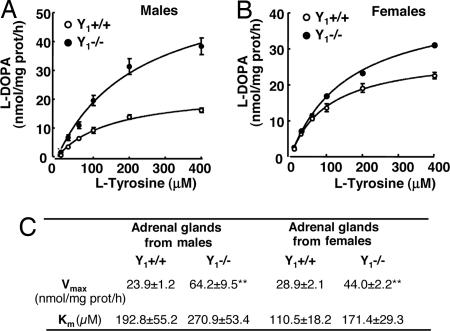
TH activity in adrenal glands from wild-type (Y1+/+) and NPY Y1 knockout (Y1−/−) mice. Saturation curves of TH activity obtained with the substrate (l-Tyr) in the adrenals of males (A) and females (B) and Y1+/+ and Y1−/− mice. (C) Kinetic parameters of saturation curves of TH activity in the adrenals of male and female, Y1+/+, and Y1−/− mice. ∗∗, P < 0.01 compared with Y1+/+; n = 5; mean ± SD.
Fig. 8.
Fig. 8.
Inhibition of TH promoter activity by NPY. (A) SK-N-MC cells transfected with a plasmid encoding the luciferase gene under the control of the rat TH promoter were incubated for 6 h in the presence of the indicated concentrations of forskolin, and luciferase activity was measured at different times before and after the addition of NPY. A different cellular extract was used at each time point. (B) Transfected SK-N-MC cells were incubated for 10 min with different concentrations of NPY and stimulated for 6 h with 1.25 μM forskolin and luciferase, and activity was measured. (C) Effect of BIBP 3226 (1 μM), a specific Y1 antagonist, on the NPY inhibitory effect of forskolin activation. (D) NPY (1.2 nM) was added before or after forskolin activation, and luciferase activity was measured. SK-N-MC cells were incubated for 10 min with NPY (1.2 nM) with or without H-89, a PKA inhibitor (E), or with or without CalC, a PKC inhibitor (F), and forskolin activation and luciferase activity were measured. Mean ± SD; three to four experiments done in triplicate. ∗∗∗, P < 0.001 compared with control. ###, P < 0.001 compared with NPY; †††, P < 0.001 compared with the respective PK inhibitor.

References

    1. Lundberg J. M., Torssell L., Sollevi A., Pernow J., Theodorsson Norheim E., Anggard A., Hamberger B. Regul. Pept. 1985;13:41–52. - PubMed
    1. Takiyyuddin M. A., Brown M. R., Dinh T. Q., Cervenka J. H., Braun S. D., Parmer R. J., Kennedy B., O’Connor D. T. J. Auton. Pharmacol. 1994;14:187–200. - PubMed
    1. Michel M. C., Beck-Sickinger A., Cox H., Doods H. N., Herzog H., Larhammar D., Quirion R., Schwartz T., Westfall T. Pharmacol. Rev. 1998;50:143–150. - PubMed
    1. Silva A. P., Cavadas C., Grouzmann E. Clin. Chim. Acta. 2002;326:3–25. - PubMed
    1. Walker P., Grouzmann E., Burnier M., Waeber B. Trends Pharmacol. Sci. 1991;12:111–115. - PubMed

Publication types

MeSH terms