. 2006 Jul;18(7):1559-74.
doi: 10.1105/tpc.106.042127. Epub 2006 Jun 23.

MicroRNA-targeted and small interfering RNA-mediated mRNA degradation is regulated by argonaute, dicer, and RNA-dependent RNA polymerase in Arabidopsis

Affiliations

MicroRNA-targeted and small interfering RNA-mediated mRNA degradation is regulated by argonaute, dicer, and RNA-dependent RNA polymerase in Arabidopsis

Michael Ronemus et al. Plant Cell. 2006 Jul.

Abstract

ARGONAUTE1 (AGO1) of Arabidopsis thaliana mediates the cleavage of microRNA (miRNA)-targeted mRNAs, and it has also been implicated in the posttranscriptional silencing of transgenes and the maintenance of chromatin structure. Mutations in AGO1 severely disrupt plant development, indicating that miRNA function and possibly other aspects of RNA interference are essential for maintaining normal patterns of gene expression. Using microarrays, we found that 1 to 6% of genes display significant expression changes in several alleles of ago1 at multiple developmental stages, with the majority showing higher levels. Several classes of known miRNA targets increased markedly in ago1, whereas others showed little or no change. Cleavage of mRNAs within miRNA-homologous sites was reduced but not abolished in an ago1 -null background, indicating that redundant slicer activity exists in Arabidopsis. Small interfering RNAs and larger 30- to 60-nucleotide RNA fragments corresponding to highly upregulated miRNA target genes accumulated in wild-type plants but not in ago1, the RNA-dependent RNA polymerase mutants rdr2 and rdr6, or the Dicer-like mutants dcl1 and dcl3. Both sense and antisense RNAs corresponding to these miRNA targets accumulated in the ago1 and dcl1 backgrounds. These results indicate that a subset of endogenous mRNA targets of RNA interference may be regulated through a mechanism of second-strand RNA synthesis and degradation initiated by or in addition to miRNA-mediated cleavage.


Figures
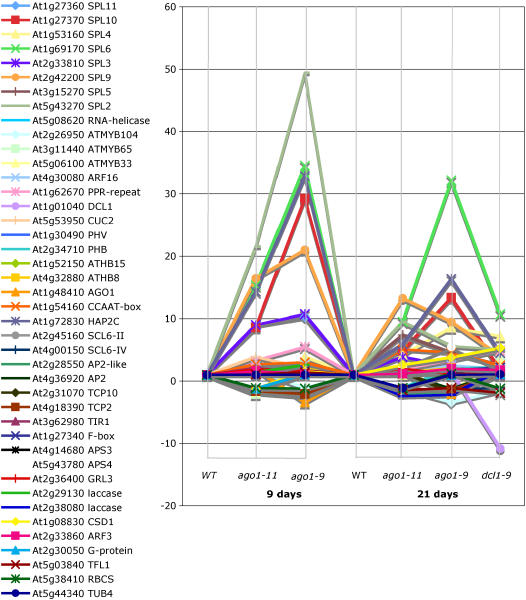
Figure 1.
Figure 1.
Graphic Display of Transcript Levels from miRNA Targets in ago1 and dcl1. Fold change values for known miRNA target transcripts represented on the AtGenome1 array are shown for wild-type, ago1-11, and ago1-9 9-d-old seedlings and for wild-type, ago1-11, ago1-9, and dcl1-9 21-d-old plants. Changes are most severe in ago1-9.
Figure 2.
Figure 2.
RNA Gel Blot Analysis of Genes Upregulated in ago1 and dcl1. Antisense riboprobes flanking the miRNA-homologous sites by 100 to 200 nucleotides were hybridized to 10 μg of total RNA from the wild type (Ler), ago1-11, and ago1-9 (left three lanes, each panel) and the wild type (Ler) and dcl1-9 (right two lanes, each panel) at 21 d.
Figure 3.
Figure 3.
Primer Extension Analysis of miRNA Target Gene 3′ Cleavage Products. Primers correspond to unique regions of genes 70 to 120 nucleotides downstream of the miRNA-homologous sites. RNAs were from 21-d wild type (Ler), ago1-11, or dcl1-9; for SCL6-IV (bottom right panel), RNAs from 11-d seedlings as well as leaf, shoot, and inflorescence tissues from 25-d wild-type (Ler) and ago1-9 plants were also used. Vertical bars (at right) indicate the positions of miRNA-homologous regions of targets.
Figure 4.
Figure 4.
Small RNA Profiles of Genes Upregulated in ago1 and dcl1. Small antisense RNAs in the wild type (Col/Ler), dcl1, dcl3, ago1-11, ago1-9, rdr2, and rdr6 at 21 d were detected by 5′ sense probes for At1g62670 (A), HAP2C (B), and SPL10 (C). No small antisense RNAs in the 21- to 26-nucleotide size class corresponding to the miRNA target genes AP2, TCP2, or SCL6-IV (all in [D]) were detected by 5′ sense probes in either Col or Ler wild-type RNA. Each lane is loaded with 20 to 25 μg of polyethylene glycol–precipitated total RNA; the positions of probes in (A) to (C) are indicated above each set of panels. Hatched boxes at the ends of each gene represent 5′ and 3′ UTRs. The top panels show antisense siRNA products upstream of the miRNA-homologous sites detected by 5′ sense probes; the middle panels show the same blots probed with sense strand oligonucleotides corresponding to the cognate miRNA for each gene. The bottom panels represent each blot probed with a U6 small nuclear (snRNA)-specific oligonucleotide as a loading control.
Figure 5.
Figure 5.
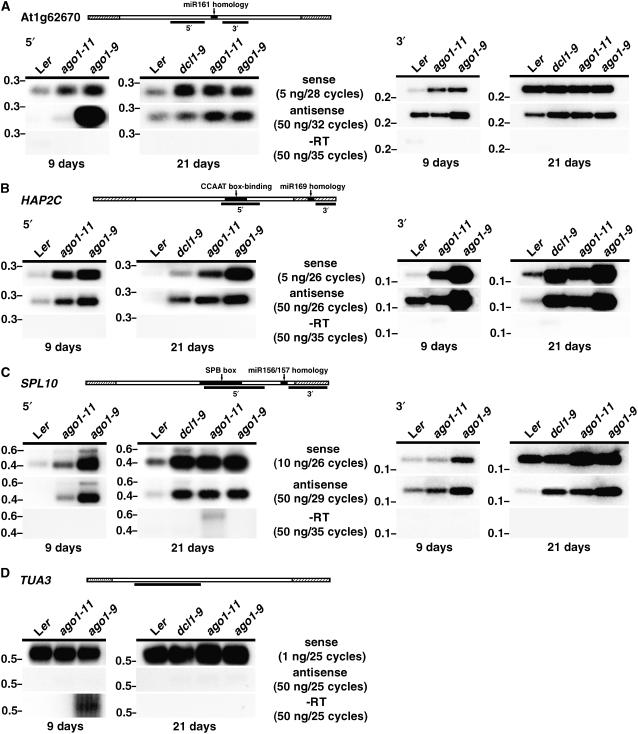
Sense and Antisense Expression of Genes Upregulated in ago1 and dcl1. RNAs from the wild type (Ler), ago1-9, and ago1-11 at 9 and 21 d and from dcl1-9 at 21 d were reverse-transcribed with strand-specific primers corresponding to At1g62670 (A), HAP2C (B), SPL10 (C), and TUA3 (D), then amplified by PCR. RT-PCR conditions ranged from 1 to 50 ng of total RNA and 25 to 32 cycles; representative panels of approximately equal hybridization intensity are shown. The top panels correspond to sense products; the middle panels refer to antisense products; and the bottom panels are controls lacking reverse transcription. All sizes are indicated in kilobases.
Figure 6.
Figure 6.
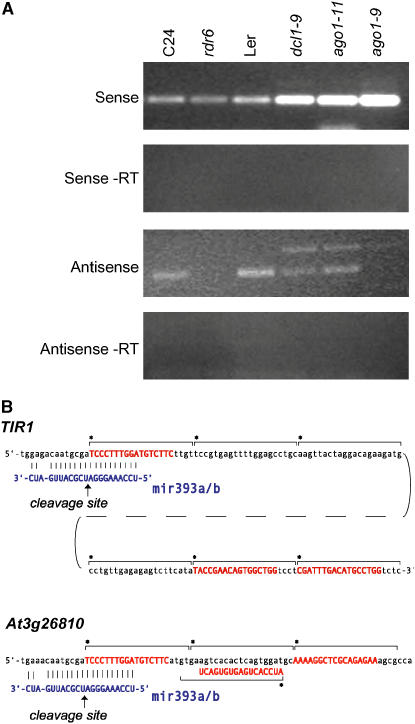
Antisense Production Downstream of miRNA Complementarity Leads to Secondary siRNAs. (A) Strand-specific RT-PCR of CSD1, 3′ of the miRNA recognition site. The CSD1 sense strand is upregulated in dcl1-9, ago1-11, and ago1-9. The CSD1 antisense strand is lost in rdr6 and ago1-9 but not in ago1-10 or dcl1-9. (B) In-register phasing of siRNA from TIR1 and one of its homologs, At3g26810. Predicted miRNA cleavage sites (Jones-Rhoades and Bartel, 2004) are in the 21-nucleotide register, with the 17-nucleotide MPSS signatures from siRNA corresponding to each gene (red). miR393 is shown in blue.
Figure 7.
Figure 7.
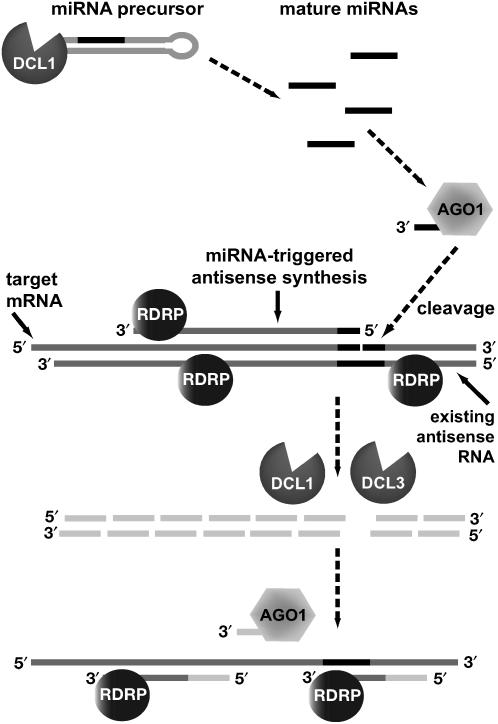
DCL1 and AGO1 in miRNA Action. DCL1 is required for the processing of miRNA precursors. Processed miRNAs (in black) then target homologous mRNAs (dark gray), which are cleaved within the miRNA-homologous site (shown in black). RdRP activity is then recruited to the miRNA/mRNA duplex and/or cleavage site; the RdRP activity transcribes the mRNA upstream into antisense RNA. After production of dsRNA and the miRNA-mediated triggering of RNAi, AGO1 recruits Dicer activity to the duplex. Twenty-one- to 22-nucleotide siRNAs (light gray) processed from dsRNA by DCL1 accumulate in wild-type plants, as do larger products, which may result from incomplete processing, abortive RdRP activity, slicing guided by in-register siRNA, or the action of a Dicer variant. The siRNA may then target additional sense or antisense RNA molecules, through AGO1, RDR2, RDR6, and DCL3, which may be required to produce a specialized class of siRNA that serves as a signal to initiate the production of 21- to 22-nucleotide siRNAs by DCL1 (Borsani et al., 2005). Antisense RNA downstream of the miRNA-complementary sites can arise through the action of RDR6 on cleaved (uncapped) mRNA, but antisense RNA is not restricted to miRNA target genes and requires other polymerases in most cases (M.W. Vaughn and R.A. Martienssen, unpublished data).

References

    1. Allen, E., Xie, Z., Gustafson, A.M., and Carrington, J.C. (2005). MicroRNA-directed phasing during trans-acting siRNA biogenesis in plants. Cell 121 207–221. - PubMed
    1. Aukerman, M.J., and Sakai, H. (2004). Correction: Regulation of flowering time and floral organ identity by a microRNA and its APETALA2-like target genes. Plant Cell 16 555. - PMC - PubMed
    1. Bao, N., Lye, K.W., and Barton, M.K. (2004). MicroRNA binding sites in Arabidopsis class III HD-ZIP mRNAs are required for methylation of the template chromosome. Dev. Cell 7 653–662. - PubMed
    1. Baulcombe, D. (2005). RNA silencing. Trends Biochem. Sci. 30 290–293. - PubMed
    1. Baumberger, N., and Baulcombe, D.C. (2005). Arabidopsis ARGONAUTE1 is an RNA slicer that selectively recruits microRNAs and short interfering RNAs. Proc. Natl. Acad. Sci. USA 102 11928–11933. - PMC - PubMed

Publication types

MeSH terms