


The role of constitutive PKA-mediated phosphorylation in the regulation of basal I(Ca) in isolated rat cardiac myocytes
- PMID: 16799650
- PMCID: PMC1752019
- DOI: 10.1038/sj.bjp.0706809
The role of constitutive PKA-mediated phosphorylation in the regulation of basal I(Ca) in isolated rat cardiac myocytes
Abstract
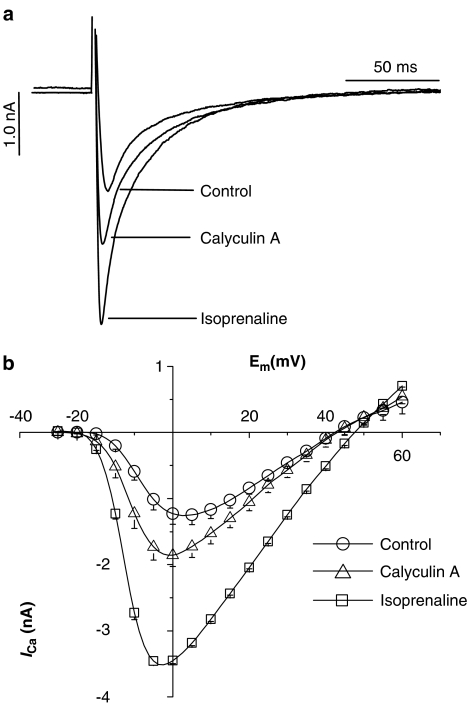
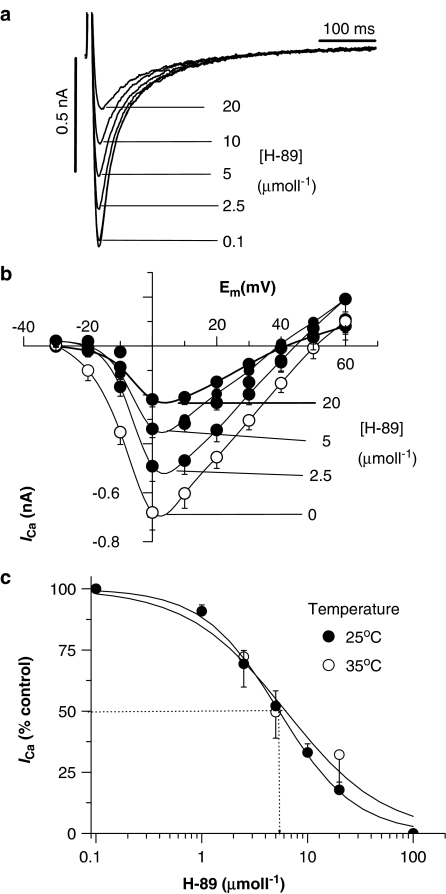
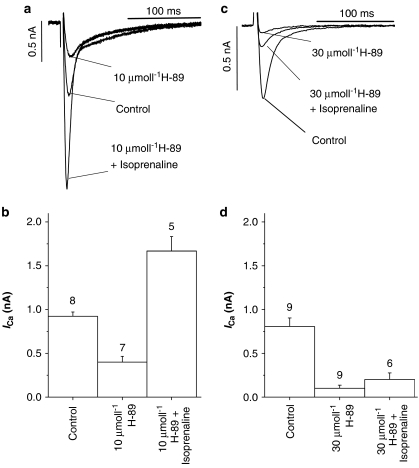
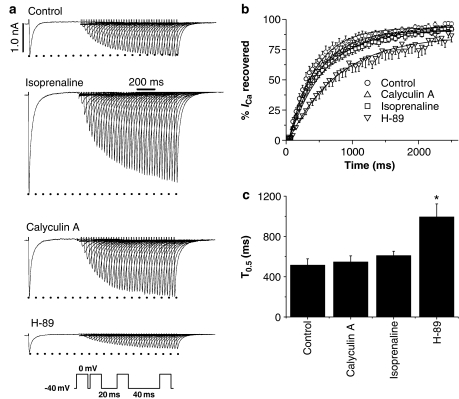
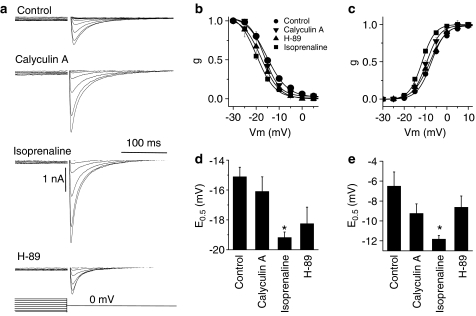
1. Pharmacological inhibitors of protein kinase A (PKA) and protein phosphatases 1/2A were used to determine whether basal L-type Ca(2+) current (I(Ca)) observed in the absence of exogenous beta-adrenergic receptor stimulation is sustained by PKA-mediated phosphorylation. Amphotericin B was used to record whole-cell I(Ca) in the perforated patch-clamp configuration. 2. Calyculin A and isoprenaline (both 1 micromol l(-1)) increased basal I(Ca) (P<0.05), whereas H-89 inhibited I(Ca) in a concentration-dependent manner with an IC(50) approximately 5 micromol l(-1). H-89 also inhibited the response to 1.0 micromol l(-1) isoprenaline, although relatively high concentrations (30 micromol l(-1)) were required to achieve complete suppression of the response. 3. Double-pulse protocols were used to study the effects of 10 micromol l(-1) H-89 on time-dependent recovery of I(Ca) from voltage-dependent inactivation as well as the steady-state gating of I(Ca). T(0.5) (time for I(Ca) to recover to 50% of the preinactivation amplitude) increased in the presence of H-89 (P<0.05) but was unaffected by calyculin A or isoprenaline. 4. Steady-state activation/inactivation properties of I(Ca) were unaffected by 10 micromol l(-1) H-89 or 1 micromol l(-1) calyculin A, whereas isoprenaline caused a leftward shift in both curves so that V(0.5) for activation and inactivation became more negative. 5. Data show that basal I(Ca) is regulated by cAMP-PKA-mediated phosphorylation in the absence of externally applied beta-receptor agonists and that relatively high concentrations of H-89 are required to fully suppress the response to beta-adrenergic receptor stimulation, thereby limiting the value of H-89 as a useful tool in dissecting signalling pathways in intact myocytes.
Figures
References
-
- BLAZEV R., HUSSAIN M., BAKKER A.J., HEAD S.I., LAMB G.D. Effects of the PKA inhibitor H-89 on excitation–contraction coupling in skinned and intact skeletal muscle fibres. J. Muscle Res. Cell. Motil. 2001;22:277–286. - PubMed
-
- BUNEMANN M., GERHARDSTEIN B.L., GAO T., HOSEY M.M. Functional regulation of L-type calcium channels via protein kinase A-mediated phosphorylation of the beta(2) subunit. J. Biol. Chem. 1999;274:33851–33854. - PubMed
-
- CHEN X., PIACENTINO V., III, FURUKAWA S., GOLDMAN B., MARGULIES K.B., HOUSER S.R. L-type Ca2+ channel density and regulation are altered in failing human ventricular myocytes and recover after support with mechanical assist devices. Circ. Res. 2002;91:517–524. - PubMed
-
- CHIJIWA T., MISHIMA A., HAGIWARA M., SANO M., HAYASHI K., INOUE T., NAITO K., TOSHIOKA T., HIDAKA H. Inhibition of forskolin-induced neurite outgrowth and protein phosphorylation by a newly synthesized selective inhibitor of cyclic AMP-dependent protein kinase, N-[2-(p-bromocinnamylamino)ethyl]-5-isoquinolinesulfonamide (H-89), of PC12D pheochromocytoma cells. J. Biol. Chem. 1990;265:5267–5272. - PubMed
-
- DAVARE M.A., HORNE M.C., HELL J.W. Protein phosphatase 2A is associated with class C L-type calcium channels (Cav1.2) and antagonizes channel phosphorylation by cAMP-dependent protein kinase. J. Biol. Chem. 2000;275:39710–39717. - PubMed
MeSH terms
Substances
LinkOut - more resources
Full Text Sources
Miscellaneous
