Structural anatomy of pure and hemianopic alexia
- PMID: 16801352
- PMCID: PMC2077748
- DOI: 10.1136/jnnp.2005.086983
Structural anatomy of pure and hemianopic alexia
Abstract
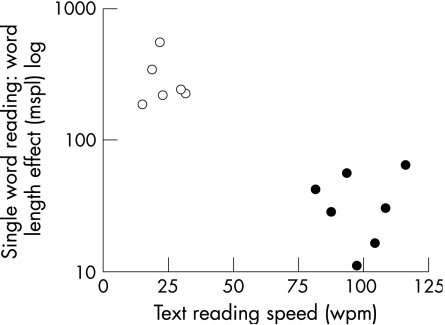
Background: The two most common types of acquired reading disorder resulting from damage to the territory of the dominant posterior cerebral artery are hemianopic and pure alexia. Patients with pronounced hemianopic alexia have a right homonymous hemianopia that encroaches into central or parafoveal vision; they read individual words well, but generate inefficient reading saccades when reading along a line of text. Patients with pure alexia also often have a hemianopia but are more disabled, making frequent errors on individual words; they have sustained damage to a brain region that supports efficient word identification.
Objective: To investigate the differences in lesion site between hemianopic alexia and pure alexia groups, as rehabilitative techniques differ between the two conditions.
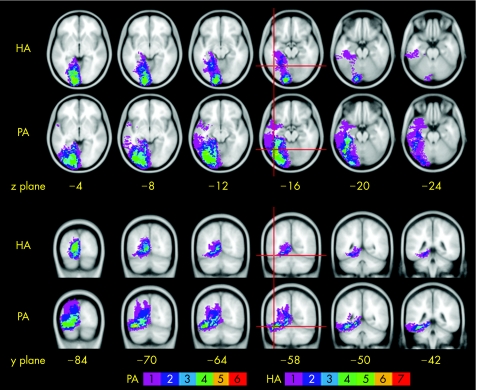
Methods: High-resolution magnetic resonance images were obtained from seven patients with hemianopic alexia and from six patients with pure alexia caused by a left occipital stroke. The boundary of each lesion was defined and lesion volumes were then transformed into a standard stereotactic space so that regional comparisons could be made.
Results: The two patient groups did not differ in terms of damage to the medial left occipital lobe, but those with pure alexia had additional lateral damage to the posterior fusiform gyrus and adjacent tissue.
Conclusions: Clinicians will be able to predict the type of reading disorder patients with left occipital lesions have from simple tests of reading speed and the distribution of damage to the left occipital lobe on brain imaging. This information will aid management decisions, including recommendations for reading rehabilitation.
Conflict of interest statement
Competing interests: None.
References
-
- Leff A P, Crewes H, Plant G T.et al The functional anatomy of single‐word reading in patients with hemianopic and pure alexia. Brain 2001124510–521. - PubMed
-
- Leff A P, Scott S K, Crewes H.et al Impaired reading in patients with right hemianopia. Ann Neurol 200047171–178. - PubMed
-
- Zihl J. Eye movement patterns in hemianopic dyslexia. Brain 1995118891–912. - PubMed
-
- Rayner K. Eye movements in reading and information processing: 20 years of research. Psychol Bull 1998124372–422. - PubMed
-
- Kerkhoff G, Munsinger U, Eberle‐Strauss G.et al Rehabilitation of hemianopic alexia in patients with postgeniculate visual field disorders. Neuropsychol Rehabil 1992221–41.
Publication types
MeSH terms
Grants and funding
LinkOut - more resources
Full Text Sources